China's industrial profits jump 20.1% in October on AI hardware and metals, while car and furniture makers slump
Profits at China's larger industrial companies rose 20.1% year on year in October, up from 14.4% in September, official data showed on 27 November. AI-related electronics, metals and energy drove the gain, but profits at car, furniture and building-materials makers fell sharply.
Profits at China's larger industrial companies grew at the fastest pace in five months in October, but most of the gain came from a few sectors. Data from the National Bureau of Statistics (NBS), released on Friday 27 November, showed profits up 20.1% from a year earlier, compared with 14.4% in September. For January to October, profits rose 16.0% to 6.74 trillion yuan, about $1 trillion at Reuters' exchange rate of 6.67 yuan to the dollar.
AI-related electronics, metals, coal and chemicals drove the increase. Profits at carmakers, furniture makers and producers of cement and glass kept falling, which points to weak household spending and a property market that is still struggling.
What do the October figures show?
The NBS figures cover companies with annual revenue from their main business of at least 20 million yuan (about $3 million). According to the official release:
- Profits in January–October totalled 6,737.4 billion yuan, up 16.0%, faster than the 15.5% rise in January–September.
- Mining profits rose 38.8% and manufacturing profits 17.5%. Profits at electricity, heat, gas and water utilities fell 14.8%.
- By ownership, profits rose 21.4% at shareholding companies, 13.0% at state-controlled companies and 11.4% at private companies. Foreign-invested companies, including those from Hong Kong, Macau and Taiwan, were almost flat at +0.2%.
- Revenue rose 6.7% to 118.41 trillion yuan, while operating costs rose 6.2%. The profit margin on revenue rose 0.45 percentage points to 5.69%.
Which industries are driving the growth?
Electronics is the biggest single factor. In the first ten months, profits in computer, communications and other electronic equipment manufacturing doubled. The NBS says that added 9.7 percentage points to total industrial profit growth.
In its commentary, the NBS said demand for AI computing power was lifting memory chips and related manufacturing. Yu Weining, chief statistician of the bureau's industry department, cited even bigger increases in smaller categories. Profits from making complete computers rose 410% and computer peripherals 200%. Optical fibre makers' profits rose 670% and optical cable makers' 150%, which the NBS linked to the construction of large AI computing centres. Profits in high-tech manufacturing as a whole rose 50.9%.
Commodities also helped. Profits in non-ferrous metal smelting and rolling rose 71.7%, and non-ferrous mining 60.2%. The NBS said demand from new energy and AI had pushed up prices of copper and aluminium, and together these two sectors added 4.6 points to overall growth. Coal mining profits rose 61.4%, chemical raw materials 50.3%, chemical fibres 87.0% and oil and gas extraction 22.8%. Oil refining made a 106.7 billion yuan profit after a loss a year earlier.
That fits with October's price data. As The Daily Context reported on 9 November, China's producer price index rose 5.7% year on year in October, its fastest pace since mid-2022, as energy and mining prices climbed. Higher factory-gate prices help upstream producers first.
Where are profits still falling?
Industries that depend on households and housing remain weak. In January–October, profits fell 26.0% at carmakers, 46.7% in non-metallic mineral products such as cement and glass, and 52.4% at furniture makers. Agricultural and food processing fell 19.5%, power generation and supply 18.4%, iron and steel 14.2%, and electrical machinery and equipment 8.0%.
The balance-sheet figures also show some strain. At the end of October, unpaid customer bills (accounts receivable) were 10.5% higher than a year earlier at 30.45 trillion yuan. The average collection period lengthened by 1.4 days to 72.2 days. Finished-goods inventories rose 12.0%, and the debt-to-assets ratio rose 0.4 points to 58.6%.
Other October data also showed a slow domestic economy. Industrial output grew 4.8% and retail sales only 0.4%, and fixed-asset investment for the first ten months was down 8.1%, according to NBS figures released earlier this month.
What are economists saying?
Lynn Song, ING's chief economist for Greater China, said the data showed the recovery remained uneven and sent mixed signals about the wider economy, Reuters reported, as quoted by Lianhe Zaobao. Reuters also noted that many companies have relied on overseas sales because demand at home is weak, which leaves them exposed to possible tariffs and trade restrictions in the US and EU.
Ding Meng, chief China economist at CITIC Bank International, said profits in AI-related and upstream industries were growing faster than in downstream industries. "The robust pace of profit growth further reinforces expectations that there will be no additional monetary policy easing in the near term," Ding said, according to Lianhe Zaobao. He listed three risks: a possible slowdown in AI data-centre investment, concerns about AI companies' profitability and debt, and further Western restrictions on Chinese exports. That, he said, is why boosting domestic demand quickly is key.
Why does this matter outside China?
China accounts for a large share of global manufacturing, so its profit trends matter abroad. Strong profits at Chinese electronics and optical-fibre makers show how far the AI build-out has reached into China's supply chains. The same demand is pushing up metal prices that affect manufacturers and commodity exporters around the world. At the same time, falling profits among carmakers and building-material producers, together with almost no profit growth at foreign-invested companies, suggest the gains are not spreading widely. Strong profits at the top could also make Beijing less willing to add stimulus.
One caution: these are year-on-year comparisons. They partly reflect where profits stood in 2025, and the NBS calculates growth on a comparable basis that can differ from simple comparisons with last year's published totals.
What comes next?
The next major data are China's official purchasing managers' surveys for November, due at the end of the month. Industrial profit figures for January–November are expected in late December. Investors will watch whether the electronics boom continues and whether weakness in consumer-facing industries starts to ease.
This article is for information only and is not investment advice.
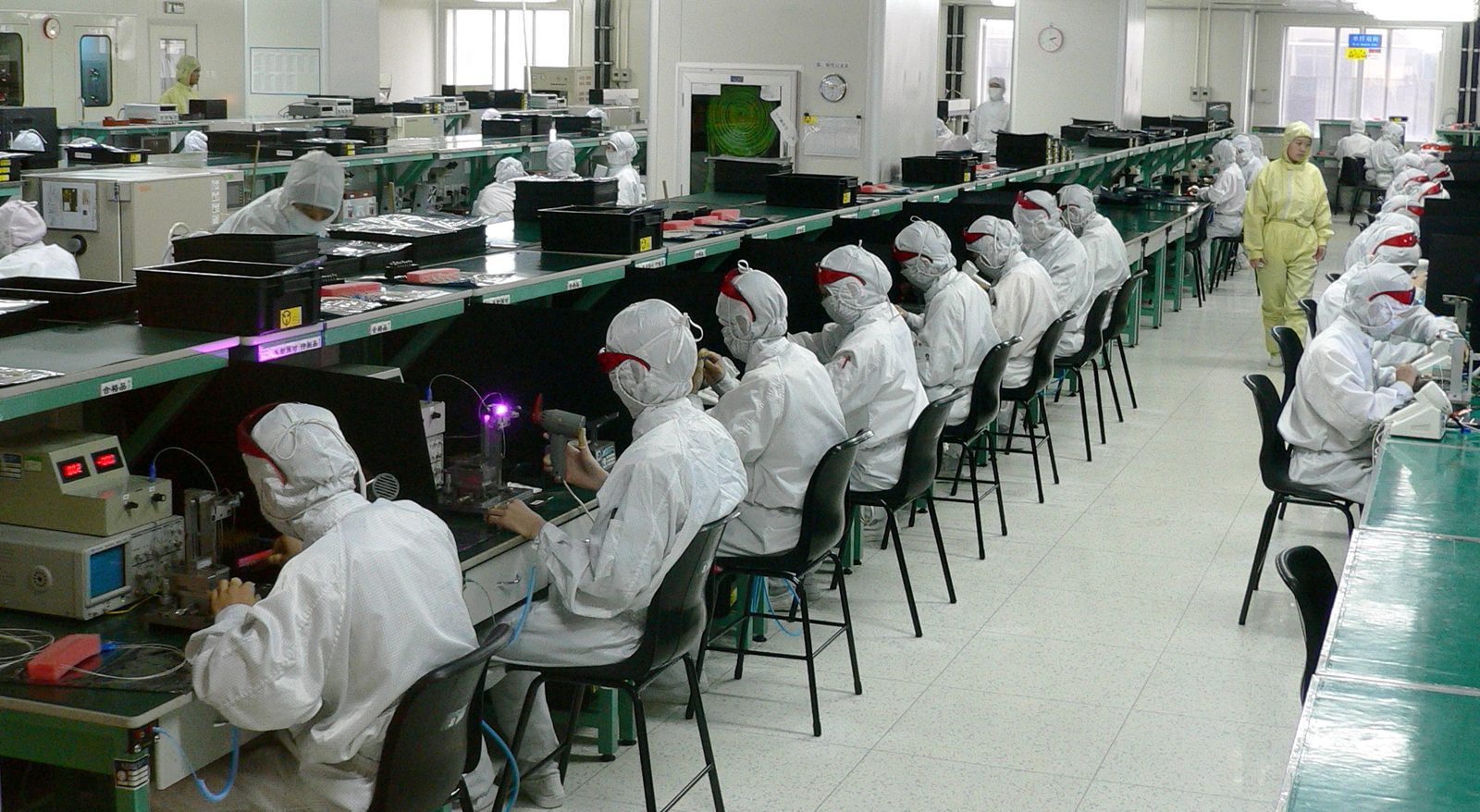
Image: File photo: fibre-optic component assembly at an electronics factory in Shenzhen, October 2005 (illustrative, not linked to the companies in the data). Photo: Steve Jurvetson, CC BY 2.0 (https://creativecommons.org/licenses/by/2.0/), via Wikimedia Commons (https://commons.wikimedia.org/wiki/File:Electronics_factory_in_Shenzhen.jpg); resized
About this article: prepared by The Daily Context editorial desk using automated, source-based reporting from the publications linked below. No reporter was on the ground.
Sources
- National Bureau of Statistics of China: Profits of industrial enterprises above designated size, January–October 2026 (in Chinese, 27 November 2026) https://www.stats.gov.cn/sj/zxfb/202611/t20261127_1965949.html
- National Bureau of Statistics of China: Yu Weining's commentary on January–October 2026 industrial profit data (in Chinese, 27 November 2026) https://www.stats.gov.cn/sj/sjjd/202611/t20261127_1965950.html
- Reuters via Investing.com: China's industrial firms post faster profit growth as recovery remains uneven (27 November 2026) https://www.investing.com/news/economic-indicators/chinas-industrial-firms-post-faster-profit-growth-as-recovery-remains-uneven-5052818
- Lianhe Zaobao: China's industrial profits rise 20.1% in October as sectoral divide persists (27 November 2026) https://www.zaobao.com.sg/en/news/china/chinas-industrial-profits-rise-20-1-october-sectoral-divide-persists
- Xinhua via gov.cn: New growth drivers fuel China's industrial profit gains (27 November 2026) https://english.www.gov.cn/archive/statistics/202611/27/content_WS6b0970e3c6d00ca5f9a0ea3a.html
- The Daily Context: China factory-gate prices rise 5.7% in October https://www.thedailycontext.com/article/china-october-2026-ppi-5-7-percent-cpi-inflation
- The Daily Context: China's economy slows across the board in October https://www.thedailycontext.com/article/china-october-2026-retail-sales-industrial-output-investment-slowdown
Kabeer Ahmad
Kabeer Ahmad is the founder and editor of The Daily Context. He oversees the site's source-based coverage of world affairs, technology, business, entertainment, lifestyle and sports, and is responsible for its editorial standards, sourcing and corrections.