Rheinmetall cuts its 2030 sales ambition to €33bn–€37bn after a year of setbacks
Germany's biggest defence company now expects 2030 sales of €33bn to €37bn, down from about €45bn, citing a lost frigate programme, a delayed Boxer contract and slower ammunition approvals. Its shares rose on Friday because investors had largely expected the reset.
Rheinmetall, Germany's largest defence company and Europe's biggest ammunition maker, has cut its sales ambition for 2030 to between €33 billion and €37 billion. Its previous target for organic sales, meaning sales without acquisitions, was about €45 billion. The company made the change at its Capital Markets Day in Hamburg on Friday 27 November, saying it was adopting a "new normal level of conservatism and recalibrated ambition" after a year in which several large projects were cancelled or delayed.
The company also lowered its 2030 operating margin goal slightly, to "about 20%" from more than 20%. Investors had largely expected the reset. Rheinmetall shares were up 3.2% at 10:03 GMT, according to Reuters, and Investing.com reported they were 4.8% higher at €802.20 on Xetra around 11:00 CET. Even so, the stock is down about 49% this year.
What exactly did Rheinmetall announce?
In slides published for the event, the Düsseldorf-based group set out a 2030 organic sales range of €33 billion to €37 billion, Reuters reported. Chief executive Armin Papperger told investors that the figure excludes acquisitions. Handelsblatt noted that the earlier plan had been around €45 billion organically and about €50 billion including takeovers. Bloomberg, comparing with the larger figure, described the move as a cut from €50 billion.
"The opportunity has not changed; the way we plan for it has," the company said in its presentation, according to CNBC. "We are becoming more cautious whilst retaining our agility in a dynamic market."
Rheinmetall left its guidance for the current year unchanged after cutting it earlier this month. It still expects 2026 sales of about €13.2 billion and an operating margin of about 18.5%, according to Investing.com. In March it had been aiming for €14 billion to €14.5 billion.
On the same day, Rheinmetall announced an order from Romania for an additional 66 Lynx armoured vehicles, worth about €738 million, Reuters reported.
Why did the company lower its targets?
Rheinmetall and analysts point to three main setbacks.
The first is the F126 frigate. Germany scrapped the programme in June after delays and expected cost overruns, Reuters reported at the time. Rheinmetall had been tipped to win the contract through NVL, the naval shipbuilding business it bought from the Lürssen group. CNBC said it would have been Rheinmetall's biggest order since the Second World War. Papperger told investors the decision was "a political thing". "The government made this decision, and the minister made that decision," he said.
The second is Arminius, a large German army programme for Boxer wheeled armoured vehicles. The contract and the advance payments that come with it have slipped, and CNBC said it is now expected next year. Papperger had suggested as recently as August that it would be signed by the end of 2026, according to Reuters. He blamed price negotiations with Berlin. "I could have the contract immediately if I reduced the prices," he said.
The third is slower acceptance testing of ammunition, which has delayed deliveries and revenue. A January explosion at an ammunition plant in Murcia, Spain, also weighed on the year, according to CNBC and a summary of the event by the research platform Quartr.
Those problems led Rheinmetall to cut its 2026 outlook on 5 November for the second time in three months. Its shares fell about 16% that day.
Which divisions took the biggest cuts?
According to the event materials as summarised by Quartr, and Papperger's remarks:
- Vehicle Systems (Boxer, Puma, Lynx, Panther): 2030 sales of €11 billion to €13 billion, about €2 billion lower than before. Papperger called it a deliberate "buffer" against delays and supply problems rather than a sign of lost orders or weaker demand. Target margin is 10% to 12%.
- Weapon and Ammunition: €10 billion to €12 billion, about €4 billion lower, with a target margin of 28% to 30%. Papperger said the group would build artillery capacity for 1.0 million to 1.1 million rounds a year rather than the 1.5 million once planned. He said customers increasingly want long-range shells, so the planned mix moves from half long-range to 90% long-range. Long-range shells are more expensive, which means fewer rounds are needed for the same sales.
- Digital Systems: €7 billion to €9 billion, down from €8 billion to €10 billion.
- Naval Systems: €3.5 billion to €4 billion, compared with the roughly €5 billion originally expected. Papperger said the division would have kept the old target if F126 had been signed.
- Air Defence: €3 billion to €3.5 billion, about €500 million lower, which Papperger said was a precaution rather than a response to weaker demand.
Why did the shares rise on a downgrade?
Because the market had already priced it in. According to Investing.com, analysts' average forecast for Rheinmetall's 2030 sales was already about €36.7 billion, near the top of the new range. Several banks cut their price targets before the event. Barclays went from €2,000 to €1,340 and Goldman Sachs from €2,100 to €1,350, though both kept buy ratings. The stock hit a low of €692.30 on 20 November, having traded above €2,000 in October 2025.
JPMorgan analysts called the new sales target "a lot more credible" but described the 20% margin goal as "very ambitious", Reuters reported. RBC Capital called it a "widely expected reset" with "a general dose of conservatism", according to CNBC.
Is Europe's rearmament boom slowing?
Not according to the company. Rheinmetall said underlying demand remains strong. It pointed to European rearmament, the need to replace ageing equipment, air defence priorities, lessons from the war in Ukraine and a rise in "hybrid" threats such as sabotage, cyber espionage and satellite jamming. Its order backlog had risen by more than 20% this year, and at 30 September 93% of it was linked to NATO countries, according to Quartr's summary.
The problem has been turning political commitments into signed contracts and approved deliveries. Papperger also rejected the argument that drones will make traditional armoured vehicles and artillery obsolete. "Don't believe what a lot of people [are] telling you in the narrative 'we only need drones.' Forget about that," he said, according to CNBC. "The market potential is still there."
The company is also trying to present itself as an "all-domain" systems integrator, linking land, sea, air, space and cyber systems through digital networks. RBC said that could help address investor concerns that Rheinmetall is an "old-tech" company. In shipbuilding, Papperger said he wants digital and weapons technology to make up 40% to 50% of the value of each vessel, up from about 20% to 25%.
What happens next?
The key test is Arminius. A signed Boxer contract with advance payments would support cash flow, which the company now expects to be only "positive" in 2026 rather than the earlier goal of converting more than 40% of operating profit into cash, according to Quartr. Investors will also watch whether German ammunition orders and approvals speed up, and how Rheinmetall's naval business fills the gap left by F126.
This article is for information only and is not investment advice.
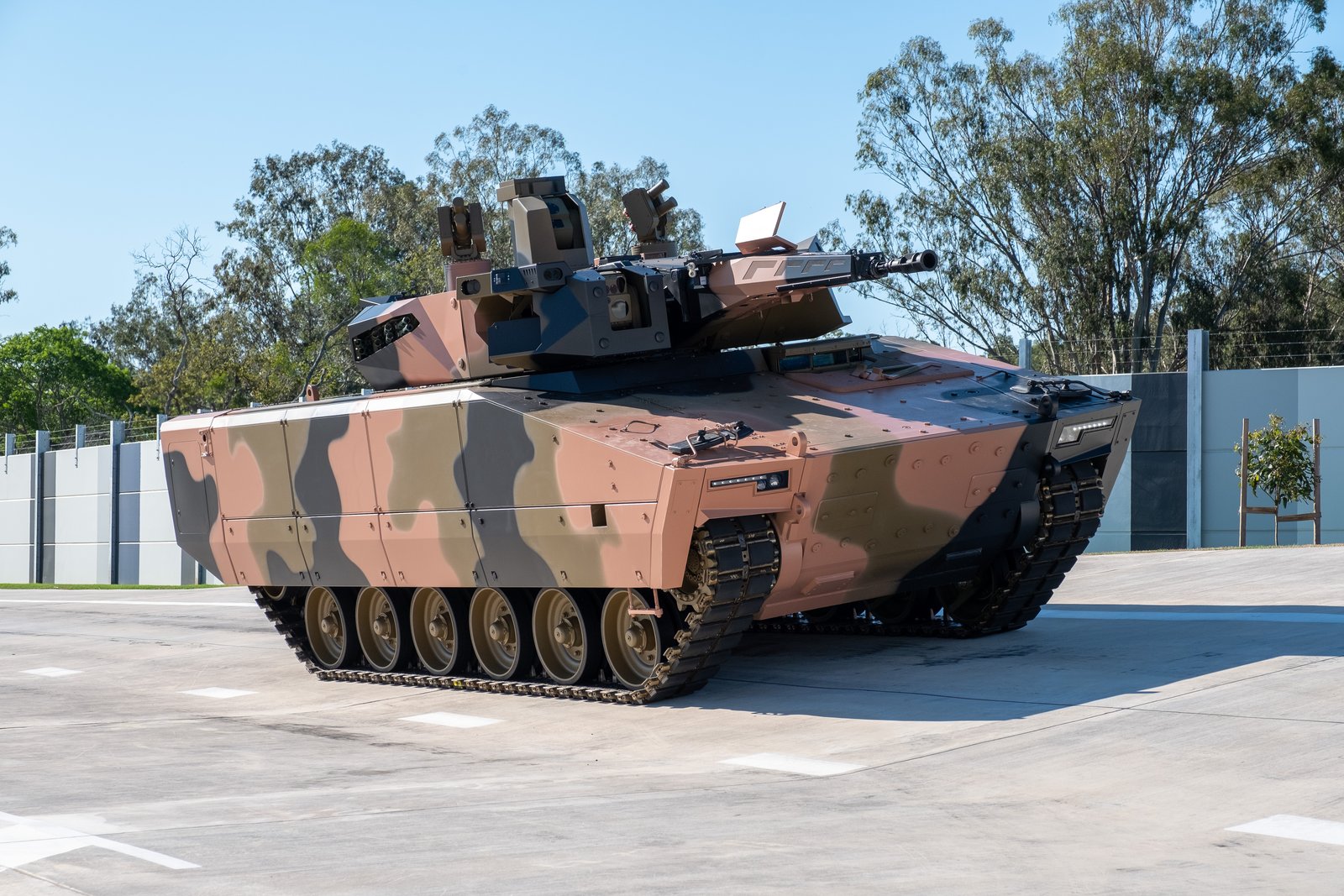
Image: File photo: a Rheinmetall Lynx KF41 infantry fighting vehicle in the version offered to Australia's LAND 400 Phase 3 programme, October 2020 (not one of the Romanian vehicles). Photo: Rheinmetall Defence, CC BY-SA 4.0 (https://creativecommons.org/licenses/by-sa/4.0/), via Wikimedia Commons (https://commons.wikimedia.org/wiki/File:Rheinmetall_LYNX_KF41_for_LAND_400_Phase.jpg); resized
About this article: prepared by The Daily Context editorial desk using automated, source-based reporting from the publications linked below. No reporter was on the ground.
Sources
- Reuters via Euronext: Germany's Rheinmetall trims 2030 targets after project setbacks (27 November 2026): https://live.euronext.com/en/financial-news/germanys-rheinmetall-trims-2030-targets-after-project-setbacks
- CNBC: Rheinmetall reins in growth ambitions as rearmament boom hits hurdles (27 November 2026): https://www.cnbc.com/2026/11/27/rheinmetall-stock-cmd-guidance-sales.html
- Bloomberg: Rheinmetall cuts back mid-term goals in conservative turnabout (27 November 2026): https://www.bloomberg.com/news/articles/2026-11-27/rheinmetall-cuts-back-mid-term-goals-in-conservative-turnabout
- Handelsblatt: Rheinmetall: Umsatzziel für 2030 sinkt auf 33 bis 37 Milliarden Euro (27 November 2026, German): https://www.handelsblatt.com/unternehmen/industrie/rheinmetall-umsatzziel-fuer-2030-sinkt-auf-33-bis-37-milliarden-euro/100273257.html
- Investing.com Germany: Rheinmetall-Aktie: Das 50-Milliarden-Ziel ist tot (27 November 2026, German): https://de.investing.com/news/stock-market-news/rheinmetallaktie-das-50milliardenziel-ist-tot--und-die-aktie-steigt-trotzdem-3788468
- Quartr: Rheinmetall CMD 2026 summary (27 November 2026): https://quartr.com/events/rheinmetall-ag-rhm-cmd-2026_oqaCr5Go
- Stock Analysis: Rheinmetall CMD 2026 transcript (27 November 2026): https://stockanalysis.com/quote/etr/RHM/transcripts/683576-cmd-2026/
- Rheinmetall: Capital Markets Day 2026 event page: https://www.rheinmetall.com/en/events/2026/ir/capital-markets-day
- Reuters: Germany ditches delayed frigate programme in major blow to Rheinmetall (24 June 2026): https://www.reuters.com/business/aerospace-defense/rheinmetall-shares-sink-after-berlin-axes-warship-deal-shifting-orders-tkms-2026-06-24/
- CNBC: Rheinmetall shares plunge 16% after outlook cut as military contracts stall (5 November 2026): https://www.cnbc.com/2026/11/05/rheinmetall-stock-outlook-sales-germany.html
Kabeer Ahmad
Kabeer Ahmad is the founder and editor of The Daily Context. He oversees the site's source-based coverage of world affairs, technology, business, entertainment, lifestyle and sports, and is responsible for its editorial standards, sourcing and corrections.