Argentina slips into technical recession as activity falls for a second quarter
Argentina's economy shrank by about 1.8% in the third quarter of 2026, its second straight quarterly fall, according to economists' calculations from official monthly activity data, meeting the common definition of a technical recession. President Javier Milei's government says confirmation must wait for GDP figures due on 16 December and points to a September rebound.
Argentina's economy contracted for a second consecutive quarter between July and September 2026, according to economists' calculations from official data, putting the country in what is commonly called a technical recession. Activity fell about 1.8% in the third quarter from the second, after a fall of about 1% in the April to June quarter, based on the monthly economic activity estimator (EMAE) published by the national statistics agency INDEC on Tuesday 24 November.
President Javier Milei's government disputes the label for now. It says the recession cannot be confirmed until INDEC publishes third-quarter gross domestic product (GDP) on 16 December, and Economy Minister Luis Caputo argues the slump is already over because activity grew in August and September.
What did the official data show?
The EMAE is INDEC's monthly index of economic output and is used as an early guide to quarterly GDP. In September 2026, seasonally adjusted activity rose 1.1% from August, but it was 1.2% lower than in September 2025, INDEC said in its release, as reported by Bloomberg Línea.
INDEC does not itself publish a quarterly growth rate in the EMAE report. Economists worked it out from the revised monthly series. Gonzalo Carrera of the consultancy Equilibra calculated a contraction of 1.8% in the third quarter and 1% in the second, revised from an earlier 0.6%, Bloomberg Línea reported; Salvador Vitelli of Romano Group reached similar figures, and Rocío Bisang of GMA Capital put the third-quarter fall at 1.77%.
The revisions mattered. Caputo noted on social media that the July and August monthly changes had been revised from -2.8% and +0.1% to -2.5% and +0.4%. Julián Neufeld of Fundación Libertad y Progreso told bne IntelliNews that without those revisions, and with the same September performance, the third-quarter fall would have been about 2.4%.
What is a technical recession?
A technical recession is a shorthand, not an official declaration: it usually means two consecutive quarters of falling output. "A technical recession refers to two consecutive quarters in which economic activity falls, remains at zero or fails to grow," Lisandro Mondino, an economist at Quilmes National University, told AFP, as reported by the Buenos Aires Times.
"With the recently published data, we have entered a technical recession, although we must wait for the Gross Domestic Product (GDP) figure published on December 16," said Federico Glustein of the University of Buenos Aires. He said Argentina's previous recession ran from the final quarter of 2023 to the first quarter of 2024, spanning the handover from Alberto Fernández to Milei.
Which parts of the economy are shrinking?
The picture is split between booming natural-resource industries and weak sectors that depend on domestic spending. Compared with September 2025, INDEC said, mining and quarrying grew 11.1%, electricity, gas and water 4% and construction 3.5%; together they added 0.6 percentage points to annual growth. Ten sectors shrank, led by fishing (-48.6%), financial intermediation (-11.5%) and manufacturing (-1.8%), which together subtracted 1.1 points.
Month on month, September's rebound was led by construction, up 5.4% from August, followed by transport (2.1%) and financial intermediation (1.8%), according to bne IntelliNews. Retail and wholesale trade grew only 0.1% and remained 3% below June. Neufeld said much of September's gain was recovery of ground lost in July.
Officials blamed temporary factors for that July drop. Finance Secretary Federico Furiase cited rain, the football World Cup and higher gas prices, and said "the economy started to recover in August", Bloomberg Línea reported.
How are households and workers affected?
The slowdown follows three years of what Milei calls his "chainsaw" spending cuts. Those cuts delivered Argentina's first fiscal surplus in 14 years in 2024 and brought annual inflation down from triple digits to around 30%, the Buenos Aires Times reported. But prices for essential services such as gas, water and electricity have risen by almost 1,000% since Milei took office in December 2023, it said.
According to official figures cited by AFP, the economy has lost more than 300,000 private-sector jobs, around 70,000 public-sector jobs and about 30,000 businesses during his term. Unemployment reached 7.9% in the second quarter of 2026, the highest under Milei, while informal employment rose by nearly two percentage points to 45%.
Household debt has grown alongside. The Centre for Political Economy (CEPA), citing central bank data, says at least 21 million people have some form of credit; bank household-loan delinquency rose from 1.5% in December 2023 to nearly 13% in September 2026, and arrears with digital wallets and non-bank lenders reached 35%. Euronews reported personal-loan interest rates of around 64% a year.
Inflation, though far below 2023's 211%, has picked up: monthly inflation was 2.2% in October, up from 1.9% in September, and forecasts for 2026 have risen to about 31% from 22.4% expected at the start of the year, according to Euronews.
What does the government say?
"We cannot confirm whether there is a technical recession ... It may be that when the third-quarter GDP figures come out, they do not end up being negative," presidential spokesperson Adrián Ravier said before the data were released.
A day later Caputo struck a more confident tone. "That is history now. We have already had two consecutive months of growth," he told broadcaster A24, according to bne IntelliNews. He acknowledged growth this year would be weaker than forecast and ruled out pre-election spending stimulus.
Why does it matter beyond Argentina?
Argentina is Latin America's third-largest economy and one of the most closely watched reform experiments in the world. Milei's programme of deep spending cuts and deregulation has been held up by supporters as a model and criticised by opponents for its social cost. Markets have grown more nervous: Euronews reported that Argentina's country-risk spread recently rose above 1,100 points, its highest since 2025, and that the official exchange rate has passed 1,630 pesos per dollar.
The political calendar adds weight. Milei is expected to seek re-election in October 2027, and economist Santiago Casas of EcoAnalytics cited political uncertainty ahead of that vote among the factors weighing on activity, alongside stagnant credit and what he called discretionary monetary policy.
What happens next?
INDEC will publish third-quarter GDP on 16 December, which will show whether the contraction is confirmed and by how much. Private forecasts summarised by bne IntelliNews expect a return to modest growth in the fourth quarter, ending the technical recession, but disagree on its strength: Neufeld forecasts around 1.6% quarterly growth, while Casas says activity is still 2.4% below December 2025 and that if September's level held, 2026 GDP would grow only about 0.3%, entirely from statistical carry-over. The consultancy LCG expects growth of at most 0.7% this year, against the government's 3% target, Euronews reported.
These are forecasts, and Argentina's data are frequently revised. This article is for information only and is not investment advice.
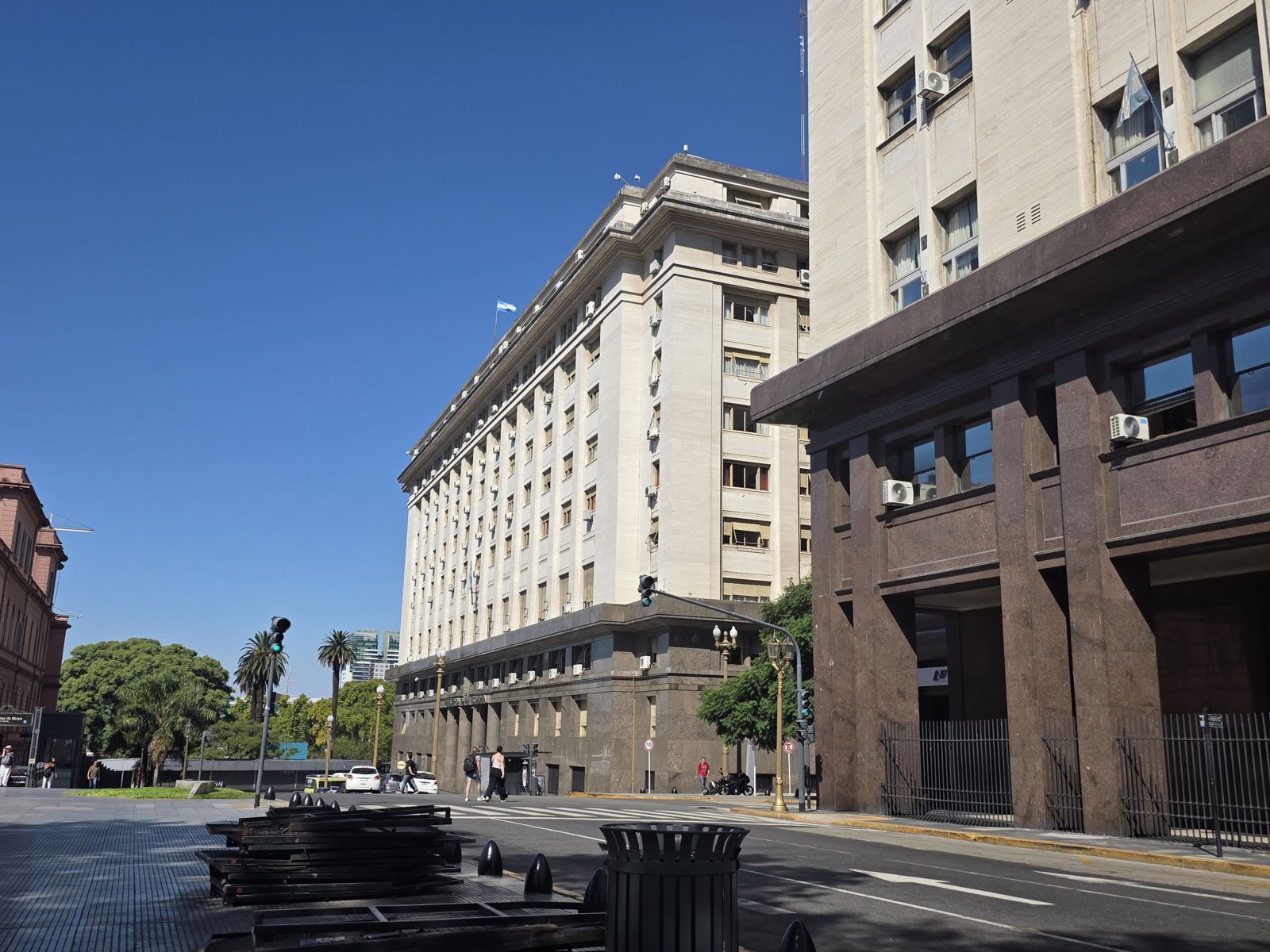
Image: File photo: Argentina's Economy Ministry (Palacio de Hacienda) on Hipólito Yrigoyen Street, Buenos Aires, 16 March 2026. Photo: Horacio Cambeiro, CC BY-SA 4.0, via Wikimedia Commons (https://commons.wikimedia.org/wiki/File:Edificio_del_Ministerio_de_Economía_de_la_Nación_Argentina_sobre_la_calle_Hipólito_Yrigoyen,_en_las_inmediaciones_de_la_Plaza_de_Mayo,_en_la_Ciudad_de_Buenos_Aires.jpg)
About this article: prepared by The Daily Context editorial desk using automated, source-based reporting from the publications linked below. No reporter was on the ground.
Sources
- Bloomberg Línea: EMAE: la economía argentina crece en septiembre pero no logra eludir la recesión técnica, según el INDEC (24 November 2026) https://www.bloomberglinea.com/latinoamerica/argentina/emae-la-economia-argentina-crece-en-septiembre-pero-no-logra-eludir-la-recesion-tecnica-segun-el-indec/
- Buenos Aires Times / AFP: Argentina entered recession in third quarter, economists say (24 November 2026) https://www.batimes.com.ar/news/economy/argentina-entered-recession-in-third-quarter-economists-say.phtml
- bne IntelliNews: Argentina seen returning to weak growth in Q4 after technical recession (26 November 2026) https://www.intellinews.com/argentina-seen-returning-to-weak-growth-in-q4-after-technical-recession-488548/
- Euronews: Argentina enters technical recession despite Milei's economic reforms (26 November 2026) https://www.euronews.com/2026/11/26/argentina-enters-technical-recession-despite-mileis-economic-reforms
- La Nación (Costa Rica) / AFP: Argentina entra en recesión técnica tras caer 1,8%, pero el Gobierno lo niega (24 November 2026) https://www.nacion.com/economia/argentina-entra-en-recesion-tecnica-tras-caer-18/WE2BV3G7LVEOFLK5PW53JMFSCI/story/
Kabeer Ahmad
Kabeer Ahmad is the founder and editor of The Daily Context. He oversees the site's source-based coverage of world affairs, technology, business, entertainment, lifestyle and sports, and is responsible for its editorial standards, sourcing and corrections.