China factory-gate prices rise 5.7%, fastest since 2022, as consumer inflation slows
China's producer price index rose 5.7% year on year in October 2026, the fastest pace since June 2022 and above a 5.3% Reuters poll forecast, driven by surging energy and mining prices. Consumer inflation slowed to 0.7% from 0.9% as food prices fell, official data released on 9 November showed.
Prices charged by Chinese factories and mines rose 5.7% in October 2026 from a year earlier, the fastest increase since June 2022, while consumer inflation slowed to 0.7%, according to data published by the National Bureau of Statistics (NBS) on Monday 9 November. The producer price index (PPI) beat the 5.3% median forecast of economists polled by Reuters, as cited by CNBC, and accelerated for a third straight month. The consumer price index (CPI) fell short of the 0.8% forecast and was down from 0.9% in September.
The two numbers point in different directions. Upstream, a jump in global energy costs is pushing up prices of coal, oil, gas and chemicals. Downstream, households are seeing cheaper food and only modest price rises elsewhere, a sign that domestic demand remains soft. The figures below come from the NBS releases and the bureau's official interpretation by Dong Lijuan, chief statistician of its urban department, translated from Chinese, with market context from CNBC.
What did China's October inflation data show?
According to the NBS, the PPI rose 5.7% year on year and 0.7% from September. The purchaser price index for industrial producers, which tracks what factories pay for inputs, rose faster: 7.9% year on year and 1.1% month on month. For January to October as a whole, factory-gate prices averaged 2.7% higher than a year earlier and input prices 4.0% higher.
The CPI was unchanged from September and rose 0.7% from October 2025. Core CPI, which strips out volatile food and energy prices, rose 0.8%, down from 1.0% in September, according to CNBC and the NBS interpretation. Consumer prices for January to October averaged 0.9% above the same period last year.
Mainland China's CSI 300 stock index was 0.56% higher after the release, CNBC reported.
What is driving factory-gate prices higher?
Energy and raw materials account for almost all of the increase. The NBS said prices of producer goods, such as fuel, metals and industrial materials, rose 7.4% year on year and contributed about 5.77 percentage points of the 5.7% headline rise. Within that, mining prices jumped 27.9%, raw materials 11.6% and processing industries 3.5%. Prices of consumer goods at the factory gate fell 0.1%.
By industry, Dong said coal mining and washing prices were 36.6% higher than a year earlier, oil and gas extraction 35.0% higher and petroleum, coal and other fuel processing 29.9% higher. Chemical raw materials rose 16.4% and non-ferrous metal smelting 18.6%. On input costs, fuel and power prices rose 18.6% and chemical raw materials 16.8%.
Month on month, Dong attributed more than 80% of October's 0.7% PPI rise to six energy-related sectors, citing higher international energy prices and seasonal demand for power-plant coal and gas as China prepares for winter. Global oil and gas prices have been elevated this year amid the US-Israel war on Iran and disruption to shipping through the Strait of Hormuz; on Monday morning, Brent crude was trading at about $98 a barrel, according to a Bloomberg markets report.
The NBS also pointed to what it called orderly capacity management in some industries and demand linked to artificial intelligence. Prices for computers, communications and other electronic equipment manufacturing rose 5.9% year on year, and electrical machinery prices 6.2%. Car manufacturing prices were flat in October after three months of declines, the bureau said.
Why is consumer inflation so low?
Food is the main drag. Food prices fell 2.9% year on year, taking about 0.49 percentage points off the CPI, according to the NBS interpretation. Fresh vegetables were 16.9% cheaper than a year earlier, pork 8.6% cheaper and fresh fruit 3.8% cheaper. Eggs, beef and mutton were exceptions, rising 12.3%, 8.7% and 5.8% respectively.
Energy pushed the other way. Petrol prices rose 22.4% from a year earlier, adding about 0.63 percentage points to the CPI, and overall consumer energy prices climbed 9.9%. Electronics have also become more expensive: the NBS said prices of data-storage devices rose 45.4%, tablets 29.3%, computers 23.0% and mobile phones 16.7%. Services prices rose 0.7%, with medical services up 3.6%.
Compared with September, travel around the National Day holiday lifted hotel prices 6.5%, airfares 3.3% and travel-agency fees 2.4%, but falls in egg, vegetable and pork prices offset that, leaving the CPI flat.
Zhang Zhiwei, president and chief economist at Pinpoint Asset Management, told CNBC that strong external demand was driving producer prices, while weak domestic demand linked to the property market was keeping consumer inflation low. "There's no clear sign of stabilization [in that sector] yet," he said, adding that this was weighing on household confidence and local government revenue.
What does this mean for businesses and the rest of the world?
For Chinese manufacturers, input costs rising faster than selling prices (7.9% against 5.7%) suggest pressure on profit margins, particularly for companies that cannot pass costs on to consumers. That is an inference from the official figures, not a finding by the NBS.
China is the world's largest exporter of manufactured goods, so its factory-gate prices are watched abroad as an early signal for import prices. After several years in which Chinese producer prices were falling, a sustained rise could add to price pressures for buyers of Chinese goods, although the October increase is concentrated in energy and raw materials rather than finished consumer goods, which were slightly cheaper at the factory gate.
Are there caveats in the data?
Yes. Since January 2026 the NBS has calculated the PPI using 2025 as a new base year, with updated product categories, sample companies and weights. The bureau estimates the change affects year-on-year readings by about 0.08 percentage points on average. Year-on-year rates also depend on price levels a year earlier, known as the base effect, so they can move sharply even when month-to-month changes are modest. Monthly figures for one month should not be read as a trend on their own.
What happens next?
The next CPI and PPI release, for November, is expected in December. Investors will be watching whether energy prices ease if talks between the US and Iran progress, and whether consumer demand improves. China's economy grew faster than expected in the third quarter and retail sales beat forecasts in September, CNBC noted, but Zhang said overall momentum has not shown a clear sign of recovery.
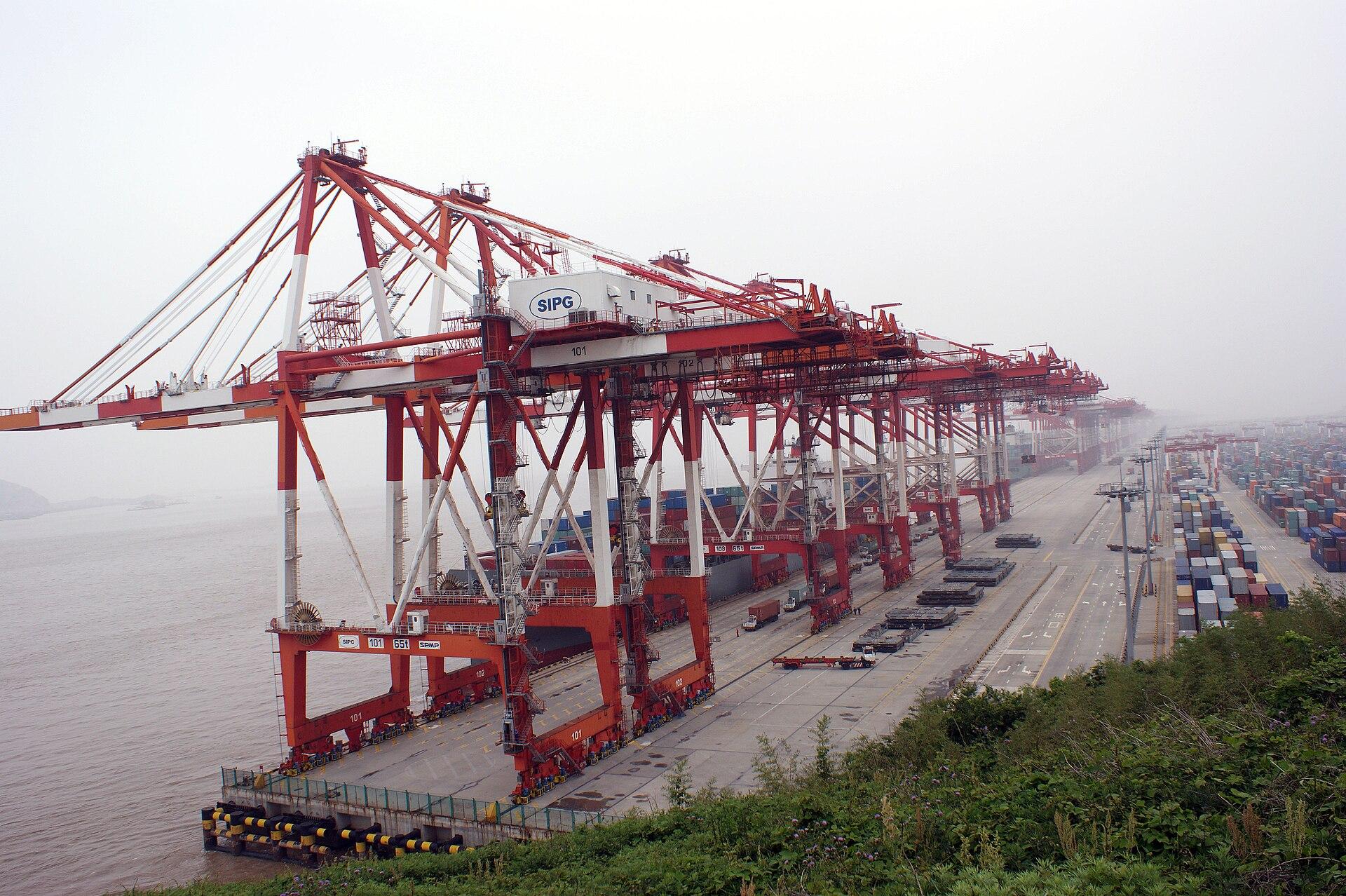
Image: Photo: Bruno Corpet (Quoique), CC BY-SA 3.0 (https://creativecommons.org/licenses/by-sa/3.0/), via Wikimedia Commons (https://commons.wikimedia.org/wiki/File:Shanghai-Yangshan-Port-Containers2013-01.JPG) — May 2013 file photo of Yangshan port, Shanghai
About this article: prepared by The Daily Context editorial desk using automated, source-based reporting from the publications linked below. No reporter was on the ground.
Sources
- National Bureau of Statistics of China: October 2026 industrial producer prices (in Chinese, 9 November 2026): https://www.stats.gov.cn/sj/zxfbhjd/202611/t20261109_1965794.html
- National Bureau of Statistics of China: October 2026 consumer prices (in Chinese, 9 November 2026): https://www.stats.gov.cn/sj/zxfb/202611/t20261109_1965795.html
- Xinhua (NBS website): Dong Lijuan's interpretation of October 2026 CPI and PPI data (in Chinese, 9 November 2026): https://www.xinhuanet.com/fortune/20261109/decb1630fe0f4b03b1eedaed46676cc1/c.html
- CNBC: China wholesale inflation hits highest in more than four years as consumer measure slows (9 November 2026): https://www.cnbc.com/2026/11/09/china-wholesale-inflation-rises-consumer.html
- Bloomberg via SWI swissinfo.ch: Asian stocks advance on tech rebound, oil falls (9 November 2026): https://www.swissinfo.ch/eng/asian-stocks-advance-on-tech-rebound%2C-oil-falls%3A-markets-wrap/92348187
Kabeer Ahmad
Kabeer Ahmad is the founder and editor of The Daily Context. He oversees the site's source-based coverage of world affairs, technology, business, entertainment, lifestyle and sports, and is responsible for its editorial standards, sourcing and corrections.