China's economy slows across the board in October as investment slump deepens
China's industrial output, retail sales and fixed-asset investment all grew more slowly than expected in October, official data showed on Monday, as the property slump kept weighing on households. Exports remain strong, and analysts say the full-year growth target is still within reach without new stimulus.
China's economy lost momentum on several fronts in October. Industrial output, retail sales and fixed-asset investment all came in below economists' forecasts, according to data published by the National Bureau of Statistics (NBS) on Monday 16 November 2026, as a long property downturn kept weighing on household spending and on construction.
Industrial output grew 4.8% from a year earlier, down from 5.5% in September and below the 5.3% expected in a Reuters poll. Retail sales of consumer goods rose just 0.4%, against 1.1% in September and a forecast of 0.8%. Fixed-asset investment fell 8.1% in the first ten months of the year, a deeper drop than the 7.2% recorded for January to September.
The figures sharpen a contrast that has defined China's economy this year: strong factories and booming exports on one side, and weak domestic demand on the other.
What did the October figures show?
The main numbers from the NBS release were:
- Industrial output: up 4.8% year on year. Manufacturing grew 5.4%, while high-tech manufacturing rose 17.6% and equipment manufacturing 10.6%. Output of industrial robots rose 26% and lithium-ion batteries 30%.
- Retail sales: 4.65 trillion yuan in October, up 0.4%. Sales in cities rose only 0.2%, while rural sales grew 1.5%. Catering income rose 0.7%.
- Services: the index of services production grew 4.6%.
- Fixed-asset investment: down 8.1% in January to October. Excluding property development, investment fell 5.1%.
- Jobs: the urban surveyed unemployment rate eased to 5.1% from 5.2% in September.
- Prices: consumer prices rose 0.7% and core inflation, which excludes food and energy, was 0.8%. Factory-gate prices were up 5.7%.
Trade was again the bright spot. The NBS said the value of goods exports rose 28.7% in yuan terms in October, and imports rose 34.7%.
Why is investment falling so sharply?
Property remains the biggest drag. Investment in real estate development was down 21.6% in the first ten months, one percentage point worse than at the end of September. The floor space of new homes and commercial buildings sold fell 13.7%, and the value of those sales fell 14.3%.
But the weakness is wider than housing. Infrastructure investment fell 5.1%, manufacturing investment fell 2.9% and private investment fell 11.4%, according to the NBS.
Caixin reported that economists at 11 institutions had on average expected a 6.9% decline in fixed-asset investment for the ten months. By Caixin's own calculation, investment in October alone was 16.9% lower than a year earlier. The publication said infrastructure spending had been held back by a shortage of eligible local projects and limited local government funding, and that support measures introduced since August had yet to make their full impact felt.
CNBC described the investment collapse as unprecedented outside the Covid-19 period.
What is happening to home prices?
New home prices fell again in October, though more slowly. Reuters calculated that prices in 70 major cities were down 0.1% from September and 2.4% from a year earlier, the smallest annual decline since November 2025.
Conditions differ sharply between cities. Among the biggest, only Shanghai recorded rising prices for both new and second-hand homes compared with both the previous month and a year earlier, Reuters reported. Resale prices in China's four tier-one cities rose for an eighth month in a row.
Zhang Dawei, an analyst at Centaline Property, told Reuters that the number of cities with rising prices kept shrinking and that signs of stabilisation were limited to a handful of places. He said completed homes that buyers "can see and touch" had become "a kind of hard currency", as buyers avoid the risk of off-plan projects that may never be finished.
Falling property values matter for spending: as Reuters noted, a drop in home values shrinks homeowners' wealth and nudges them to save rather than spend, especially when the job market is weak. Wang Qing, chief macroeconomic analyst at Golden Credit Rating International, told Lianhe Zaobao that the property sector was the main reason consumption was sluggish in October, and that weak consumption would be "difficult to reverse in the short term".
Is China still on track for its growth target?
Probably, according to the analysts quoted by Lianhe Zaobao. China's economy grew 4.5% year on year in the third quarter, helped by the global boom in artificial intelligence hardware and strong overseas demand for cars. With exports expected to stay strong for the rest of the year, analysts said the full-year target of 4.5% to 5% remained within reach.
Xu Tianchen, a senior economist at the Economist Intelligence Unit, told the newspaper he expected fourth-quarter growth of 4.6% to 4.7% and that the authorities were unlikely to add stimulus before the end of the year. Chen Bo of the National University of Singapore's East Asian Institute said there was "no reason for urgent policy intervention", while describing the economy as increasingly "K-shaped", with high-tech industries growing quickly as traditional manufacturing and property-related sectors decline.
Goldman Sachs expects growth to slow to 4.6% this year from 5% in 2025, and to 4.5% in 2027, CNBC reported.
The NBS itself was cautious. Its statement said the economy was "generally stable" but acknowledged that "the domestic imbalance between strong supply and weak demand is acute" and that some businesses were facing difficulties.
What are the risks for 2027?
The main worry is that China's growth now leans heavily on exports, and in particular on demand for AI-related equipment.
Wang Qing pointed out that a key US index of semiconductor shares has historically moved several months ahead of China's chip exports, and that its growth had slowed markedly since July. He expects growth in the value of China's chip exports to ease in 2027, which could drag on overall exports. If that happens, he said, policymakers could turn to broad interest rate cuts and more fiscal support.
Citi Research analysts, quoted by CNBC, said further European Union trade measures aimed at China looked "plausible" and could add to tensions, although they expected Beijing to be open to negotiating concessions.
China's trade surplus passed the $1 trillion mark for the year in October, the earliest it has ever reached that level. The Daily Context covered that milestone and October's consumer and producer price data in earlier reports.
What to watch next
- November data: activity figures for November are due in mid-December. Wang expects one extra working day compared with last year to help industrial output.
- Policy signals: China's annual Central Economic Work Conference, usually held in December, normally sets the tone for growth targets and stimulus in the year ahead.
- Property: whether the narrowing fall in home prices spreads beyond the largest cities.
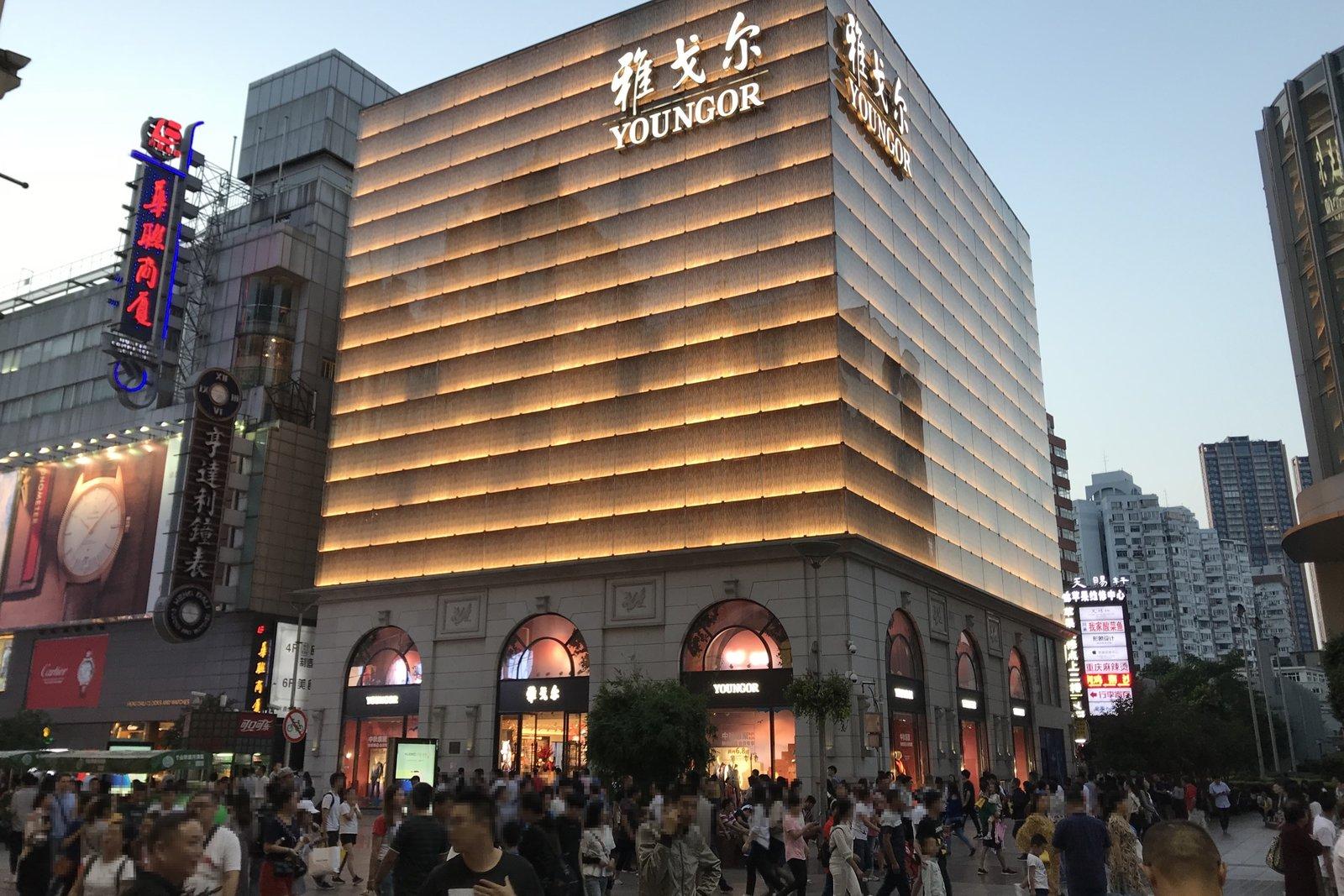
Image: そらみみ, CC BY-SA 4.0 (https://creativecommons.org/licenses/by-sa/4.0/), via Wikimedia Commons (https://commons.wikimedia.org/wiki/File:Nanjing_Road_Shopping_Street_in_front_of_entrance_No.3_of_East_Nanjing_Road_Station.jpg) — September 2018 file photo of Nanjing Road, Shanghai, illustrative only; cropped and resized
About this article: prepared by The Daily Context editorial desk using automated, source-based reporting from the publications linked below. No reporter was on the ground.
Sources
- National Bureau of Statistics of China (via english.gov.cn): National Economy was Generally Stable with Innovation-Led and High-Quality Development in October (16 November 2026) https://english.www.gov.cn/archive/statistics/202611/16/content_WS6afa6dccc6d00ca5f9a0e4b3.html
- Reuters (via Investing.com): China's factory output, retail sales growth slow in October (16 November 2026) https://www.investing.com/news/economy-news/chinas-factory-output-retail-sales-growth-slow-in-october-5028313
- CNBC: China's slowdown deepens in October as industrial output, retail sales, investment miss estimates (16 November 2026) https://www.cnbc.com/2026/11/16/china-retail-sales-october-industrial-output-investment.html
- Caixin Global: China's Fixed-Asset Investment Decline Deepens (16 November 2026) https://www.caixinglobal.com/2026-11-16/chinas-fixed-asset-investment-decline-deepens-102505237.html
- Reuters (via Investing.com): China's new home prices fall again in October; slowest annual decline in almost a year (16 November 2026) https://www.investing.com/news/economic-indicators/drop-in-chinas-new-home-prices-narrows-to-11month-low-5028306
- Lianhe Zaobao: China's economy slows in October but full-year growth target remains within reach: analysts (16 November 2026) https://www.zaobao.com.sg/en/news/china/chinas-economy-slows-october-full-year-growth-target-remains-within-reach-analysts
- National Bureau of Statistics of China: Sales prices of commercial residential buildings in 70 large and medium-sized cities, October 2026 (Chinese, 16 November 2026) https://www.stats.gov.cn/zwfwck/sjfb/202611/t20261116_1965836.html
Kabeer Ahmad
Kabeer Ahmad is the founder and editor of The Daily Context. He oversees the site's source-based coverage of world affairs, technology, business, entertainment, lifestyle and sports, and is responsible for its editorial standards, sourcing and corrections.