US retail sales rise 0.2% in October as shoppers cut back on cars and furniture
US retail and food services sales rose 0.2% in October 2026 to $748.2 billion, slowing sharply from September's 0.8% gain as auto and furniture sales fell. A core measure tied to consumer spending rose a firmer 0.6%, keeping a Federal Reserve rate rise in December firmly in view.
US shoppers spent only slightly more in October than in September. Retail and food services sales rose 0.2% to $748.2 billion, the US Census Bureau reported on Tuesday, 17 November 2026, down from a 0.8% rise the month before. The slowdown was driven mainly by a drop in sales at car dealers and furniture stores.
The headline gain matched economists' forecasts, according to Reuters, but the Census Bureau noted that it is too small to be statistically meaningful: the margin of error is plus or minus 0.4 percentage points. Underneath the headline, a narrower "core" measure that feeds into economic growth figures rose a healthier 0.6%, beating expectations.
What do the October retail sales figures show?
The Census Bureau's advance estimate, published at 8:30am Eastern time, showed:
- Total retail and food services sales: up 0.2% on the month and up 6.8% on October 2025. Sales for August to October were 6.4% higher than a year earlier.
- September: the 0.8% monthly gain was left unrevised, though the dollar level of September sales was revised up to $746.6 billion from an initially reported $745.0 billion.
- Excluding motor vehicles and parts: up 0.6%.
- Excluding motor vehicles, parts and gasoline stations: up 0.5%.
The figures are adjusted for seasonal patterns and for holiday and trading-day differences, but not for price changes. That matters: with prices rising, part of any increase in sales reflects higher prices rather than people buying more goods.
Which parts of retail grew and which shrank?
According to the Census Bureau's tables, the biggest monthly decline was at furniture and home furnishings stores, down 2.3%. Motor vehicle and parts dealers fell 1.6%, clothing stores fell 0.7%, sporting goods, hobby, musical instrument and book stores fell 0.7%, and grocery stores slipped 0.2%. Sales at electronics and appliance stores were unchanged.
On the other side, online and other non-store retailers rose 1.2%, health and personal care stores rose 1.5%, gasoline stations rose 1.5%, building materials and garden stores rose 0.5%, and restaurants and bars rose 0.2%. Miscellaneous store retailers jumped 4.7%.
Gasoline stations stand out over the year: their sales were 30.3% higher than in October 2025, reflecting a surge in fuel prices this year. Overall retail sales excluding gasoline stations rose just 0.1% in October.
What is "core" retail sales and why does it matter?
Economists pay close attention to a measure, sometimes called the "control group", that strips out sales at car dealers, gasoline stations, building materials stores and restaurants. Because those categories are volatile or not directly part of how consumer spending is counted, the remaining figure corresponds most closely with the consumer spending component of gross domestic product (GDP).
Reuters reported that this core measure rose 0.6% in October, ahead of economists' forecast of 0.4%, after an upwardly revised 0.5% rise in September (first reported as 0.1%). That suggests underlying spending held up better than the weak headline figure implies.
"More consumers are clearly struggling with rapidly rising prices but are not yet ready to throw in the towel," Scott Anderson, chief US economist at BMO Capital Markets, told Reuters. He said consumers appeared to be "strategically allocating their monthly budgets to stretch their dollars into different categories every month".
Why are prices and the Federal Reserve part of this story?
Retail sales are being read alongside a run of firm inflation data. Consumer prices rose 0.4% in October, more than the 0.3% economists expected, with core prices excluding food and energy up 0.3%, the Bureau of Labor Statistics reported on 10 November, according to CNBC. Separately, on the same day as the retail figures, the BLS said import prices rose 1.1% in October, above the 0.7% forecast, driven partly by a 3.6% increase in fuel costs, Reuters reported.
Fed officials have said that the effects of the US-Israeli war with Iran and of tariffs are adding to price pressures. The Fed held its benchmark rate in a 3.75% to 4% range at its October meeting. Financial markets have priced in a quarter-point rate increase at the Fed's 8–9 December meeting and expect another in January, according to CME Group's FedWatch tool as cited by Reuters. Resilient spending gives the Fed less reason to hold back.
Who is feeling the squeeze?
Reuters reported that consumer spending is being driven mainly by higher-income households that have been cushioned by stock market gains, while more households are relying on credit cards and the saving rate fell to a near four-year low in September. Inflation-adjusted disposable income fell 0.3% in September, according to government data cited by Reuters.
The Associated Press reported that shoppers pulled back on a range of purchases, from cars to clothing, furniture and hobbies, ahead of the start of the holiday shopping season. A separate measure, the CNBC/NRF Retail Monitor based on card spending data, also showed a 0.2% rise in October, its slowest monthly gain since November 2025, according to Quartz.
What are the limits of these figures?
The advance estimate is based on a sample of about 4,800 retail and food services companies, and is routinely revised as fuller data arrive. A one-month reading of 0.2% cannot be distinguished from zero at the Census Bureau's 90% confidence level. Because the numbers are not adjusted for inflation, they do not show whether Americans bought more goods in volume terms. Year-on-year comparisons for some other government statistics, including annual consumer price inflation, are unavailable this month because last year's federal government shutdown disrupted October 2025 data collection.
What happens next?
The Census Bureau will publish November retail sales on 16 December 2026, which will capture Black Friday and early holiday spending. That release will come one week after the Fed's December policy decision, which markets currently expect to be a rate increase.
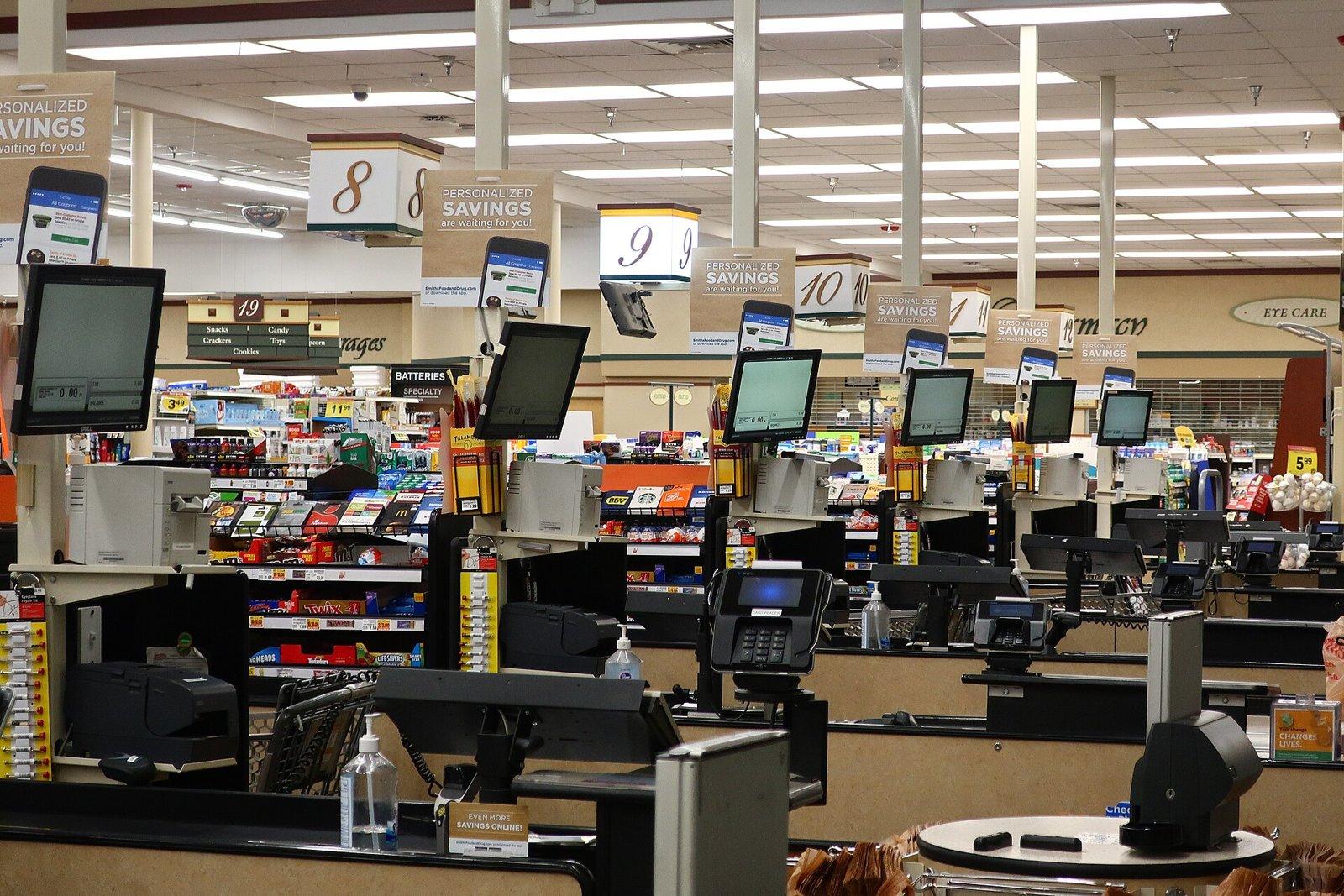
Image: Mr. Satterly, CC0, via Wikimedia Commons (https://commons.wikimedia.org/wiki/File:Checkouts_at_Smith%27s_Food_and_Drug_in_Gillette,_Wyoming.jpg) — September 2019 file photo of checkouts at a supermarket in Gillette, Wyoming; illustrative only
About this article: prepared by The Daily Context editorial desk using automated, source-based reporting from the publications linked below. No reporter was on the ground.
Sources
- US Census Bureau: Advance monthly sales for retail and food services, October 2026, release CB26-181 (17 November 2026) https://www.census.gov/retail/sales.html
- Reuters via Investing.com: US retail sales increase moderately; import prices rise above expectations (17 November 2026) https://www.investing.com/news/economy-news/us-retail-sales-increase-moderately-in-october-5033051
- Associated Press: Spending growth slowed at retail stores in October as high prices give shoppers pause (17 November 2026) https://apnews.com/article/retail-sales-inflation-consumers-0f76e8e304f5560e5a3116c4fec5d6b0
- Quartz: U.S. retail sales edged up 0.2% in October (17 November 2026) https://qz.com/us-retail-sales-october-census-slowing-holidays-111726
- CNBC: Consumer prices rose 0.4% in October, more than expected (10 November 2026) https://www.cnbc.com/2026/11/10/cpi-inflation-report-october-2026.html
Kabeer Ahmad
Kabeer Ahmad is the founder and editor of The Daily Context. He oversees the site's source-based coverage of world affairs, technology, business, entertainment, lifestyle and sports, and is responsible for its editorial standards, sourcing and corrections.