Spain's first general strike in 14 years puts housing crisis at centre of election
Millions of workers in Spain joined a 24-hour general strike on Wednesday, 11 November 2026, the country's first since 2012, to protest against soaring rents and house prices. Unions and tenants' groups put participation at about 4 million, and the stoppage lands less than three weeks before a snap general election on 29 November in which housing is a central issue.
Millions of people in Spain stopped work on Wednesday, 11 November 2026, in the country's first general strike in 14 years, a 24-hour walkout aimed squarely at the cost of housing. Spain's two largest unions, the Workers' Commissions (CCOO) and the General Union of Workers (UGT), said about 4 million workers took part, with the heaviest participation at ports, car factories and waste services.
The strike, called first by tenants' associations and then backed by the unions under the slogan "Salaries. Housing. Prices.", came less than three weeks before a snap general election on 29 November. Picket lines, roadblocks and evening marches in Madrid, Barcelona and dozens of other cities were followed by scattered clashes with police, and officials reported dozens of arrests.
What happened during Spain's general strike?
The stoppage began at midnight. Pickets quickly blocked entry to factories, wholesale food markets and transport depots, according to Reuters and The Guardian. In Barcelona, workers set up roadblocks, some with burning tyres, and key roads including the AP-7 motorway were closed in both directions. Public transport in the Catalan capital came close to a standstill, and the Barcelona metro said no trains would run outside peak commuting hours.
In Madrid, protesters on the Gran Vía shopping street cheered as stores including Primark, H&M and Pull & Bear lowered their shutters under a heavy riot police presence, Reuters reported. Scuffles broke out between pickets and police near the city's main wholesale market. Madrid's metro said peak-hour usage was down 42% compared with the same period a week earlier.
Many schools and universities were closed or running at minimal capacity. In Madrid the strike added to a separate teachers' strike that had been running for nearly a month over working conditions.
Afternoon and evening marches went ahead in more than 90 places despite 14 weather alerts issued by Spain's state meteorological agency for two storms. Marches in Cádiz, Seville, Córdoba and Huelva were cancelled because of forecast wind gusts of up to 120 km/h. The same weather system had swept Portugal earlier in the day; our report on Storm Charles is here: https://www.thedailycontext.com/article/storm-charles-portugal-schools-closed-flights-cancelled-madeira-algarve-november-2026
In Barcelona, organisers claimed 400,000 people joined the evening demonstration, while local police put the figure at 55,000. After dark, small groups of hooded protesters vandalised shops and set fire to rubbish bins, leading to clashes with police, The Guardian reported.
How many people joined the strike?
There is no single official count, and the figures below come from organisers unless stated otherwise.
- Overall: the Confederation of Tenants' Unions said about 4 million people had taken part by midday and predicted 5 million by the end of the day. Spain has roughly 23 million workers, according to the national statistics institute.
- By sector (CCOO and UGT estimates): about 90% at ports and in the automotive industry, 85% in the meat industry, 82% in waste collection, 75% in energy, 38% in health and social services (where minimum service rules apply) and 35% in the postal service.
- Factories: the unions reported "total stoppages" at Volkswagen's plant in Navarre and SEAT's in Barcelona.
- Electricity: grid operator Red Eléctrica said power demand fell by as much as 15.5% between 10 a.m. and 11 a.m., an independent indicator that activity was lower than normal.
- By region: support was strongest along the Mediterranean and Cantabrian coasts, where tenants' groups estimated participation of about 75%, and weaker in inland regions such as Castile and Extremadura, where they put it at 41% to 45%.
For comparison, the last general strike, in March 2012 against austerity measures during the eurozone debt crisis, drew about 3.6 million strikers according to the tenants' confederation.
Why are Spaniards protesting about housing?
Housing costs have risen far faster than incomes. According to figures cited by The Guardian, rents in Spain climbed by about 80% over a decade while home prices rose by 63%. The Youth Council of Spain says the average rent of €1,176 a month is equivalent to about 98.7% of a young person's average monthly salary.
Supply is a central part of the problem. The Bank of Spain estimates a shortfall of about 750,000 homes, which it expects to exceed one million by 2028, Reuters reported. Campaigners also blame the growth of tourist lets, short-term rentals and investment buying. Before the strike, the tenants' union in Granada said it had disabled about 300 key lockboxes used by short-term rental hosts in the city's tourist areas.
Anger boiled over in September after the eviction of 87-year-old Maricarmen Abascal from the Madrid home she had lived in for more than seven decades, and her subsequent death. Protests and encampments followed across the country.
Unai Sordo, head of CCOO, told the broadcaster Cadena SER that wage bargaining alone could not keep up with housing costs that had risen by as much as 12% a year. "There is one issue that is fracturing the country, and that is the difficulty many people face in accessing housing," he said.
What do the strikers want?
Tenants' unions are calling for a crackdown on housing speculation, the elimination of tourist lets and stronger protections for renters. "We won't stop until we transform this country's housing model from top to bottom," Alicia del Río, a spokesperson for the Madrid Tenants' Union, said as the strike began, according to Reuters.
Business groups disagree with the approach. Ángela de Miguel, vice-president of the employers' federation CEOE, told state broadcaster TVE that the strike was counterproductive because small businesses also suffer from the housing shortage, which makes it harder to recruit staff. She argued that the answer was to build more homes and cut taxes on construction and home buying.
How much did the strike cost the Spanish economy?
The economic hit is likely to be smaller than in past general strikes. Miguel Cardoso, chief economist at BBVA Research, estimated the stoppage could shave 0.1% to 0.2% off Spain's annual gross domestic product, Reuters reported. He said remote working and the growing weight of services, including fast-growing hospitality and finance sectors that are less unionised than industry and the public sector, would limit the impact.
That estimate is a forecast, not a measured result. Official data that would show the strike's effect on output will not be available for weeks.
Were there arrests or injuries?
Police reported 40 arrests by midday from 476 incidents linked to the strike, including blockades of offices and industrial estates and the burning of rubbish containers, according to Reuters. Later in the day, government officials said more than 50 people had been arrested over minor incidents nationwide, The Guardian reported.
The unions said they would file a criminal complaint over what they called a "disproportionate" police operation involving tear gas and batons that left 20 protesters injured. The reports reviewed for this article did not include a police response to that claim.
How does the strike affect Spain's 29 November election?
Prime Minister Pedro Sánchez of the Socialist party called the snap election after parliament rejected his government's emergency decrees to curb evictions and limit rent rises. Opinion polls suggest the most likely result is a right-wing coalition between the People's Party (PP), led by Alberto Núñez Feijóo, and the far-right party Vox.
Sánchez has tried to keep housing at the centre of the campaign, which has also been shaped by corruption cases involving people close to him and a deadly high-speed rail crash last month. Before the strike he posted a video crediting the labour movement and the right to strike with gains such as the eight-hour day and national health insurance.
Parties on the right described the strike as an effort by unions to help Sánchez stay in office. The PP president of the Madrid region, Isabel Díaz Ayuso, accused strikers of "holding citizens hostage" and said she had asked Feijóo to promise that "this garbage will end", according to The Guardian.
What happens next?
The strike was a one-day action, and no further general strike has been announced. Tenants' groups have said they will keep campaigning, and the housing question is now set to dominate the final weeks before the 29 November vote. Whichever government emerges will inherit the same shortfall of homes and the same pressure from renters. Final participation figures and any official estimate of the strike's economic cost may differ from the early numbers reported on the day.
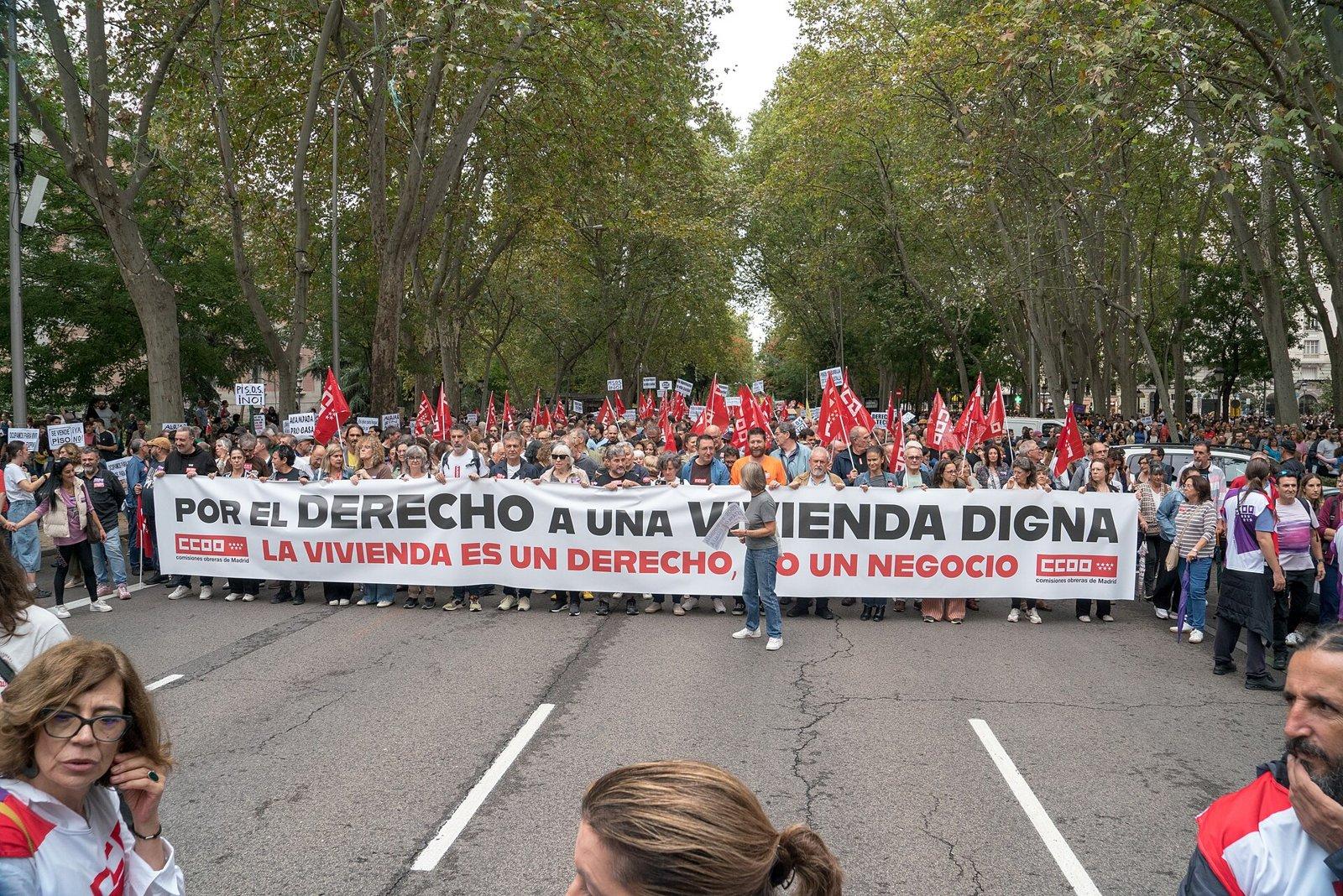
Image: Photo: Nemo, CC BY-SA 4.0 (https://creativecommons.org/licenses/by-sa/4.0/), via Wikimedia Commons (https://commons.wikimedia.org/wiki/File:26S-Manifestaci%C3%B3n_por_la_vivienda--04.jpg) — file photo of a housing-rights march in Madrid on 3 October 2026, not taken during the 11 November strike
About this article: prepared by The Daily Context editorial desk using automated, source-based reporting from the publications linked below. No reporter was on the ground.
Sources
- Reuters via Euronext (David Latona): Millions of Spaniards stage first general strike in 14 years as anger rages over housing, 11 November 2026 https://live.euronext.com/en/financial-news/millions-spaniards-stage-first-general-strike-14-years-anger-rages-over-housing
- The Guardian (Ashifa Kassam and Stephen Burgen): Millions join Spain's first general strike in 14 years in protest at housing crisis, 11 November 2026 https://www.theguardian.com/world/2026/nov/11/spain-general-strike-housing-costs
- NBC News / Reuters: Workers launch general strike across Spain over severe housing crisis, 11 November 2026 https://www.nbcnews.com/world/spain/workers-launch-general-strike-spain-severe-housing-crisis-rcna608710
- El Demócrata: Four million support the strike for housing, 11 November 2026 https://www.democrata.es/en/economy/the-tenants-union-raises-support-for-the-housing-strike-to-four-million/
- Associated Press: Housing protests sweep Madrid and Barcelona after Spain's workers' strike, 11 November 2026 https://apnews.com/article/spain-strike-housing-elections-pedro-sanchez-68a061a72d7cdf842b7803a816e46ef0
Kabeer Ahmad
Kabeer Ahmad is the founder and editor of The Daily Context. He oversees the site's source-based coverage of world affairs, technology, business, entertainment, lifestyle and sports, and is responsible for its editorial standards, sourcing and corrections.