Storm Charles: Portugal shuts schools, cancels flights as storm hits
Storm Charles reached mainland Portugal on Wednesday, 11 November, after battering Madeira overnight, prompting the first nationwide closure of Portugal's schools for a storm, hundreds of flight cancellations and the cancellation of Web Summit's second day. By mid-afternoon local time, authorities had logged hundreds of incidents, mostly flooding and fallen trees, but reported no deaths or serious injuries.
Storm Charles brought Portugal to a near standstill on Wednesday, 11 November 2026. Every school in the country was closed, non-essential public services shut, hundreds of flights were cancelled and the Web Summit technology conference in Lisbon called off its second day. The storm flooded parts of Madeira overnight before reaching the mainland, but by mid-afternoon local time authorities were reporting hundreds of incidents, mainly floods and fallen trees, and no deaths or serious injuries.
The storm also weakened before landfall. Portugal's weather service, IPMA, said the low-pressure system had split into two centres over the Atlantic, which reduced the strongest winds expected in Lisbon and shifted the heaviest impact south towards the Alentejo and the Algarve. Officials stressed that heavy rain and coastal flooding remained the main danger into Wednesday evening.
What happened in Portugal on 11 November?
The government declared a "situation of alert" and ordered schools and non-essential public services to close for the day, telling people to stay home wherever possible. According to the Associated Press, as reported by BBC News Brasil, it was the first time Portugal's roughly 8,000 schools had all suspended classes because of a storm forecast. Public-sector staff were told to work remotely, and the supermarket chain Pingo Doce closed its stores, Euronews reported.
Air travel was heavily disrupted. Data on the website of airport operator ANA showed 222 cancelled departures and arrivals at Lisbon and Faro by 09:20 local time, 208 of them in Lisbon, Euronews reported. Reuters later put the total at more than 200 flights, while the Portuguese newspaper Público counted about 360 cancellations nationwide by 11:00. The figures differ because they were compiled at different times and from different sources.
Rail operator CP cancelled four Intercity trains crossing Lisbon's 25 de Abril bridge, speed limits were cut on the 25 de Abril and Vasco da Gama bridges over the Tagus, and the National Maritime Authority said 18 harbour bars were closed by 07:30, with waves of up to six metres and maximum heights of 10 metres forecast.
Web Summit, which organisers said expected close to 70,000 attendees, cancelled its second day after the government "formally advised" that it should not take place because of the risks of tidal flooding, transport disruption and high winds on outdoor structures. Organisers said the event would resume on Thursday.
How badly was Madeira hit?
Madeira took the storm first, on Tuesday night. IPMA said more than 240 millimetres of rain fell in six hours in the island's mountains, with gusts above 130 km/h at higher points.
Madeira's Regional Civil Protection Service said that by 13:10 on Wednesday it had recorded 285 incidents since 22:00 on Tuesday, involving 718 personnel and 287 vehicles. They included 78 landslides, 72 floods and 42 fallen trees. Funchal had the most incidents (73), followed by Santa Cruz (67), Câmara de Lobos (33) and Machico, where the lower town centre flooded.
The most serious case involved a 78-year-old man in the parish of São Roque, Funchal, who was swept away when a stream burst its banks and flooded the garage he was in. Firefighters and police rescued him alive, and DN Madeira reported he had no serious injuries. A senior regional civil protection officer said "the worst has passed" because the storm tracked slightly south of the island and was weaker than first forecast.
How many incidents were reported on the mainland?
The national emergency and civil protection authority, ANEPC, recorded 538 incidents across mainland Portugal between midnight and noon on Wednesday, mostly flooding, fallen trees and road clearances, with the Lisbon and Setúbal regions worst affected. National commander Mário Silvestre described that number as within the "normal" pattern for such weather.
Lisbon's municipal civil protection service alone logged 136 incidents in the city by noon, including 120 floods. In the Algarve, the regional command counted 76 incidents by 14:00, led by 29 fallen trees, with no injuries and nobody displaced, the regional newspaper Barlavento reported. Grid operator E-REDES said about 2,000 customers were without power at midday.
These figures come from the most recent official updates available at the time of writing and will rise. The storm's peak rain was forecast between 15:00 and 18:00 local time, with heavy rain possible until 21:00, so final totals will not be known until Thursday. On Tuesday, before Charles arrived, the earlier Storm Bruna had already caused 1,240 incidents on the mainland, 743 of them floods.
Why did Portugal take such drastic precautions?
The response was shaped by earlier storms this year. Between 22 January and 16 February 2026, Portugal was hit by six successive storms that authorities say left at least seven people dead, and Reuters noted the government was criticised then for a slow response.
Interior Minister Luís Neves rejected suggestions that this time officials had overreacted. "Reactivity has very high costs," he told reporters, adding that "we cannot respond to the population only when there is a disaster." He said the alert would remain in place until midnight and that he hoped to lift it on Thursday, when "the aim is to try to return to normal."
Forecasters had warned on Tuesday of gusts of up to 150 km/h. On Wednesday IPMA cut its wind forecast as the storm deepened less than expected, and Lisbon, Setúbal and Beja were downgraded from red to orange for wind while remaining under warnings for rain. Faro district in the Algarve kept a red warning for both rain and wind.
What about Spain?
Charles was expected to reach southwestern Spain on Wednesday afternoon. Spain's weather agency, AEMET, warned of "serious or very serious" impacts from rain, wind and rough seas, Reuters reported. In Andalusia, the regional government moved its flood plan to an emergency phase and suspended in-person classes along the coasts of Cádiz and Huelva, Euronews reported.
Inland, about 3,000 residents of Piedralaves in Ávila province were evacuated on Tuesday because of the risk that the Horcajo dam could overflow after days of rain from Storm Bruna, and they remained out of their homes on Wednesday. AEMET had also issued a red warning for winds above 130 km/h on La Palma in the Canary Islands.
What happens next?
The National Maritime Authority said rough seas would continue until around midday on Thursday, 12 November, and coastal and riverside areas remain off-limits. The government expects to lift the alert on Thursday and begin repairs. Web Summit is scheduled to resume, though transport may take time to recover after a day of cancellations.
For anyone in the affected areas, the authorities' own advice is to avoid unnecessary journeys, never cross flooded roads on foot or by car, stay away from the coast and riverbanks, avoid parking in underground car parks or flood-prone areas, and call 112 in an emergency. Official warnings are published by IPMA and ANEPC in Portugal and by AEMET in Spain.
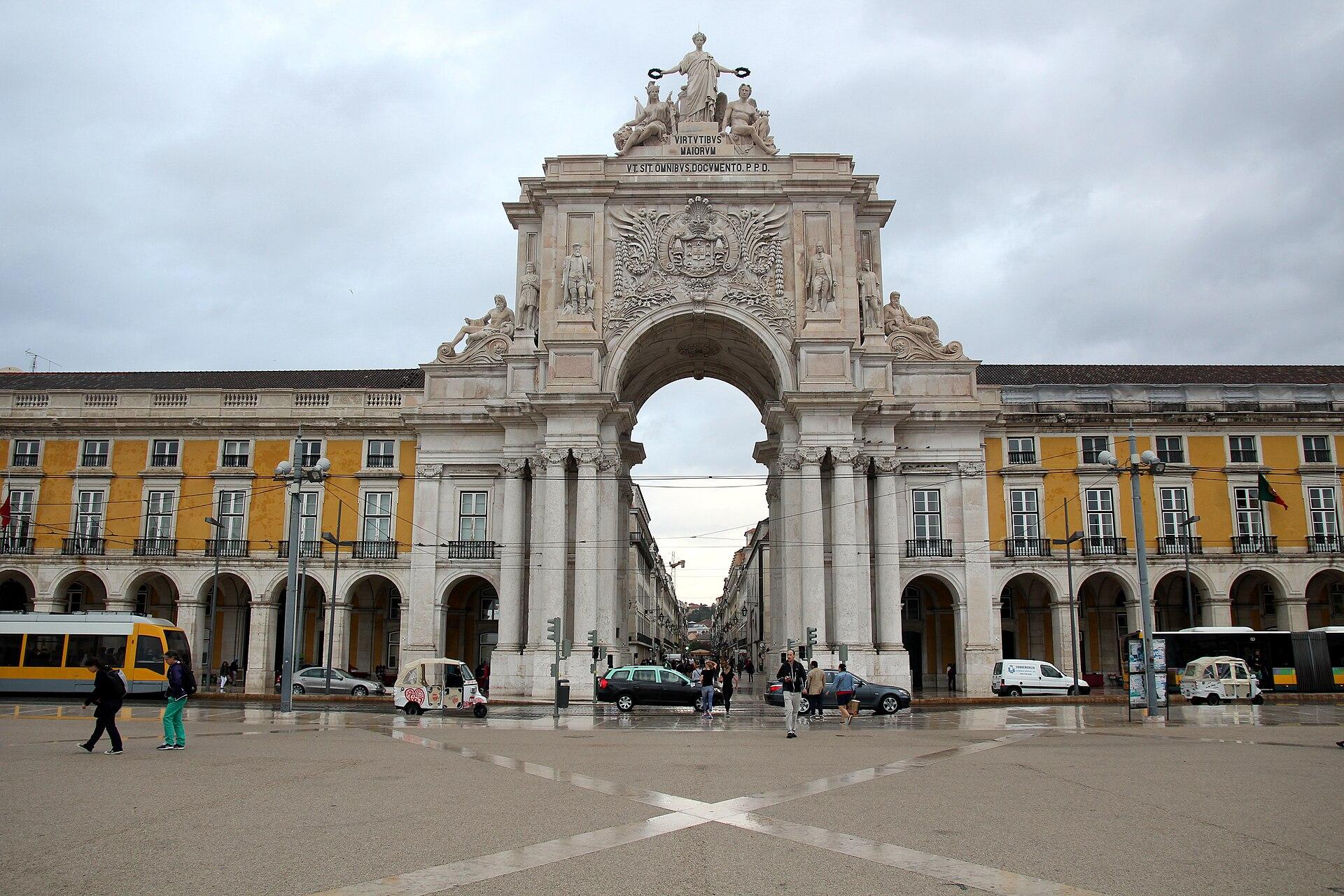
Image: Photo: Bex Walton from London, England, CC BY 2.0, via Wikimedia Commons (https://commons.wikimedia.org/wiki/File:Praça_do_Comercio_in_the_rain_(22368399065).jpg) — October 2015 file photo of Lisbon in the rain; not taken during Storm Charles
About this article: prepared by The Daily Context editorial desk using automated, source-based reporting from the publications linked below. No reporter was on the ground.
Sources
- Euronews Portugal live coverage, "Mau tempo: Período mais grave está à porta" (11 November 2026): https://pt.euronews.com/2026/11/11/mau-tempo-portugal-em-alerta-devido-a-passagem-da-depressao-charles
- RTP, "Depressão Charles. MAI rejeita excesso de zelo" (11 November 2026): https://www.rtp.pt/noticias/pais/depressao-charles-mai-rejeita-excesso-de-zelo-e-avisa-que-o-periodo-mais-grave-esta-ai-a-porta_e1778319
- Diário de Notícias, "Depressão Charles dividiu-se em dois núcleos" (11 November 2026): https://www.dn.pt/sociedade/depresso-charles-dividiu-se-em-dois-ncleos-ipma-reduz-nvel-de-alerta-para-lisboa-setbal-e-beja
- Reuters via UOL, "Portugal cancela mais de 200 voos e fecha escolas" (11 November 2026): https://noticias.uol.com.br/ultimas-noticias/reuters/2026/11/11/portugal-cancela-mais-de-200-voos-e-fecha-escolas-com-chegada-da-tempestade-charles.htm
- BBC News Brasil, "Tempestade Charles em Portugal" (11 November 2026): https://www.bbc.com/portuguese/articles/cr4gndejkdnvo
- Barlavento, Algarve civil protection update (11 November 2026): https://www.barlavento.pt/algarve-76-ocorrencias-mau-tempo-depressao-tempestade-charles/
- Euronews, "Web Summit Lisbon day 2 cancelled due to Storm Charles" (10 November 2026): https://www.euronews.com/2026/11/10/web-summit-lisbon-day-2-cancelled-due-to-storm-charles
- The Straits Times (Reuters), "Portugal braces for Storm Charles" (10 November 2026): https://www.straitstimes.com/world/europe/portugal-braces-for-storm-charles-to-shut-schools-ready-rescue-teams
- Euronews Spanish, Piedralaves evacuation and Spain warnings (10 November 2026): https://es.euronews.com/2026/11/10/espana-y-portugal-en-alerta-por-el-fuerte-temporal-de-las-borrascas-charles-y-bruna
- Notícias ao Minuto Brasil, Madeira rainfall and Tuesday incident totals (11 November 2026): https://www.noticiasaominuto.com.br/mundo/2428297/tempestade-charles-deixa-carros-submersos-e-provoca-caos-em-portugal
- El Economista, earlier 2026 storms and Web Summit (10 November 2026): https://www.eleconomista.com.mx/internacionales/portugal-suspende-clases-actividades-esenciales-web-summit-avance-tormenta-charles-20261110-843223.html
Kabeer Ahmad
Kabeer Ahmad is the founder and editor of The Daily Context. He oversees the site's source-based coverage of world affairs, technology, business, entertainment, lifestyle and sports, and is responsible for its editorial standards, sourcing and corrections.