Najib Razak begins house arrest as Malaysian minister quits in protest
Malaysia's former prime minister Najib Razak left Kajang Prison on 10 November to serve the rest of his 1MDB-linked sentence at his Kuala Lumpur home, after a High Court order ended a dispute over his royal pardon. Transport Minister Anthony Loke resigned in protest the same day.
Najib Razak, Malaysia's former prime minister, is now serving the rest of his corruption sentence at home rather than in prison. He arrived at his house in Kuala Lumpur late on Tuesday, 10 November, under heavy police escort, hours after the High Court issued a fresh order allowing house arrest under a conditional royal pardon.
The move has divided Malaysia's governing coalition. Anthony Loke, secretary-general of the Democratic Action Party (DAP), resigned as transport minister with immediate effect, saying he was keeping a promise to step down once Najib began house arrest.
What did the court decide?
High Court judge Aslam Zainuddin set aside a disputed order issued on 6 November and replaced it with a new one, the New Straits Times reported. Under the new order, Najib, 73, will serve the remainder of his reduced six-year sentence in the SRC International case at No. 11, Jalan Langgak Duta, his residence in the Taman Duta area of Kuala Lumpur, until 23 August 2028.
According to Bernama, as cited by The Edge, the vehicle carrying Najib left Kajang Prison at 9pm and reached his home at 9.27pm. The BBC reported that the mansion had been declared a federal prison ahead of his return.
His lawyer, Muhammad Shafee Abdullah, called the ruling "a final relief", but told reporters that house arrest was "still an imprisonment because he can't leave the house unless he gets special permission or for a special reason", DW reported.
Why was there a dispute over his release?
Najib was convicted in 2020 of abuse of power, criminal breach of trust and money laundering over 42 million ringgit (about $10m) transferred from SRC International, a former unit of the state fund 1Malaysia Development Berhad (1MDB), into his accounts. He was sentenced to 12 years in prison and fined 210 million ringgit, and began his sentence in August 2022 after losing his final appeal.
On 29 January 2024, the Federal Territories Pardons Board, chaired by the king, halved the prison term and cut the fine to 50 million ringgit, The Edge reported. On 18 September this year, the board allowed him to serve the rest of the sentence under house arrest, provided the fine was paid.
The United Malays National Organisation (UMNO), which Najib once led, raised the money and paid the fine on Friday, 6 November. Najib briefly left prison that day but was returned hours later after the Attorney General's Chambers sought clarification of the court order issued after the payment. According to The Edge, prosecutors said it was unclear whether paying the fine meant Najib should be placed under house arrest or that his SRC sentence was complete. The prosecutors then applied for a corrected order in line with the pardon, which the court granted on Tuesday.
The attorney general's intervention prompted a public rebuke from the palace. In a statement reported by Al Jazeera and DW, the palace said King Sultan Ibrahim's pardon was "clear, explicit and without any ambiguity" and that attempts to challenge it would amount to defying a royal order.
Home Minister Saifuddin Nasution Ismail urged all sides to "handle the matter maturely and responsibly", saying in a statement that "they should not let political polemics undermine the people's confidence in the nation's institutions", according to Al Jazeera.
Why did Anthony Loke resign?
Loke first announced his resignation in September in protest at the conditional pardon, but stayed on at Prime Minister Anwar Ibrahim's request until Najib began house arrest, Singapore broadcaster CNA reported. The DAP, a key partner in Anwar's Pakatan Harapan coalition, has described the resignation as a party decision to show its disagreement with the pardon.
"Following the decision of the Kuala Lumpur High Court today for Datuk Seri Najib Tun Razak to serve his sentence under house arrest, and in line with the position I announced last Friday, my resignation as the Minister of Transport takes effect immediately," Loke said in a statement quoted by The Star.
Speaking at a rally in Melaka that evening, ahead of state elections there, Loke said the king's prerogative to grant a pardon must be respected but that his party needed to state its position. "Kleptocrats who have caused the country to lose billions and to lose respect globally, and yet today he is permitted to return to his bungalow and sleep on his own bed," he said, according to CNA, adding that on this the party had to make its stand clear.
The BBC reported that critics also questioned the legal basis of the arrangement, saying Malaysian law makes no provision for house arrest.
What was the 1MDB scandal?
1MDB was a state investment fund that Najib helped set up after becoming prime minister in 2009. US investigators estimate that about $4.5bn was siphoned from it, and prosecutors have said more than $1bn ended up in accounts linked to Najib. According to US investigators cited by DW, the stolen money paid for luxury property, a superyacht and artworks, and helped finance the Hollywood film The Wolf of Wall Street.
The scandal contributed to the defeat of Najib's government in the 2018 general election. Najib has consistently denied wrongdoing and says he was misled by advisers, especially the financier Jho Low, who denies wrongdoing and remains at large. In 2024 he apologised for how the affair had been handled, DW reported.
Could Najib go back to prison?
Yes. The house arrest covers only the SRC case. In December 2025, in a second trial involving 1MDB funds, Najib was convicted of misappropriating about 2.3 billion ringgit, sentenced to 15 years in prison and fined 11.4 billion ringgit, The Edge reported. That sentence is due to begin after his house arrest ends.
He is appealing that conviction. Al Jazeera reported that his lawyers have asked for the prison term and fines to be halted, citing his poor health and inability to pay the fine. If the appeal fails, Najib could return to prison after August 2028.
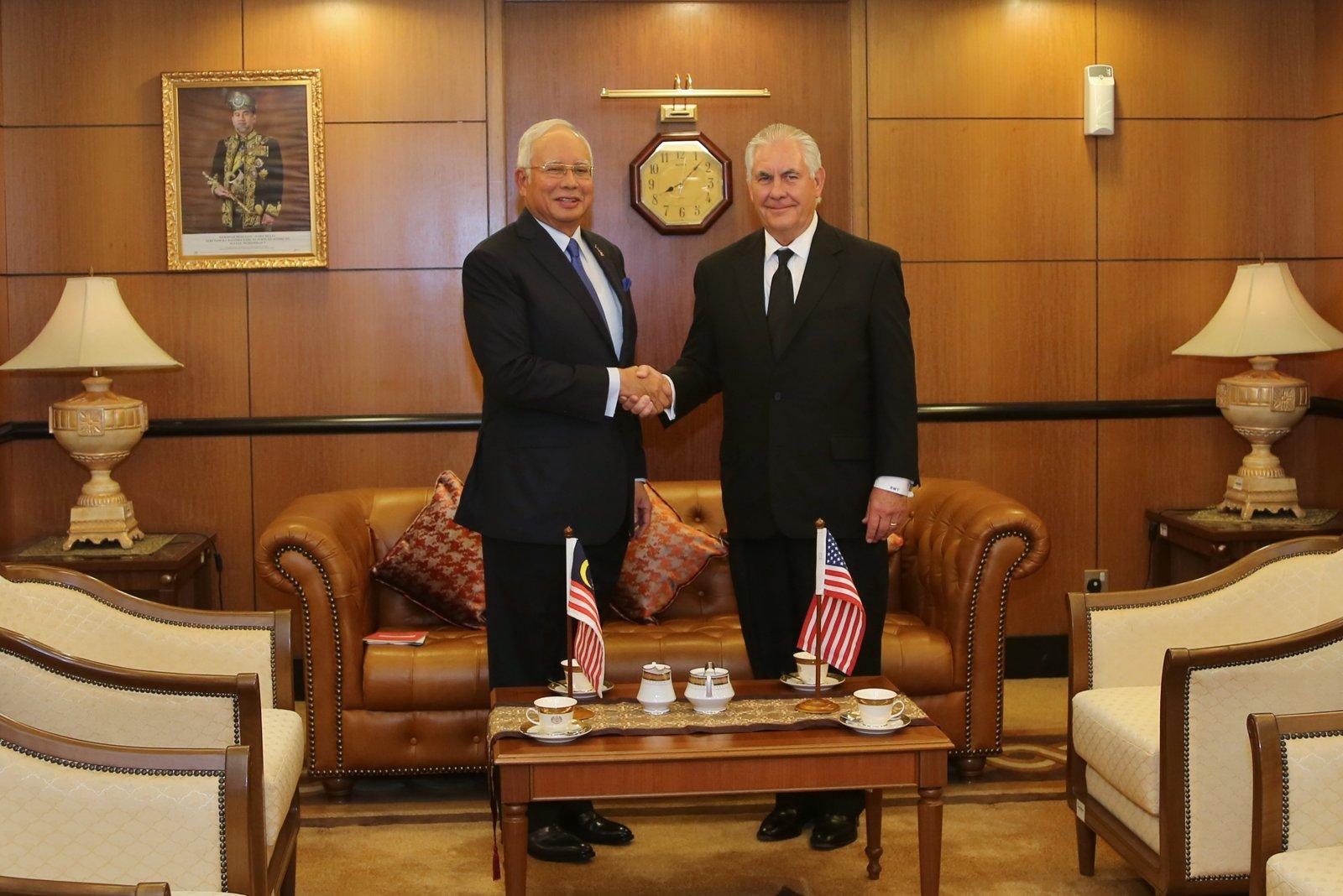
Image: Photo: U.S. Embassy Kuala Lumpur, public domain (U.S. government work), via Wikimedia Commons (https://commons.wikimedia.org/wiki/File:Secretary_of_State_Rex_Tillerson_meet_Prime_Minister_Dato'_Sri_Mohd_Najib_Tun_Abdul_Razak_(36459181515).jpg) — August 2017 file photo of Najib Razak, then prime minister, with Rex Tillerson; not taken this week
About this article: prepared by The Daily Context editorial desk using automated, source-based reporting from the publications linked below. No reporter was on the ground.
Sources
- New Straits Times: https://www.nst.com.my/news/nation/2026/11/1574746/updated-najib-begin-house-arrest-today
- The Edge Malaysia: https://theedgemalaysia.com/node/825217
- BBC News: https://www.bbc.com/news/articles/cxnv0v4yln7do
- Al Jazeera (AFP/Reuters): https://www.aljazeera.com/news/2026/11/10/malaysian-court-clears-former-pm-najib-razak-for-house-arrest-transfer
- DW: https://www.dw.com/en/malaysia-najib-razak-house-arrest/a-79913437
- CNA: https://www.channelnewsasia.com/asia/malaysia-transport-minister-anthony-loke-resignation-take-effect-immediately-najib-house-arrest-6538901
- The Star: https://www.thestar.com.my/news/nation/2026/11/10/loke-quits-as-transport-minister-after-najib-house-arrest-ruling
Kabeer Ahmad
Kabeer Ahmad is the founder and editor of The Daily Context. He oversees the site's source-based coverage of world affairs, technology, business, entertainment, lifestyle and sports, and is responsible for its editorial standards, sourcing and corrections.