Global fossil CO2 emissions set to fall 0.4% in 2026 as Iran war hits oil
Global carbon dioxide emissions from fossil fuels and cement are projected to fall about 0.4% in 2026 to 38.2 billion tonnes, according to the Global Carbon Budget published on 10 November. Scientists say the dip comes mainly from lower oil use after the Iran conflict and the Strait of Hormuz closure, not a lasting peak, and total emissions including land use still hit a record.
The world's carbon dioxide emissions from burning fossil fuels are on course to fall slightly this year, but scientists say it is for the wrong reasons. The Global Carbon Budget 2026, published on Tuesday 10 November by the Global Carbon Project, projects that CO2 from fossil fuels and cement will drop by about 0.4% to 38.2 billion tonnes (GtCO2). The main driver is a 1.9% fall in emissions from oil after the Iran conflict and the closure of the Strait of Hormuz pushed up prices and cut supply.
The projection is preliminary. The report's range runs from a 1.5% fall to a 0.6% rise, so a small increase cannot be ruled out. And because emissions from deforestation and fires are rising, total CO2 emissions are still expected to reach a record 43.3 GtCO2, slightly above 42.8 GtCO2 in 2025.
What does the Global Carbon Budget measure?
The Global Carbon Budget is an annual assessment by more than 140 researchers, led by the University of Exeter's Pierre Friedlingstein. This is its 21st edition, published in the journal Earth System Science Data alongside a related study in Nature Climate Change. It tracks where CO2 comes from (fossil fuels, cement and land-use change such as deforestation) and where it goes (the oceans, land ecosystems and the atmosphere).
"Fossil emissions" in the report combine fossil fuels and cement production. "Land-use emissions" cover deforestation, forest degradation, wood harvest, peatland drainage and fires, minus regrowth. The "remaining carbon budget" is the estimated amount of CO2 the world can still emit while keeping a given chance of limiting warming to a target such as 1.5C above pre-industrial levels.
Why are fossil emissions falling this year?
Oil is the story. The report projects oil emissions will fall by 1.9%, or about 243 million tonnes of CO2, one of the largest annual drops on record outside the Covid-19 year of 2020, according to a Carbon Brief analysis co-written by Friedlingstein. Petrol and diesel prices in the US, China and the EU were 10% to 50% higher than in 2025, depending on fuel and period. Oil emissions are projected to fall in every major region, with the biggest drop in China at 4.6%.
Clean technology played a role too. A parallel study by the same team estimates that growth in electric vehicles accounted for around a fifth of the fall in oil emissions in 2026.
Other fuels moved differently. Coal emissions are projected to rise by 0.6%, as strong growth in India outweighs sharp falls in the EU and US. Gas emissions are expected to dip 0.3%, which is effectively flat. Coal remains the largest source, at about 41% of fossil CO2, ahead of oil at 33% and gas at 21%.
"It's downwards which sounds good, but this is largely driven by the war in Iran, what's happened in the Strait of Hormuz," study co-author Glen Peters of Norway's CICERO Center for International Climate Research told the Associated Press. "So in a way, a little bit of good news, but for the wrong reasons."
Which countries are cutting emissions and which are rising?
The report's 2026 projections for the largest emitters are:
- China, about 32% of global fossil emissions: down 0.9%, with oil falling 4.6%, gas down 0.9% and coal up 0.3%. The report links this to renewables growth and a milder summer than 2025's record heat.
- United States, about 13%: down 1.3%, mainly because coal emissions fall 6.7% after an unusual rise in 2025.
- India, about 8%: up 4.4%, faster than its 3.5% annual average over the past decade, with coal up 5.9%.
- European Union, about 6%: down 1.5%, with coal down 2.9% and oil down 1.8%.
- Japan, about 2.5%: down 1.0%, continuing a longer decline.
- International aviation and shipping: each down about 1%, partly because of reduced traffic in the Middle East.
- Rest of the world, about 38%: down 0.7%, mostly from oil.
Every country figure carries its own uncertainty range. The report also found that 40 countries, together responsible for 26% of global fossil emissions, significantly cut emissions while growing their economies over 2016 to 2025, up from 22 countries in the previous decade.
If fossil emissions are down, why are total emissions at a record?
Land-use emissions are projected to rise to 5.1 GtCO2 in 2026 from 4.4 GtCO2 in 2025. The report attributes the increase to peat fires, almost all started by people, and forest degradation in south-east Asia during drier conditions linked to this year's strong El Niño. Carbon Brief notes that if land-use emissions had stayed at 2025 levels, total emissions would have fallen slightly to around 42.6 GtCO2.
Over the longer term the picture is mixed. Land-use emissions averaged 4.9 GtCO2 a year over 2016 to 2025, about 21% lower than the decade before. Total emissions grew by an average of 0.3% a year over the past decade, compared with 1.7% a year in the decade before that. Brazil, the Democratic Republic of the Congo and Indonesia together account for around 54% of land-use emissions.
Does this mean global emissions have peaked?
The researchers say no. Their Nature Climate Change study estimates that rising energy demand would have added about 0.78 GtCO2 in 2026, and growth in solar, wind and EVs offset about 69% of that. The rest of the fall is attributed mostly to high energy prices and supply constraints. In other words, the team's central estimate suggests emissions would have kept rising without the energy shock from the Iran war.
"A decline in fossil CO2 emissions is encouraging, but a reduction driven partly by geopolitical shocks is not a sustainable climate solution," Friedlingstein said, as quoted by ABC News in Australia. "While renewables and electric vehicles are increasingly offsetting growth in energy demand, further acceleration is needed if global emissions are to peak and enter a sustained decline."
Looking ahead to 2028, the study models two scenarios that assume the 2026 price shock does not persist. If clean technology deployment stays at 2026 levels, it offsets about 63% of demand-driven growth; if it keeps accelerating along recent trends, about 79%. In both cases emissions in 2028 would still be higher than in 2025. The authors caution that their method is a simplified estimate that assumes clean energy displaces fossil fuels one-for-one.
How much carbon budget is left for 1.5C?
Very little. With human-caused warming estimated at 1.37C above pre-industrial levels in 2025, the report puts the remaining budget for a 50% chance of limiting warming to 1.5C at 150 GtCO2 from the start of 2027, less than four years of current emissions. The budgets for 1.7C and 2C are about 510 GtCO2 and 1,035 GtCO2, or roughly 12 and 24 years at today's rate.
Atmospheric CO2 is projected to average 427.7 parts per million in 2026, about 54% above pre-industrial levels. Natural sinks still absorb roughly half of human emissions. The land sink in 2025 was the largest on record, at about 13.3 GtCO2, after recovering from the 2023 to 2024 El Niño, but the researchers expect the El Niño that began in June 2026 to weaken it in 2027. They estimate that climate change made the land and ocean sinks 19% and 8% smaller over 2016 to 2025 than they would otherwise have been.
Why does it matter now?
The figures arrive as governments meet at the COP31 climate talks in Antalya, Türkiye, where finance and the transition away from fossil fuels are central issues. They suggest that clean energy is now absorbing most of the growth in energy demand, but that a durable fall in emissions still depends on faster deployment rather than on price shocks that may reverse. For background on the talks, see our COP31 coverage: https://www.thedailycontext.com/article/cop31-antalya-opens-climate-finance-fossil-fuels-november-2026
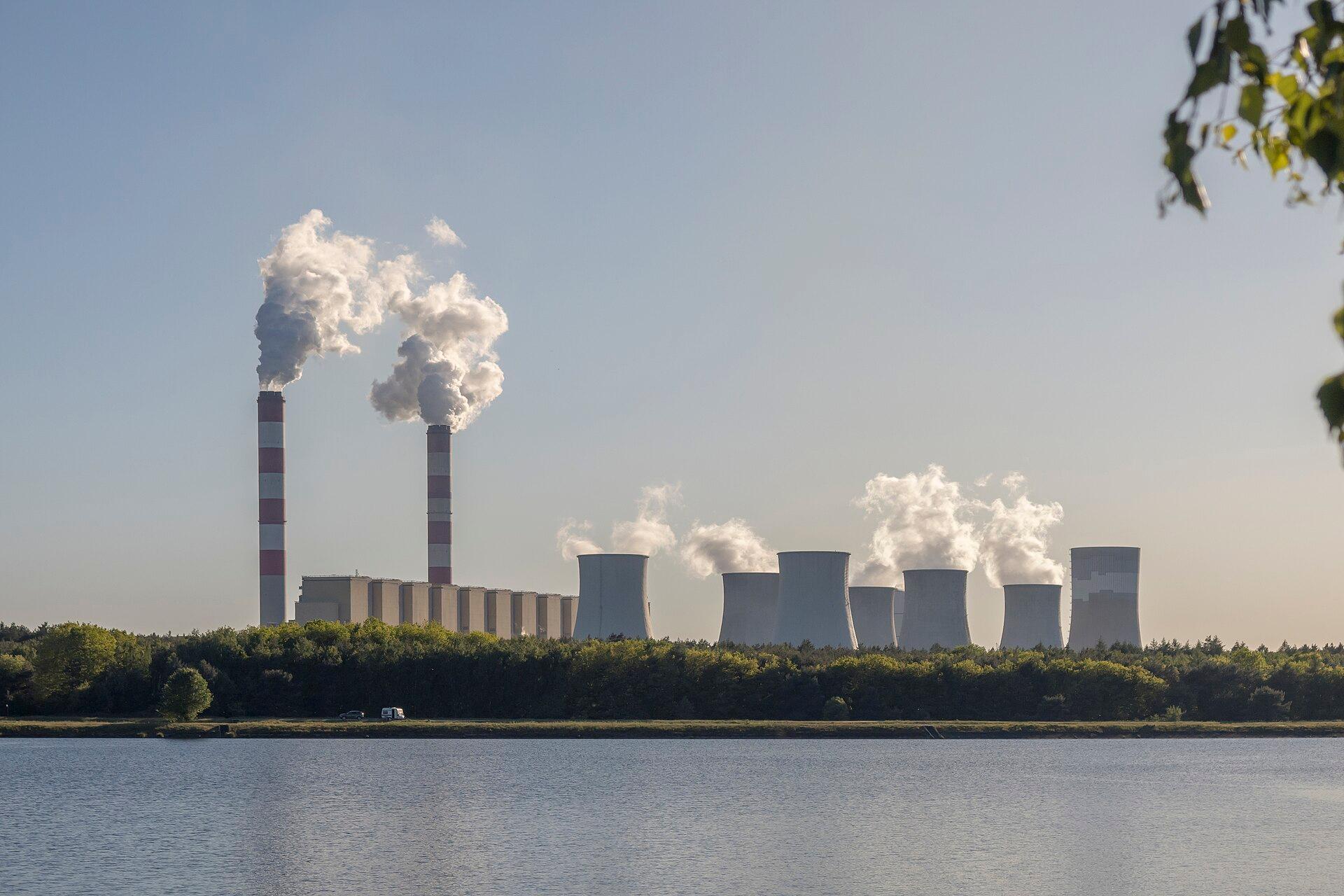
Image: Photo: Stephan van Helden, CC BY-SA 4.0 (https://creativecommons.org/licenses/by-sa/4.0/), via Wikimedia Commons (https://commons.wikimedia.org/wiki/File:View_across_Slok_reservoir_to_Belchatow_power_plant.jpg) — May 2024 file photo of the Bełchatów power station, Poland; illustrative, not specific to the report
About this article: prepared by The Daily Context editorial desk using automated, source-based reporting from the publications linked below. No reporter was on the ground.
Sources
- Carbon Brief: Analysis: Fossil-fuel CO2 emissions set to dip in 2026 as Iran conflict hits oil use https://www.carbonbrief.org/analysis-fossil-fuel-co2-emissions-set-to-dip-in-2026-as-iran-conflict-hits-oil-use
- Associated Press: Heat-trapping carbon pollution drops, but scientists cite the Iran war https://apnews.com/article/climate-fossil-fuels-emissions-pollution-war-energy-3adab6b51554800012a11fa0936f34f8
- ABC News: 2026 carbon budget says Iran war sparked decline in fossil fuel emissions https://www.abc.net.au/news/2026-11-10/fossil-fuel-emissions-to-fall-in-2026-due-to-iran-war/107329262
- Our World in Data: Global CO2 emissions from fossil fuels are set to fall in 2026 https://ourworldindata.org/data-insights/global-co2-emissions-from-fossil-fuels-are-set-to-fall-in-2026
- New Scientist: Global carbon emissions set to fall in 2026 due to Iran energy shock https://www.newscientist.com/article/2598130-global-carbon-emissions-fall-in-2026-due-to-iran-energy-shock/
Kabeer Ahmad
Kabeer Ahmad is the founder and editor of The Daily Context. He oversees the site's source-based coverage of world affairs, technology, business, entertainment, lifestyle and sports, and is responsible for its editorial standards, sourcing and corrections.