Trakia motorway pile-ups in fog kill 12 near Yambol, Bulgaria
Twelve people were killed and 51 taken to hospital after two chain-reaction crashes involving 86 vehicles on Bulgaria's Trakia motorway near Zimnitsa, Yambol Region, in sudden dense fog on Tuesday 10 November 2026. The government has declared Wednesday 11 November a day of national mourning.
Twelve people have been killed and dozens injured in two chain-reaction crashes on Bulgaria's Trakia motorway near the Zimnitsa junction in Yambol Region on the morning of Tuesday 10 November 2026. Officials say a sudden bank of dense fog, wet road surfaces and speeds unsuitable for the conditions were the most likely causes. In total, 86 cars, lorries and other vehicles were involved.
Bulgaria's Ministry of Health said in a 3pm update that 11 people died at the scene and one more died in hospital in Yambol, and that 51 people had been admitted to hospitals in Sliven, Yambol and Burgas, 13 of them with serious injuries. Prime Minister Rumen Radev called it "a dark day for the whole of Bulgaria", and the Council of Ministers is declaring Wednesday 11 November a day of national mourning.
What happened on the Trakia motorway?
The first call to the 112 emergency number came in at about 7:10am local time (05:10 GMT), Yambol regional governor Georgi Chalakov said, according to the Bulgarian state news agency BTA and the BBC. BTA's Bulgarian service reports that one pile-up happened at about kilometre 289 on the carriageway towards Burgas, on the Black Sea coast, and the other at about kilometre 294, before the Zimnitsa junction, on the carriageway towards Sofia.
Lyubomir Nikolov, the acting chief secretary of the Interior Ministry, said the first crash began on the Burgas-bound side when a lorry blocked the path of a passenger bus, BTA reports. Another collision followed behind the bus, involving a lorry carrying wheat, and a car then hit the back of that lorry. Nikolov said everyone who died had been travelling towards Burgas.
The second pile-up, on the Sofia-bound side, was probably triggered the same way, Nikolov said: "Drivers were probably distracted by the nearby collision, which would explain why both crashes happened in the same area." Interior Minister Ivan Demerdzhiev, speaking at the scene, said visibility before the crashes had been 70 to 80 metres, that "the fog thickened sharply", and that vehicles on the Burgas-bound carriageway "piled up extremely quickly", BTA reported.
Deputy Interior Minister Kaloyan Kaloyanov told reporters that 63 vehicles were involved on the Burgas-bound carriageway and 23 on the Sofia-bound side, according to the Bulgarian news agency BGNES. Early estimates had been far lower: the Yambol governor first spoke of about 50 vehicles, and the Sliven governor, Mihail Kasherov, of more than 70. A BTA correspondent saw crushed cars and lorries along roughly a kilometre of motorway as the fog lifted.
How many people were killed and injured?
The official toll rose through the day. By 11:30am the Ministry of Health counted 11 dead, 10 at the scene and one in hospital in Yambol, and warned that the figure could rise once wreckage was cleared. Prime Minister Radev and Health Minister Katya Ivkova then gave a toll of 12 in the early afternoon.
Accounts of where the twelfth victim died differed during the day. Some officials and reports, including BTA, said 10 people died at the scene and two in hospital. The ministry's 3pm update, the most recent official figure we found, says 11 died at the scene and one in the Yambol hospital, giving a total of 12.
Injury figures have also varied as patients were counted and moved between hospitals. Officials gave tallies of 46, 48, 50 and 51 at different points. The ministry's 3pm figure was 51 people in hospital: 33 in Sliven, 11 in Yambol and 7 in Burgas, with 13 seriously injured. Nikolov said earlier that no children had been reported among the dead or injured.
The victims had not been publicly identified when this article was prepared. The Ministry of Health has set up a hotline, 02 930 1152, and a 24-hour duty line, 0888 33 45 45, for people looking for relatives taken to hospital.
How did rescuers reach the injured?
Rescue work was slowed by the same fog that caused the crashes. A medical helicopter that took off from Sliven could not land, the Ministry of Health said, and its crew were driven to the scene by police instead. Chalakov told BTA that rescue teams had to remove sections of crash barrier to reach people, and Demerdzhiev said police officers had to carry injured people out by hand on stretchers because ambulances could not get into the middle of the crash sites.
Bulgarian National Radio reports that the government aircraft was diverted to Burgas and that military Spartan transport planes were placed on standby to fly seriously injured patients to hospitals in Sofia if needed. Dr Ivan Seliminski Hospital in Sliven suspended surgery to free up staff and resources, BTA reports. The National Centre for Transfusion Haematology asked eligible donors across the country to give blood.
Chalakov declared a partial state of emergency in the municipalities of Straldzha, Tundzha and Yambol from 7:30am, and the BG-ALERT emergency notification system was activated in Yambol, Sliven and Burgas districts to warn drivers and point them to diversions. The motorway was closed in both directions, and the Road Infrastructure Agency said it expected the closure to last a long time because of the number of lorries involved and the investigation.
What caused the crashes and who is investigating?
Officials have consistently named the sudden fog as the main factor, alongside wet asphalt and speeds that were too high for the conditions, a point made by regional road administration director Galin Kostov. No final cause has been established.
The Yambol district prosecutor's office opened two pre-trial investigations, one for each crash, and said the National Investigation Service would take over because of the severity of the case, BTA reports. Demerdzhiev said nine investigators would examine the scene, including the road markings and the asphalt.
Demerdzhiev also pointed to what Bulgarian National Radio described as systemic shortcomings in how road safety is managed. He said the cameras of the national toll system are not linked to the traffic police, and that the motorway lacks electronic information boards to warn drivers of hazards such as fog. Without those systems, he said, preventive action was impossible. Those are the minister's own comments; no official review of the warning systems has yet been published.
Why does this matter for road safety in Bulgaria?
Bulgaria has the highest road death rate in the European Union. Final European Commission figures for 2025, published on 27 October 2026, put Bulgaria at 71 road deaths per million inhabitants, ahead of Romania (68) and Croatia (67) and well above the EU average of 43. Bulgaria recorded 456 road deaths in 2025.
The same data show some progress. Bulgaria's road deaths fell 5% in 2025 compared with 2024 and 27% compared with 2019, and the Commission lists Bulgaria among only five member states on course to halve road deaths by 2030. But the Commission's early indicator for the first six months of 2026 shows deaths in Bulgaria rising compared with the same period of 2025. Balkan Insight, citing Bulgaria's National Statistical Institute, reports 465 road deaths in 2025; the small difference from the Commission's figure reflects different counting sources.
The Trakia motorway runs west to east across Bulgaria and connects the capital, Sofia, with the Black Sea coast at Burgas, carrying both cars and heavy goods traffic. After Tuesday's crashes, Burgas police urged drivers to slow down and leave more space between vehicles where visibility was poor, BTA reports.
What happens next?
Wednesday 11 November is a day of national mourning. Radev, who was hosting European Commission President Ursula von der Leyen, cancelled the rest of his programme in Varna, and President Iliana Iotova cut short her visit to the Paris Peace Forum to return home, Bulgarian National Radio reports.
The National Investigation Service will lead the inquiry, including on-site inspections, witness questioning and expert examinations. Further questions are likely to focus on whether earlier fog warnings, variable speed signs or better links between monitoring cameras and the police could have reduced the toll. The death toll and injury figures may still change, and The Daily Context will update this article if officials publish materially new information.
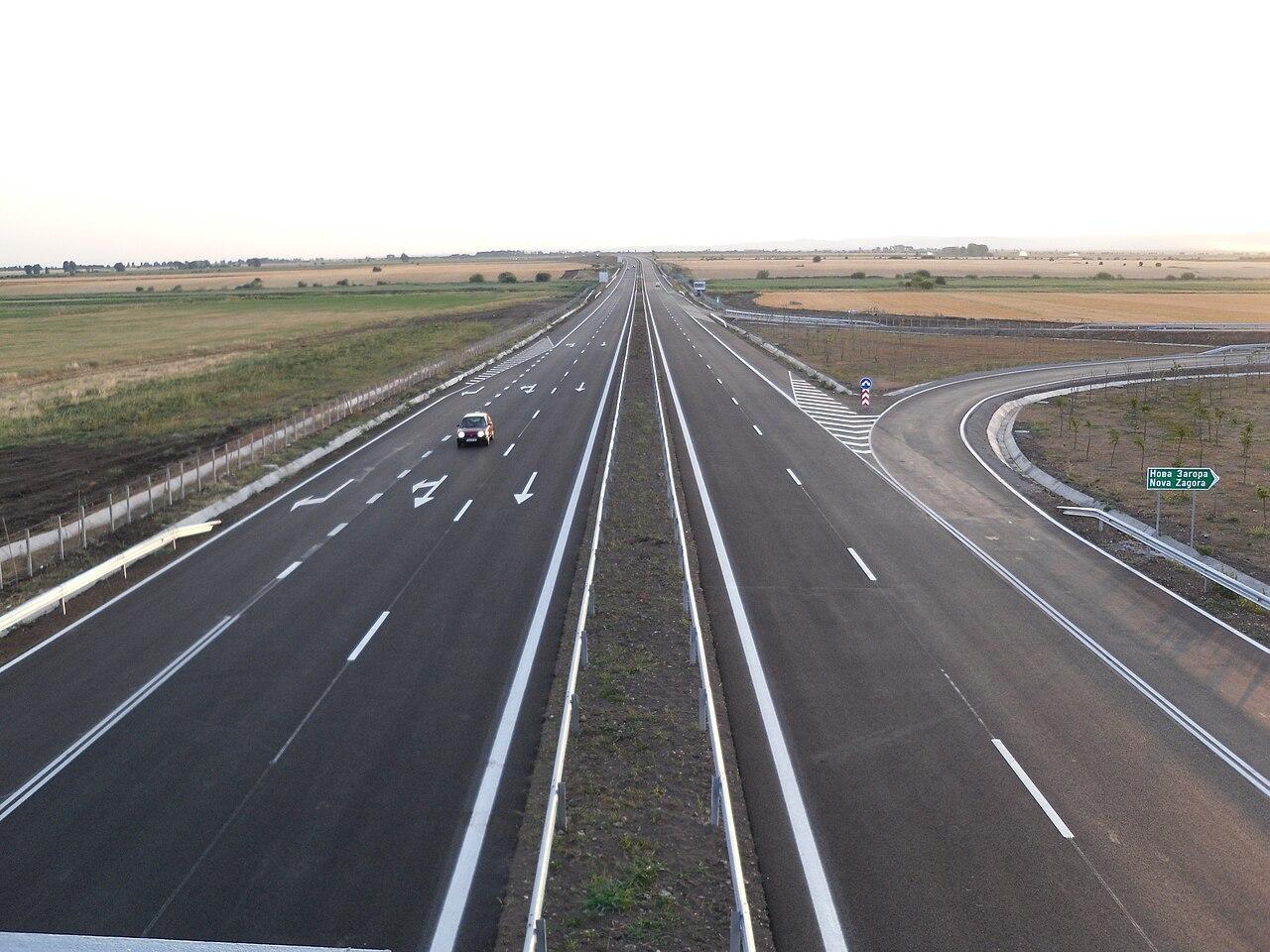
Image: Photo: Bikerboy-93, public domain, via Wikimedia Commons (https://commons.wikimedia.org/wiki/File:Trakia_highway_near_to_Nova_Zagora.jpg) — July 2012 file photo of the Trakia motorway near Nova Zagora, west of the crash site; not the scene of the crashes
About this article: prepared by The Daily Context editorial desk using automated, source-based reporting from the publications linked below. No reporter was on the ground.
Sources
- Bulgarian Ministry of Health: Update on casualties of the Trakia motorway crash as of 15:00, 10 November 2026 (in Bulgarian): https://www.mh.government.bg/bg/novini/aktualno/5050
- Bulgarian Ministry of Health: Update as of 11:30, 10 November 2026 (in Bulgarian): https://mh.government.bg/bg/novini/aktualno/5048
- BTA: 12 Killed in Two Pile-Ups on Trakia Motorway near Yambol: https://www.bta.bg/en/news/bulgaria/1243529-12-killed-in-two-pile-ups-on-trakia-motorway-near-yambol
- BTA: Nine Investigators to Probe Trakia Motorway Crashes, Visibility Was 70-80 Metres: https://www.bta.bg/en/news/bulgaria/1243931-nine-investigators-to-probe-trakia-motorway-crashes-visibility-was-70-80-metres
- BTA: National Investigation Service Takes over Trakia Motorway Pile-Ups Investigation: https://www.bta.bg/en/news/bulgaria/1243742-national-investigation-service-takes-over-trakia-motorway-pile-ups-investigation
- BTA (in Bulgarian): Two serious pile-ups in dense fog on the Trakia motorway near Zimnitsa: https://www.bta.bg/bg/news/bulgaria/1243538-dve-tezhki-verizhni-katastrofi-v-gasta-magla-stanaha-na-magistrala-trakiya-kra
- Bulgarian National Radio: Bulgaria declares Day of National Mourning for victims of motorway pile-up: https://bnrnews.bg/en/post/556212/bulgaria-declares-national-mourning-day-on-november-11-for-victims-of-motorway-pile-up
- Bulgarian National Radio: At least 11 dead, dozens injured in Bulgarian motorway pile-up: https://bnrnews.bg/en/post/556080/at-least-11-dead-dozens-injured-in-bulgarian-motorway-pile-up
- BGNES: 12 Killed, 50 Injured as 86 Vehicles Involved in Massive Pile-Ups on Bulgarian Motorway: https://www.bgnes.com/society/12-killed-50-injured-as-86-vehicles-involved-in-massive-pile-ups-on-bulgarian-motorway
- BBC News: Twelve dead after motorway pile-ups in Bulgaria fog: https://www.bbc.com/news/articles/ckx2q2velpjjo
- BNT News: Death Toll from Serious Accident near Zimnitsa Rises to 12: https://bntnews.bg/news/death-toll-from-serious-accident-near-zimnitsa-rises-to-12-tomorrow-is-a-day-of-mourning-1421551news.html
- Balkan Insight: Bulgaria Declares Mourning Over Deadly Motorway Pile-Up: https://balkaninsight.com/2026/11/10/bulgaria-declares-mourning-over-deadly-motorway-pile-up/bi/
- European Commission: Road safety statistics for 2025 confirm drop in EU road deaths: https://transport.ec.europa.eu/news-events/news/road-safety-statistics-2025-confirm-drop-eu-road-deaths-2026-10-27_en
Kabeer Ahmad
Kabeer Ahmad is the founder and editor of The Daily Context. He oversees the site's source-based coverage of world affairs, technology, business, entertainment, lifestyle and sports, and is responsible for its editorial standards, sourcing and corrections.