Abu Dhabi talks end with Russia-Ukraine prisoner swap deal, no ceasefire
Two days of US-mediated talks between Russia and Ukraine in Abu Dhabi ended on 11 November with an agreement in principle on a large prisoner-of-war exchange, but no ceasefire or deal on territory. US envoys Jared Kushner and Steve Witkoff say they will meet Vladimir Putin in Moscow on 12 November and then brief Volodymyr Zelensky in Dublin.
The first face-to-face talks between Russian and Ukrainian negotiators in nine months ended in Abu Dhabi on Wednesday, 11 November, with one concrete result: an agreement in principle on what US envoy Jared Kushner called "the biggest humanitarian release of prisoners". There was no announced breakthrough on a ceasefire, territory or security guarantees.
Kushner said he and fellow envoy Steve Witkoff would fly to Moscow on Thursday, 12 November, to meet Russian President Vladimir Putin, and then travel to Dublin to brief Ukrainian President Volodymyr Zelensky, who is attending European leaders' meetings there this week.
What did Russia and Ukraine agree in Abu Dhabi?
The only outcome confirmed by all three delegations is a planned large-scale exchange of prisoners of war. "One of the positives is we agreed that we're going to have the biggest humanitarian release of prisoners, which we're going to finalize the numbers tomorrow," Kushner told reporters after the talks, according to the Associated Press.
The heads of both delegations confirmed it. Vladimir Medinsky, the Kremlin aide who led Russia's team, told Russian journalists: "We have reached an agreement in principle on a new large-scale prisoner exchange. The specific details will be announced in the near future," Radio Free Europe/Radio Liberty reported. Rustem Umerov, head of Ukraine's Foreign Intelligence Service and Kyiv's chief negotiator, said another exchange had been agreed and that the exact number would be announced later, Interfax-Ukraine reported.
Neither side has published the size or timing of the swap. After the first day of talks on Tuesday, Zelensky said a "1,000 for 1,000, maybe 1,500 for 1,500" format was being discussed, according to Interfax-Ukraine and Euronews. Until the numbers are confirmed, those figures should be read as the range under discussion rather than a settled deal.
For context, Russia and Ukraine also agreed to exchange 1,000 prisoners each during talks in Istanbul in May 2025, again without agreeing a ceasefire, Euronews noted.
How did the two days of talks unfold?
The round, mediated by the United States and hosted by the United Arab Emirates, was the first trilateral meeting since talks in Geneva in February 2026. Earlier rounds were held in Abu Dhabi in January and early February.
The first session, on Tuesday, 10 November, lasted about four hours, according to Interfax-Ukraine. Zelensky described it as "constructive and quite substantive". He said it focused mainly on humanitarian issues, including prisoner exchanges and returning Ukrainian civilians and children taken by Russia, as well as on the substance of security guarantees for Ukraine, AP reported. Interfax-Ukraine said Russia's demands for security guarantees for itself, Ukraine's reconstruction and a future European security architecture were also discussed.
The second session on Wednesday was shorter. RFE/RL reported that it ended after a little less than two hours. Umerov said on Telegram that Kyiv's team would then meet European partners separately.
Ukraine's delegation included Umerov, presidential office head Kyrylo Budanov, his first deputy Serhiy Kyslytsia, military intelligence deputy chief Vadym Skibitsky and ruling-party parliamentary leader Davyd Arakhamia, according to Interfax-Ukraine. Alongside Witkoff and Kushner, the US side included General Alexus Grynkewich, commander of US European Command and NATO's Supreme Allied Commander Europe.
What remains unresolved?
The core disputes are where they were before the talks. Russia continues to insist that Ukraine withdraw from the part of the eastern Donbas region that Kyiv still controls, while Zelensky says territorial questions can only be settled at the level of national leaders, Euronews reported. Moscow has also rejected an immediate ceasefire, saying broader security arrangements must come first.
Al Jazeera's Arabic service reported that participants announced no practical steps towards a ceasefire along the front line, no truce on attacks against energy infrastructure and no understanding on freedom of navigation in the Black Sea.
Kushner acknowledged the gap. He said there was "not great trust or love between the leaders" and that "these deals do take time", according to The Guardian's live coverage. He said a meeting between Putin and Zelensky "would be great", but that "the Russians have said they would like to see more progress made before that happens".
What role did Europe play?
European governments were present in Abu Dhabi but not at the negotiating table with Russia. RFE/RL reported that Germany, France and the UK, together with Italy, NATO and the European Union, held consultations with US and Ukrainian representatives separately from the trilateral sessions.
Medinsky dismissed their presence. "No, we did not communicate with them. We don't really understand in what capacity they are here," he told reporters, according to Euronews, adding that Moscow had received no concrete proposals from European countries. Kushner, by contrast, said Europe had to be involved in any discussion of Ukraine and post-war security, The Guardian reported.
Did the fighting pause during the talks?
No. While negotiators met, Russia and Ukraine continued to exchange drone strikes. RFE/RL reported that Ukrainian Prime Minister Serhiy Koretskiy said Russia had attacked six major electricity facilities in four regions overnight into 11 November, and that a drone strike left parts of the city of Kryvyi Rih without electricity and heating.
On the Russian side, the governor of the Leningrad region said 150 Ukrainian drones were shot down over the region overnight and that a fire broke out in the port area of Ust-Luga, a major Baltic oil and energy export hub, injuring three workers, RFE/RL reported. Russia's Defence Ministry said it had intercepted 627 Ukrainian drones overnight. These figures come from the respective governments and could not be independently verified.
What happens next?
Three dates matter in the coming days:
- 12 November: Kushner and Witkoff are due to meet Putin in Moscow "to go over what was discussed today and to try to make more progress", Kushner said, adding that the US side saw "some openings and some opportunities", CNN and RTÉ reported.
- 12–13 November: The envoys then plan to fly to Dublin to debrief Zelensky. Ireland, which holds the EU Council presidency, is hosting a European Political Community summit and an informal meeting of EU leaders, according to RTÉ and the Kyiv Independent.
- The prisoner numbers: Kushner said the figures for the exchange would be finalised on Thursday. The Daily Context will update its coverage when the numbers and timing are confirmed.
For background on who attended and what each side wanted going in, see our earlier report: https://www.thedailycontext.com/article/abu-dhabi-trilateral-ukraine-talks-november-2026
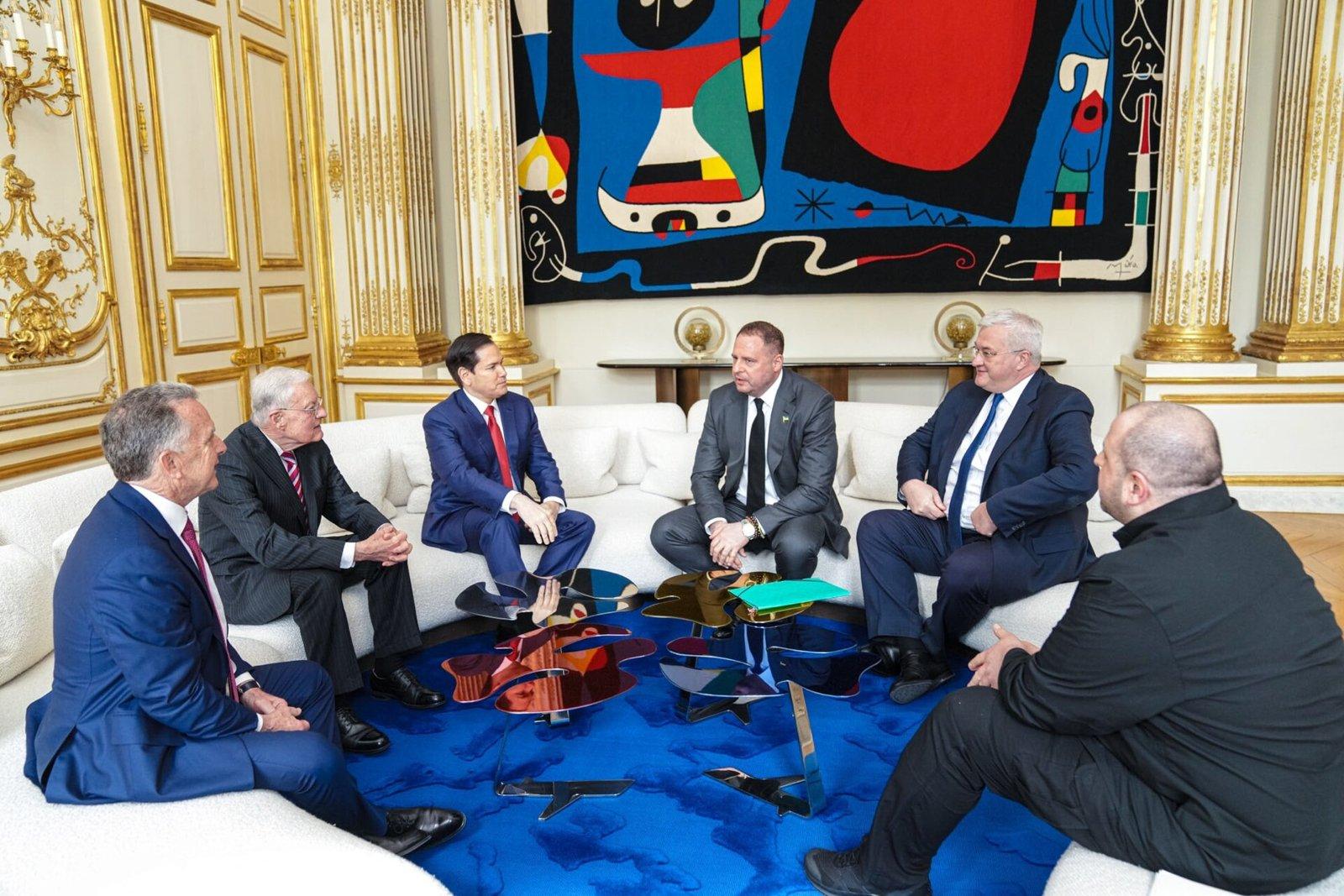
Image: Photo: Freddie Everett / U.S. Department of State, public domain, via Wikimedia Commons (https://commons.wikimedia.org/wiki/File:Secretary_Rubio_Meets_with_Ukrainian_Ministers_(54458422384).jpg) — April 2025 file photo of earlier US-Ukraine talks in Paris; not taken in Abu Dhabi
About this article: prepared by The Daily Context editorial desk using automated, source-based reporting from the publications linked below. No reporter was on the ground.
Sources
- Associated Press (11 Nov 2026): https://apnews.com/article/russia-ukraine-war-talks-kushner-witkoff-7c8d1024302e0c6ad8be064eec852a64
- Euronews (11 Nov 2026): https://www.euronews.com/2026/11/11/abu-dhabi-peace-talks-end-with-prisoner-exchange-agreement-as-us-envoys-prepare-to-meet-pu
- Radio Free Europe/Radio Liberty (11 Nov 2026): https://www.rferl.org/a/ukraine-russia-talks-resume-in-abu-dhabi-amid-drone-attacks/33895197.html
- Interfax-Ukraine (11 Nov 2026): https://en.interfax.com.ua/news/general/1234775.html
- Interfax-Ukraine (11 Nov 2026): https://en.interfax.com.ua/news/general/1234562.html
- Kyiv Independent (11 Nov 2026): https://kyivindependent.com/2nd-day-of-trilateral-peace-talks-begins-between-ukraine-russia-us-in-abu-dhabi/
- The Guardian live coverage (11 Nov 2026): https://www.theguardian.com/world/live/2026/nov/11/europe-ukraine-russia-us-talks-abu-dhabi-zelenskyy-latest-news-updates
- CNN (11 Nov 2026): https://edition.cnn.com/2026/11/11/politics/trump-envoys-russia-trip-peace-talks-intl
- RTÉ (11 Nov 2026): https://www.rte.ie/news/2026/1111/1598831-zelensky-dublin/
- Al Jazeera Arabic (11 Nov 2026): https://www.aljazeera.net/news/2026/11/11/%d8%b9%d8%a7%d8%ac%d9%84-%d8%a5%d9%86%d8%aa%d8%b1%d9%81%d8%a7%d9%83%d8%b3-%d8%b9%d9%86-%d9%85%d8%b5%d8%af%d8%b1-%d8%b1%d9%88%d8%b3%d9%8a-%d8%a7%d8%ae%d8%aa%d8%aa%d8%a7%d9%85
Kabeer Ahmad
Kabeer Ahmad is the founder and editor of The Daily Context. He oversees the site's source-based coverage of world affairs, technology, business, entertainment, lifestyle and sports, and is responsible for its editorial standards, sourcing and corrections.