Congo Ebola outbreak 'not under control' six months on, Africa CDC says
Six months after it was declared on 15 May 2026, the Bundibugyo Ebola outbreak in the Democratic Republic of the Congo has passed 11,000 confirmed cases and about 5,500 deaths, and Africa CDC's director-general says it is still not under control. Early hotspots have calmed, but 400 to 500 new cases a week, attacks on health workers and slow-moving funding are holding the response back.
The Ebola outbreak in the Democratic Republic of the Congo (DRC) is "still serious, and is still not under control" six months after it was declared, the head of the Africa Centres for Disease Control and Prevention (Africa CDC), Jean Kaseya, told Reuters on Sunday, 15 November 2026. Congo's health ministry had recorded 11,376 confirmed infections and 5,568 deaths as of 14 November, according to government figures reported by Bloomberg, a fatality rate of almost 49%.
The outbreak is caused by Bundibugyo virus, a rarer species of Ebola virus for which no vaccine or treatment has yet been proven to work. A joint six-month statement published by Africa CDC on 15 November says the response has brought several early epicentres under control, but that 400 to 500 new cases are still being reported each week and the outbreak has spread to 67 health zones across eight provinces. Congo's own data, as cited by Bloomberg, put the figure at 68 health zones.
For background on how the outbreak developed through its first months, see our earlier report on the outbreak passing 10,000 cases: https://www.thedailycontext.com/article/congo-ebola-bundibugyo-outbreak-10000-cases-november-2026
How big is the outbreak now?
Different official sources publish figures on different days, so totals vary slightly:
- Congo government data, 14 November: 11,376 confirmed cases and 5,568 deaths in 68 health zones (as reported by Bloomberg).
- Africa CDC joint statement, 15 November: "more than 11 000 cases and 5400 deaths", 67 health zones in eight provinces, and around 3,000 recoveries.
- Reuters, citing government data, 15 November: more than 11,200 infections and 5,500 deaths.
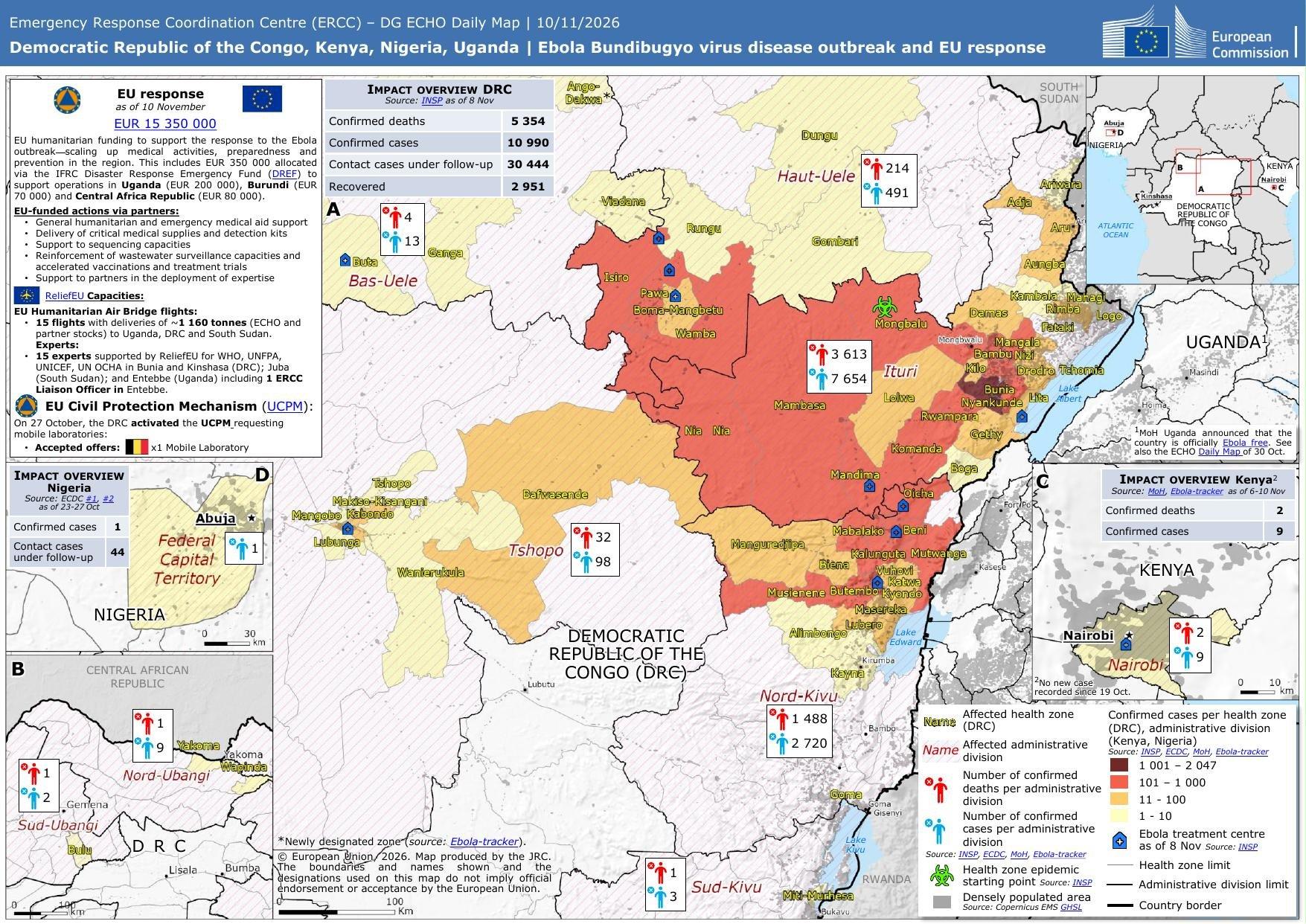
- European Commission ECHO daily map, figures as of 8 November: 10,990 confirmed cases, 5,354 confirmed deaths, 2,951 recoveries and 30,444 contacts under follow-up, with Ituri province accounting for 7,654 confirmed cases and North Kivu 2,720.
Reuters describes it as the second-largest Ebola outbreak on record after the 2014–16 West African epidemic, which infected more than 28,600 people and killed more than 11,000. Kaseya warned: "If we don't stop this outbreak now, it would be the worst Ebola outbreak that the world will have."
Children have been hit hard. The Africa CDC statement says children account for more than a quarter of confirmed cases and a third of deaths, and that seven in ten children under five with confirmed Ebola have died.
Why is Ebola still spreading in Congo?
Officials point to several overlapping problems rather than a single cause.
Cases are being found too late. Kaseya told Reuters that more than 80% of new cases are emerging outside known contact lists and more than 65% of deaths happen in the community rather than in health centres. That matters because Ebola is most contagious in the late stages of illness and after death, when caring for patients at home or preparing bodies for burial can pass on the virus. The joint statement says community deaths account for two-thirds of confirmed deaths and that contact follow-up "remains below target". In North Kivu alone, 153 Ebola patients and suspected cases were being cared for in ordinary health facilities outside designated treatment centres on 14 November, Bloomberg reported from government data.
Violence is blocking access. The joint statement says there have been more than 80 attacks on health care since the outbreak was declared. It cites an armed attack in Cantine-Aloya that killed 66 civilians, including three health workers, after which more than 1,000 contacts were lost to follow-up and three confirmed patients remained unaccounted for; a second attack on the town was reported on 11 November. Julien Harneis, the UN's senior Ebola response coordinator, said that on one recent weekend the Allied Democratic Forces (ADF), an armed group active in eastern Congo, killed more people than the virus did, according to Bloomberg.
Fear and mistrust. The International Rescue Committee told Bloomberg its teams had documented 84 rumours, including a recurring belief that people taken to treatment centres "do not return home alive". With roughly half of confirmed patients dying, William Clemmer of Corus International told Bloomberg that reluctance to enter care is understandable.
Hunger and a stretched health system. UN agencies estimate almost 29 million people in Congo face acute food insecurity, with more than 11 million in Ituri, North Kivu and South Kivu, Bloomberg reported. Asking exposed people to isolate is harder when they need to leave home to earn money or find food. Many clinics also lacked reliable water, electricity and sterilisation before the outbreak began, Clemmer said.
What progress has the response made?
The six-month statement lists real gains. Early epicentres including Mongbwalu, Nyankunde, Nizi, Rwampara and Butembo have been brought under control, and new cases in Bunia have halved, though transmission there remains significant. Diagnostic capacity has grown from two laboratories to more than two dozen, and close to 2,000 treatment beds are available in 104 treatment and transit centres. More than 17,000 community health workers and 46,000 community actors have been trained, and almost 90% of registered deaths now receive a safe and dignified burial, according to the statement.
On vaccines, thousands of people are receiving Merck's Ervebo, which is licensed against the Zaire species of Ebola, while scientists study whether it offers any cross-protection against Bundibugyo. Africa CDC has said emerging evidence suggests it may, and supports its use in high-risk children while evaluation continues, Bloomberg reported. Two Bundibugyo-specific candidate vaccines, one from the University of Oxford with the Serum Institute of India and one from Moderna, are due to enter a late-stage trial in Congo, with results expected in early 2027. In North Kivu more than 3,300 people have been vaccinated, leaving only 247 doses there and prompting a request for 10,000 more, according to the latest government report cited by Bloomberg.
Where has the money gone?
Funding has become a public dispute. Kaseya told Reuters about US$2.9 billion has been pledged and called on donors to release around US$1.6 billion of that and to coordinate more closely with Kinshasa to avoid duplication. "We are not pointing fingers," he said. "We are saying it's a collective failure." He also acknowledged that some health workers had not been paid for months and said the government was working to digitise the payroll.
At a briefing on 15 November, Kaseya said around US$1.2 billion had been disbursed or was being disbursed and that Africa CDC had visibility over about US$820 million, including money already spent and balances still available, according to Congo's state news agency ACP. Médecins Sans Frontières (MSF) said in the past week that help was still not reaching hotspots, citing untrained staff, ambulances without fuel and a shortage of surveillance teams, Reuters reported. The joint statement calls for "fast, flexible funding" to be sustained through 2027.
Has Ebola spread beyond Congo?
Imported cases have been confirmed in Kenya and Nigeria, the joint statement says, and Al Jazeera noted the outbreak now has the widest geographic spread of any Ebola outbreak in Africa. The ECHO map records nine confirmed cases and two deaths in Kenya and one confirmed case in Nigeria, and notes that Uganda's health ministry has declared the country Ebola-free. Bloomberg reported that neighbouring countries have so far avoided sustained spread.
What happens next?
Kaseya said a meeting between Congo's government and its partners would be held in the coming days to align unspent funds with the government's priorities, ACP reported. The joint statement says the next phase must reach communities still beyond the response's effective reach, and calls for a halt in hostilities to protect health workers. Trial results for Bundibugyo-specific vaccines are not expected until early 2027, so for now the response relies on finding cases, tracing contacts, isolating patients and safe burials.
Figures in this article come from official statements and news reports published between 8 and 16 November 2026 and are likely to change as new data is released.
Image: © European Union, 2026 — ERCC/DG ECHO Daily Map of 10 November 2026, produced by the JRC (figures as of 8 November), reused under the European Commission reuse policy (https://commission.europa.eu/legal-notice_en), via Wikimedia Commons (https://commons.wikimedia.org/wiki/File:ECDM_20261110_DRC_Ebola_update.pdf); rendered from PDF and resized
About this article: prepared by The Daily Context editorial desk using automated, source-based reporting from the publications linked below. No reporter was on the ground.
Sources
- Africa CDC: Six months on, accessing hard-to-reach communities key to halting Ebola outbreak (15 November 2026): https://africacdc.org/news-item/six-months-on-accessing-hard-to-reach-communities-key-to-halting-ebola-outbreak/
- Reuters via CNBC Africa: Africa CDC says Ebola outbreak still out of control six months since it was declared (16 November 2026): https://www.cnbcafrica.com/2026/africa-cdc-says-ebola-outbreak-still-out-of-control-six-months-since-it-was-declared
- Bloomberg via Moneyweb: Congo Ebola outbreak defies control as conflict, hunger fuel crisis six months in (16 November 2026): https://www.moneyweb.co.za/news/africa/congo-ebola-outbreak-defies-control-as-conflict-hunger-fuel-crisis-six-months-in/
- ACP: Africa CDC now has a trail of USD 820 million allocated to the Ebola response (15 November 2026): https://acp.cd/anglais/drc-africa-cdc-now-has-a-trail-of-usd-820-million-allocated-to-the-ebola-response/
- Al Jazeera: Africa CDC says Ebola outbreak in DR Congo "still not under control" (15 November 2026): https://www.aljazeera.com/news/2026/11/15/africa-cdc-says-ebola-outbreak-in-dr-congo-still-not-under-control
- European Commission ERCC/DG ECHO Daily Map, 10 November 2026, via Wikimedia Commons: https://commons.wikimedia.org/wiki/File:ECDM_20261110_DRC_Ebola_update.pdf
Kabeer Ahmad
Kabeer Ahmad is the founder and editor of The Daily Context. He oversees the site's source-based coverage of world affairs, technology, business, entertainment, lifestyle and sports, and is responsible for its editorial standards, sourcing and corrections.