China's trade surplus tops $1 trillion again as AI boom lifts exports
China's goods trade surplus passed $1 trillion in the first ten months of 2026, according to customs data released on 10 November, after October exports jumped 35.2% and imports 41.6% in dollar terms. Demand for AI hardware drove much of the growth, sharpening trade tensions ahead of next week's APEC summit in Shenzhen.
China's goods trade surplus has passed $1 trillion for the second year running, and it got there faster than ever. Customs data released on Tuesday 10 November showed a surplus of $1.04 trillion for January to October 2026, after exports in October rose 35.2% from a year earlier to about $412.3 billion and imports climbed 41.6% to about $307.1 billion. The October surplus alone was $105.3 billion, down from $133.5 billion in September because imports grew even faster than exports.
The main driver on both sides of the ledger is the global race to build artificial intelligence infrastructure. China is selling more chips, servers and other high-tech goods abroad, and buying more components and raw materials to make them. The result is a surplus that is likely to beat last year's record and add to friction with the United States and the European Union just before Chinese President Xi Jinping and US President Donald Trump are due to meet at the Asia-Pacific Economic Cooperation (APEC) summit in Shenzhen next week.
What do the October numbers show?
The headline figures, published by China's General Administration of Customs (GAC), were stronger than economists expected. A Reuters poll had forecast export growth of 33.5% and import growth of 32% for October. Export growth was only slightly slower than September's 36.3%, while import growth accelerated sharply from about 31%.
The GAC's breakdown by trade mode shows total trade in October of about $719.4 billion in dollar terms, up 37.9% year on year. Ordinary trade, the largest category, grew about 32% in both directions. Processing trade with imported materials, the type of business in which Chinese factories import parts and export finished goods, rose about 45%, with its imports up nearly 72%. Goods passing through bonded logistics zones grew even faster.
In yuan terms, the growth rates look smaller: October exports were up 28.7% to 2.79 trillion yuan and imports up 34.7% to 2.08 trillion yuan. For January to October, total trade reached 44.81 trillion yuan, up 20%, accelerating from 18.8% growth in the first nine months. Exports over the period rose 17.6% to 25.99 trillion yuan and imports 23.6% to 18.82 trillion yuan. The gap between the dollar and yuan figures reflects exchange-rate movements, and readers comparing reports should check which currency is being used.
Why is AI driving China's trade?
The customs data puts numbers on a trend that has been building all year. According to Reuters, China's semiconductor exports rose 111.1% year on year in the first ten months in dollar terms, and shipments of high-tech products overall jumped 47.9%. China's state broadcaster CGTN, citing the GAC, reported integrated circuit exports of 2.33 trillion yuan over the period, up 101.9%, and integrated circuit imports of 3.88 trillion yuan, up 58%.
That two-way flow explains why imports are rising so quickly. CNBC calculated from official figures that imports of high-tech products rose about 72% in value in October. Tianchen Xu, a senior economist at the Economist Intelligence Unit, told CNBC that "imports were still dominated by AI trade," alongside purchases of copper and other critical minerals. Energy imports also rose by value: CNBC put the increases at roughly 41% for crude oil, 50% for liquefied natural gas and 60% for coal. Reuters reported that crude oil imports reached their highest level since March as buyers adjusted to supply disruptions in the Middle East.
Trade with China's Asian neighbours that sit in the chip supply chain grew especially fast. GAC country data for January to October shows trade with South Korea up 56.6% in yuan terms, with Hong Kong up 48.7% and with Taiwan up 26.4%. Trade with the Association of Southeast Asian Nations (ASEAN), China's largest trading partner group, rose 24.2% to 7.68 trillion yuan, with Vietnam up 33.7%.
Cars are the other big story. CGTN reported that China shipped 9.74 million vehicles abroad in the first ten months, up 49.6%. Reuters noted that domestic vehicle sales fell for a 12th straight month in October, according to separate industry data, which is pushing carmakers to look overseas.
How are the US and the EU affected?
China's surplus with the United States narrowed slightly in October to $32.71 billion, from $34.01 billion in September, Reuters reported. Exports to the US rose 32.9% from a low base a year earlier, when tariffs had sharply cut shipments, and imports from the US rose by about 35%, according to CNBC. Over January to October, trade with the US was 3.59 trillion yuan, up 6.3%, much slower growth than with Asia.
The two governments are in a fragile truce. Beijing and Washington on Monday formally extended by two months a trade truce that had been due to expire on 10 November, according to Reuters and Hong Kong broadcaster RTHK. China said last week that buying more US farm goods would depend on the agreed reciprocal tariff cuts being implemented.
Europe is a sharper pressure point. CNBC reported that China's exports to the EU grew 24.4% in October while imports from the bloc fell by more than 4%, widening China's monthly surplus with the EU to $33.4 billion. GAC data shows China's January to October exports to the EU up 12.4% in yuan terms while imports were nearly flat, up 0.4%. Imports from Germany fell 4.4% over the period.
The EU agreed last month with Beijing to limit imports of Chinese hybrid vehicles over the next few years. The cap, which takes effect on 1 December, is 350,000 cars a year, according to CNBC. Brad Setser, a senior fellow at the Council on Foreign Relations, told CNBC that this is above the roughly 300,000 hybrids China exported to Europe last year but well below the 800,000-a-year pace of the past three months. Reuters noted that factories may bring forward shipments before the curbs apply, which would lift exports in the near term.
What does it mean for China's economy?
Strong exports are filling a gap left by weak household demand. Retail sales grew just 1.1% in September, CNBC reported, and a long property slump has hit household wealth and confidence. Export strength has let policymakers stick with moderate stimulus while aiming for this year's growth target of 4.5% to 5%.
The International Monetary Fund and many of China's trading partners have urged Beijing to rely more on domestic consumption. The latest figures suggest that rebalancing is not happening yet. For context on price pressures inside China's economy, see our report on October inflation and factory-gate prices: https://www.thedailycontext.com/article/china-october-2026-ppi-5-7-percent-cpi-inflation
Markets barely reacted. China's CSI300 index and the Shanghai Composite were each up about 0.1% by the lunch break on Tuesday, according to Reuters.
What are economists watching next?
Most analysts expect exports to stay strong for the rest of 2026. "We expect Chinese exports to stay strong for the rest of this year, led by electronics and autos," Dave Chia, an economist at Moody's Analytics, was quoted by RTHK as saying. Lynn Song, chief economist for Greater China at ING, told CNBC that China "remains well on pace for a new record high for the trade surplus by year-end despite a miss in October", since the monthly surplus came in below forecasts.
The outlook for 2027 is less certain. Citi Research analyst Yuanliu Hu told CNBC that export growth could slow to about 8% next year as favourable comparisons with weak 2025 months fade and global AI investment moderates. Macquarie analysts, quoted by RTHK, said the outlook "depends on how long the AI boom will last," and expect exports to accelerate in the fourth quarter before slowing from early 2027. Nguyen Hoang Nam of Capital Economics estimated a seasonally adjusted 2% fall in exports from September to October, suggesting momentum may already be cooling.
Trade policy is the other risk. "The risk of additional tariffs and other trade barriers will remain elevated in 2027, particularly as Chinese manufacturers continue expanding their presence in overseas markets," Joe Peissel, lead macroeconomist at Trivium China, told Reuters. Nam also said that a smaller drop in rare-earth export volumes in October suggested China "may have begun to relax enforcement of some export controls," possibly under US pressure.
What remains uncertain?
Several points are worth treating with caution. The full-year surplus will depend on November and December data, due in December and January. The truce between Washington and Beijing now runs only to January, and next week's Xi-Trump meeting in Shenzhen could change the picture in either direction. Growth rates also differ depending on whether figures are measured in dollars or yuan, and some high-tech categories are reported differently by different outlets. This article uses the GAC's published tables where available and attributes other figures to the outlets that calculated or reported them.
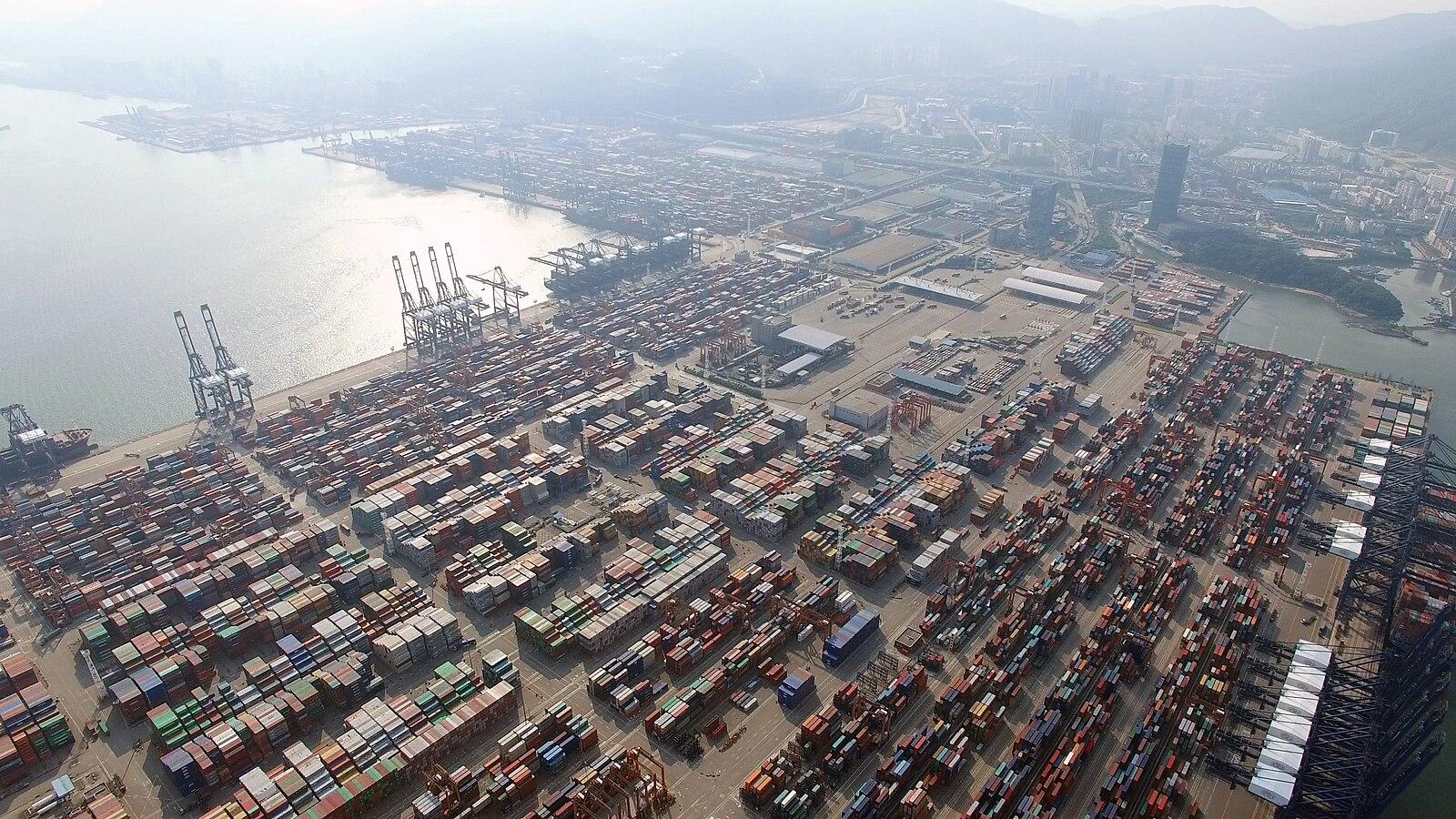
Image: Photo: Gigel.atat, CC BY-SA 4.0 (https://creativecommons.org/licenses/by-sa/4.0/), via Wikimedia Commons (https://commons.wikimedia.org/wiki/File:Yantian-port_from_above.jpg) — September 2015 file photo of Yantian port, Shenzhen; illustrative, not taken in October 2026
About this article: prepared by The Daily Context editorial desk using automated, source-based reporting from the publications linked below. No reporter was on the ground.
Sources
- General Administration of Customs of China: China's Total Export & Import Values by Trade Mode, Oct 2026 (in USD) http://english.customs.gov.cn/Statics/398df605-351d-4d3e-8b55-c7caac29b9b0.html
- General Administration of Customs of China: China's Total Export & Import Values by Country/Region, Oct 2026 (in CNY) http://english.customs.gov.cn/Statics/1bd4db37-f793-46b1-b6fc-87a242dec5a3.html
- General Administration of Customs of China: China's Total Export & Import Values by Trade Mode, January-Oct 2026 (in CNY) http://english.customs.gov.cn/Statics/39cd3a1e-2c50-4dd7-baf0-c41b9480e00d.html
- Reuters: China's trade surplus soars past $1 trillion as AI boom powers exports https://www.reuters.com/3fec1b0a85a0/world/asia-pacific/chinas-trade-surplus-soars-past-1-trillion-october-exports-jump-352-yy-2026-11-10/
- CNBC: China's goods surplus tops $1 trillion for a second year amid calls for Beijing to rebalance trade https://www.cnbc.com/2026/11/10/china-trade-october-exports-imports-surplus-.html
- Associated Press: China's trade surplus surpasses $1 trillion for a 2nd straight year, as exports surge 35% https://apnews.com/article/china-trade-economy-trump-surplus-0fc56d7bd8bbff86ce6672bb67691f22
- RTHK: China says trade surplus surpassed US$1tn in October https://news.rthk.hk/rthk/en/component/k2/1877232-20261110.htm
- CGTN: China's foreign trade surges 20% in first 10 months of 2026 https://news.cgtn.com/news/2026-11-10/China-s-foreign-trade-growth-picks-up-pace-in-first-10-months-1RX4BQgwjSw/p.html
Kabeer Ahmad
Kabeer Ahmad is the founder and editor of The Daily Context. He oversees the site's source-based coverage of world affairs, technology, business, entertainment, lifestyle and sports, and is responsible for its editorial standards, sourcing and corrections.