Paraguay's Ueno Bank collapse: frozen savings, an ousted president and what comes next
The failure of Ueno Bank, a fast-growing digital lender with about 2.9 million customers, froze accounts for roughly half of Paraguay's adults, put hundreds of millions of dollars of pension money at risk and led to the impeachment and detention of President Santiago Peña, who denies wrongdoing. Here is how the crisis unfolded and what depositors can expect.
A week after Paraguay's central bank seized Ueno Bank, the country is dealing with its worst financial and political shock in years. The digital lender, which said it had about 2.9 million customers in a country of roughly 6.1 million people, was placed into resolution after regulators found its capital had fallen below half the legal minimum. Customers were locked out overnight, public pension money was trapped inside the bank, and within four days President Santiago Peña had been impeached, removed and detained. Peña denies any wrongdoing.
By Monday 9 November 2026, the Banco Central del Paraguay (BCP) said 93.1% of the Ueno customers covered by the state deposit guarantee had received money back, about 1.74 million people sharing roughly 2.13 trillion guaraníes (about US$340 million), according to EFE. Larger savers, pension funds and public bodies with deposits above the guarantee ceiling still face an uncertain wait.
What happened to Ueno Bank?
According to the BCP's statement, its board voted unanimously to begin a resolution procedure for Ueno Bank S.A. under Law 2.334/03. The central bank said the bank's solvency ratio had fallen below 50% of the legal minimum after accounting adjustments were applied to its financial statements during a regularisation process. The decision was taken late on Monday 2 November and announced in the early hours of Tuesday 3 November, when the bank's app stopped showing balances.
The regulator appointed administrators to take control of the bank, take inventory of its assets and manage an orderly exit. It described the problem as specific to one institution and said it did not put the rest of Paraguay's banking system at risk.
Behind the solvency gap were loans to companies tied to Ueno's own owners. WIRED en Español reports that the Superintendency of Banks began examining the bank in June 2026 after detecting signs that it had exceeded limits on lending to people and companies linked to its shareholders, particularly firms in Grupo Vázquez, the conglomerate that controlled Ueno. AP reports that regulators found poorly documented lending and expenses that had been wrongly counted as assets. Once the books were corrected, the capital cushion was no longer enough.
NPR reports that Ueno's loans included US$146 million made to just three companies directly linked to Grupo Vázquez. Former finance minister Manuel Ferreira told the Paraguayan newspaper ABC Color, as quoted by NPR, that some promissory notes were signed by the same people on both sides of the transaction.
How did a young digital bank become so big?
Ueno grew from an older finance company, Financiera El Comercio, which dates back to the 1970s. It rebranded and moved to a digital model in 2021 and became a licensed bank in 2023, according to WIRED and NPR. Accounts could be opened by phone, and heavy marketing, cashback offers and merchant promotions brought in customers quickly. Ueno said it had 2.9 million customers, around 60% of Paraguay's adult population, while the central bank counted about 1.8 million depositors. Bloomberg reports the bank held deposits of 17 trillion guaraníes, about US$2.8 billion.
It also became a home for large amounts of public money. Paraguay's Social Security Institute (IPS) had about US$355 million invested in Ueno, around 9% of its investment portfolio, NPR and Bloomberg report. IPS investment director Hugo Díaz told ABC Color on 9 November that the institute's total exposure was about US$516.4 million: roughly US$358.7 million from the pension reserve and contingency funds, plus about US$157 million in operating accounts used for health services, payments and salaries. EFE reports that about US$800 million belonging to public institutions, mostly pension money, was deposited in the bank.
The new central bank governor, Jorge Schreiner, has criticised how those funds were placed. He told the newspaper El Observador that IPS and the Caja Fiscal (the civil service pension fund) had "perverted the order of priority" of safety, liquidity and then return, choosing Ueno because it paid more.
Why did the crisis bring down President Peña?
The bank's ties to political power turned a banking failure into a constitutional crisis. In a 2023 asset declaration made weeks after taking office, Peña listed shares in Ueno Holding worth about US$845,000, according to NPR; those shares were about 1.6% of the company's paid-up capital when he sold them in March 2025. He also appointed Carlos Carvallo, who had led Financiera Ueno, the company from which Ueno Bank grew, as central bank governor in 2023. The central bank has said Carvallo recused himself from all decisions on Ueno, Reuters reported.
The political timeline moved very fast:
- Tuesday 3 November: the BCP announces Ueno's resolution; Carvallo resigns, and arrest warrants are issued for Ueno executives, ABC Color reports. Long queues and protests follow in Asunción, with police using tear gas and water cannon at earlier demonstrations, according to the BBC.
- Wednesday 4 November: former president Horacio Cartes, whose Colorado Party faction had backed Peña in 2023, calls for an investigation and says there should be "no impunity for anyone", NPR reports.
- Thursday 5 November: Peña announces his resignation in a video on X, saying it "was never my intention to betray the trust you placed in me". The Chamber of Deputies opens impeachment proceedings, and Congress does not accept the resignation.
- Friday 6 November: the Senate votes 44-0, with one senator absent, to remove Peña for poor performance of his duties. Vice-President Pedro Alliana is sworn in to serve out the term until August 2028. Peña is detained the same evening, BBC and Reuters report.
- Saturday 7 November: prosecutors charge Peña with breach of trust and administration for personal gain. Judge Humberto Otazú orders pretrial detention at a presidential guard military facility, BBC Mundo reports.
The impeachment charges alleged conflicts of interest, manipulation of regulatory oversight, diversion of pension funds and an institutional cover-up involving the central bank, according to the BBC and Reuters. Prosecutors allege Peña used his influence to keep state deposits at Ueno. Peña has pleaded not guilty, and his lawyer Ricardo Preda called the allegations "reckless", "irresponsible and opportunistic", the BBC reports. None of the charges has been tested in court.
Carvallo has also been charged and detained, as have eight Ueno executives, including chief executive Miguel Vázquez, NPR reports. Peña is the second Paraguayan president removed by impeachment since the end of the Stroessner dictatorship in 1989, after Fernando Lugo in 2012.
What happens to depositors' money?
Paraguay's Deposit Guarantee Fund covers up to 75 monthly minimum wages per person or company at each institution, currently 228.3 million guaraníes, the BCP says. EFE converts that to about US$38,600 at current exchange rates; AFP gives a figure of about US$36,000. Bloomberg has reported, as cited by WIRED en Español, that about 97% of depositors would be fully covered.
Payments have come in stages. The BCP first announced an initial payment of up to 10 million guaraníes, then an advance of up to 40 minimum wages, with any overdue debts to Ueno deducted first. On Monday 9 November it added customers with larger balances, who can receive an advance of up to 121.76 million guaraníes, and some borrowers. It said all advance payments must be made by Wednesday 11 November, the legal deadline. Holders of certificates of deposit (CDAs), customers whose accounts are blocked and those with operations linked to the state development bank AFD are still waiting, according to the central bank statement reported by RDN.
Money above the guarantee ceiling, including most of the pension funds' deposits, depends on what the administrators can recover from Ueno's assets. The BCP has said it will use the legal mechanisms available to cover balances above the ceiling to the greatest extent possible, but it has not promised full repayment. IPS has said pensions will be paid on 17 November, ABC Color reports.
What are investigators doing now?
Prosecutors have carried out a series of raids. On Monday 9 November they searched Peña's home in Asunción for almost five hours, seizing documents, phones, CCTV footage, tablets and computers, AFP reports, a day after searching his holiday home in San Bernardino. They also searched a Ueno branch and seized documents on Peña's investments, which they used to ask Luxembourg to help freeze crypto assets. EFE reports that investigators have seized luxury cars, a yacht and two light aircraft in the wider investigation into Miguel Vázquez and 27 other people. Prosecutors say they are working with authorities in the United States, Argentina and Luxembourg to trace assets abroad.
On the political side, the Senate unanimously confirmed Schreiner, a former central bank board member and former head of the securities regulator, as BCP governor on Monday. Alliana asked his ministers and senior officials to submit their resignations as part of a reshuffle. Opposition attempts to start separate impeachment proceedings against Alliana did not gain enough support, AFP reports.
Why does it matter beyond Paraguay?
AP notes that the collapse threatens Paraguay's growing reputation as a regional haven for investors. The speed of the institutional response has been noted abroad, but the episode raises questions about supervision of fast-growing fintech lenders and about how much public money they should be allowed to hold. Exporter Eduardo López told NPR the scandal would deepen distrust among his US business contacts. Alliana said US Secretary of State Marco Rubio had called him to reaffirm Washington's support, according to AFP.
What should readers watch next?
The next milestones are the 11 November deadline for advance payments, the administrators' assessment of Ueno's assets, any plan for depositors above the ceiling and for IPS reserves, and the court process for Peña, Carvallo and the Ueno executives. Figures for total public exposure vary between sources and are likely to be revised. This article will be updated as official data is released.
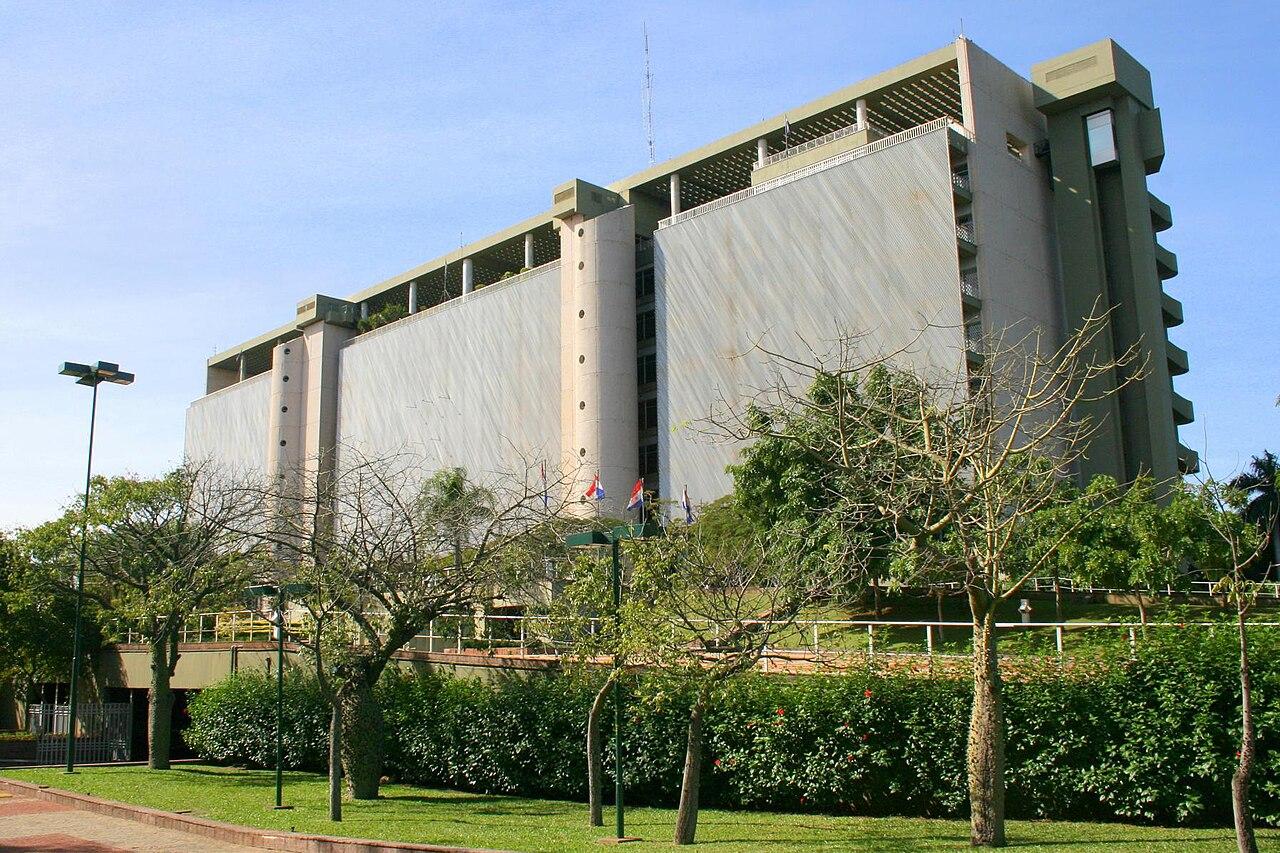
Image: Photo: FF MM (Felipe Méndez), CC BY-SA 3.0, via Wikimedia Commons (https://commons.wikimedia.org/wiki/File:Banco_Central_del_Paraguay_by_Felipe_M%C3%A9ndez.jpg) — 2010 file photo of the Central Bank of Paraguay headquarters, Asunción; not taken during the current crisis
About this article: prepared by The Daily Context editorial desk using automated, source-based reporting from the publications linked below. No reporter was on the ground.
Sources
- AFP: https://www.afp.com/en/crisis-hit-paraguay-asks-help-recover-missing-ueno-funds
- NPR (Charles Parkinson, 9 November 2026): https://www.npr.org/2026/11/09/nx-s1-6034066/paraguay-president-pena-ueno
- BBC News: https://www.bbc.com/news/articles/c68jzzvjgdy9o
- BBC News Mundo (pretrial detention): https://www.bbc.com/mundo/articles/c64g1nd9qvn0o
- BBC News Mundo (impeachment): https://www.bbc.com/mundo/articles/cwkg55edm8r7o
- Reuters via Yahoo News: https://www.yahoo.com/news/world/articles/paraguays-senate-resumes-president-pe-135031291.html
- AP News: https://apnews.com/article/paraguay-ueno-digital-bank-seizure-santiago-pena-9d7521ddee45a185d2618c7e09a243a3
- ABC Color (Banco Central del Paraguay statements): https://www.abc.com.py/economia/2026/11/04/todos-los-comunicados-del-bcp-sobre-ueno-bank/
- ABC Color (IPS exposure): https://www.abc.com.py/nacionales/2026/11/09/la-fortuna-del-ips-en-ueno-bank-revelan-que-hay-mas-de-us-516-millones-atrapados/
- RDN (BCP payment update, 9 November): https://www.rdn.com.py/2026/11/09/bcp-incorpora-nuevos-ahorristas-a-los-pagos-de-ueno/
- EFE via Infobae: https://www.infobae.com/america/agencias/2026/11/10/paraguay-designa-nuevo-titular-del-banco-central-en-medio-de-crisis-por-la-caida-de-ueno/
- Bloomberg Línea: https://www.bloomberglinea.com/latinoamerica/alliana-propone-a-un-exregulador-para-liderar-el-banco-central-de-paraguay-tras-escandalo-de-ueno-bank/
- WIRED en Español: https://es.wired.com/articulos/que-paso-con-ueno-el-banco-digital-cuya-caida-derivo-en-una-crisis-politica-y-dudas-sobre-la-seguridad-de-las-fintech
- El Observador: https://observador.com.py/presidente-del-bcp-ips-y-caja-fiscal-pervirtieron-el-orden-de-prelacion-para-inversiones/
Kabeer Ahmad
Kabeer Ahmad is the founder and editor of The Daily Context. He oversees the site's source-based coverage of world affairs, technology, business, entertainment, lifestyle and sports, and is responsible for its editorial standards, sourcing and corrections.