Merz ties EU budget to Ukraine aid; four states push back
German Chancellor Friedrich Merz has told EU leaders that a collective commitment to fund Ukraine's 2027 shortfall is an 'essential prerequisite' for agreeing the bloc's 2028–2034 budget. Slovakia, Czechia, Hungary and Bulgaria have rejected the linkage, and Slovakia's Robert Fico called it blackmail.
Germany has put the European Union's next long-term budget on the line over Ukraine. In a letter to European Council President António Costa, Chancellor Friedrich Merz wrote that a collective commitment by all 27 member states to help close Ukraine's funding gap is an "essential prerequisite" for agreeing the bloc's 2028–2034 budget and "any further matters, particularly those with financial implications". Four countries, Slovakia, the Czech Republic, Hungary and Bulgaria, rejected the linkage on Tuesday 10 November 2026, and Slovak Prime Minister Robert Fico called it "typical blackmail".
The clash sets up difficult talks at an informal summit of EU leaders in Dublin this Friday and a special budget summit in Brussels on 26–27 November.
What did Merz demand?
The letter, dated 6 November and first reported by the Financial Times, has since been seen by the Guardian, Euronews and Rapporteur. In it Merz argues that support for Ukraine is in the EU's "shared vital interest", but that "bilateral assistance to Ukraine is distributed unevenly and carried mostly by only a few member states". He writes that "a collective commitment … without exception" is needed before Germany will move on other financial questions.
Merz also asks that the next seven-year budget, known as the multiannual financial framework (MFF), include a "sound" multi-year financing perspective for Ukraine from 2028, including interest costs that have already built up on earlier loans, according to Rapporteur. The Guardian reported that Berlin also wants decisions on funding Ukraine to move from unanimity to qualified-majority voting, so a single government could not block them.
A German government official told the Guardian: "Financial support for Ukraine of all EU member states is essential in order to successfully complete the MFF."
Both the MFF and new joint borrowing for Ukraine need unanimous agreement among member states, which is why tying them together raises the stakes. Germany is the EU's largest net contributor to the budget, and it also wants steep cuts in the proposed spending plan.
How big is Ukraine's funding gap?
The EU agreed last year to lend Ukraine €90 billion, intended to cover about two-thirds of its military and civilian needs for 2026 and 2027. Russia's continued bombardment has since added costs, and President Volodymyr Zelenskyy has asked for €70 billion to fill a budget shortfall, the Guardian reported.
The EU has endorsed that figure and pledged to find about €45 billion, roughly two-thirds, through an instrument that has not yet been defined. Ukraine's other allies, including the UK and Canada, are expected to cover the rest. Euronews reported that a new round of EU joint borrowing has emerged as the frontrunner option.
Hungary, Slovakia and the Czech Republic secured exemptions from the existing €90 billion loan, and the other 24 countries share its roughly €3 billion in annual interest costs in proportion to the size of their economies, according to Rapporteur. All three, now joined by Bulgaria, have said they want to stay out of the next round too.
Merz had earlier pushed to use some of the roughly €210 billion of Russian central bank assets frozen in the EU to fund Ukraine, but that plan was blocked by opposition led by Belgium, where most of the assets are held, the Guardian reported. The €90 billion loan was the fallback.
Why are four countries objecting?
Fico, speaking in Bratislava alongside Czech Prime Minister Andrej Babiš, said: "What the chancellor is doing is typical blackmail, and I will not give in to it." Euronews quoted him as threatening his own veto: "Just as Mr Merz talks about using his veto, I can say exactly the same."
Hungary's Prime Minister Péter Magyar, who met Merz in Berlin on Tuesday, took a softer tone but the same position. He said he did not consider the letter blackmail, but that linking the budget with Ukraine aid "does not necessarily have a good message". He said Hungary could not commit to fresh EU-level debt while it is struggling to contain a large public deficit, adding: "We will find a solution for the EU budget. I am sure of it."
Bulgarian Prime Minister Rumen Radev, speaking in Varna, also cited high deficits as the reason Bulgaria wants an exemption from future credit lines, while saying his country would keep supporting Ukraine through other means, such as energy flows, and was "in no way blocking" decisions taken at Council level.
There is also a budget fight underneath the Ukraine dispute. All four countries belong to the "Friends of Cohesion", a group of 17 states that wants to protect regional development and farm funding in the next budget, putting them at odds with "frugal" net contributors that want across-the-board cuts. Rapporteur reported that frugal leaders have been irked at the idea of paying more into cohesion funds while those same countries opt out of the next Ukraine loan.
How has Costa responded?
Costa, who chairs EU summits, replied to Merz in a letter seen by Euronews. He said the budget and Ukraine financing will be discussed together at the special European Council on 26–27 November, once the European Commission has presented options to cover Ukraine's shortfall. He also promised to "make time for a broad discussion on Ukraine" at the informal Dublin meeting this week, leaving room for Merz to raise the issue there.
Costa wants an MFF deal by the end of 2026, the Guardian reported, partly because national elections in France, Poland and Italy in 2027 are likely to make agreement harder.
What does this mean for businesses and taxpayers?
The MFF sets the EU's spending ceilings for seven years and funds programmes ranging from farm payments and regional development to research and infrastructure. A prolonged standoff would not stop current EU spending, which runs under the 2021–2027 framework, but it would delay certainty for governments, regions, farmers and companies that plan around EU funding from 2028.
For Ukraine, the question is timing. The existing €90 billion loan is meant to cover 2026 and 2027, and the additional €45 billion is aimed at the gap identified for that period. A delay in agreeing the new instrument would make it harder for Kyiv to plan its budget, though no source has yet suggested an immediate cash crunch. How any new joint debt is structured, and who pays the interest, will also affect national budgets across the EU.
What happens next?
EU leaders meet informally in Dublin on Friday 13 November, where Costa has said Ukraine will be discussed. The Commission is expected to set out options for the €45 billion before the special summit on 26–27 November, which is formally dedicated to the budget and Ukraine financing. Any final deal on either issue still needs every member state's approval, so the four objecting governments retain leverage, and so does Germany.
It is not yet clear whether a compromise will take the form of formal opt-outs, alternative contributions such as energy support, or changes to cohesion funding. The Daily Context will update this article as positions change.
For background on the peace talks running in parallel, see our coverage of the Abu Dhabi trilateral talks: https://www.thedailycontext.com/article/abu-dhabi-trilateral-ukraine-talks-november-2026
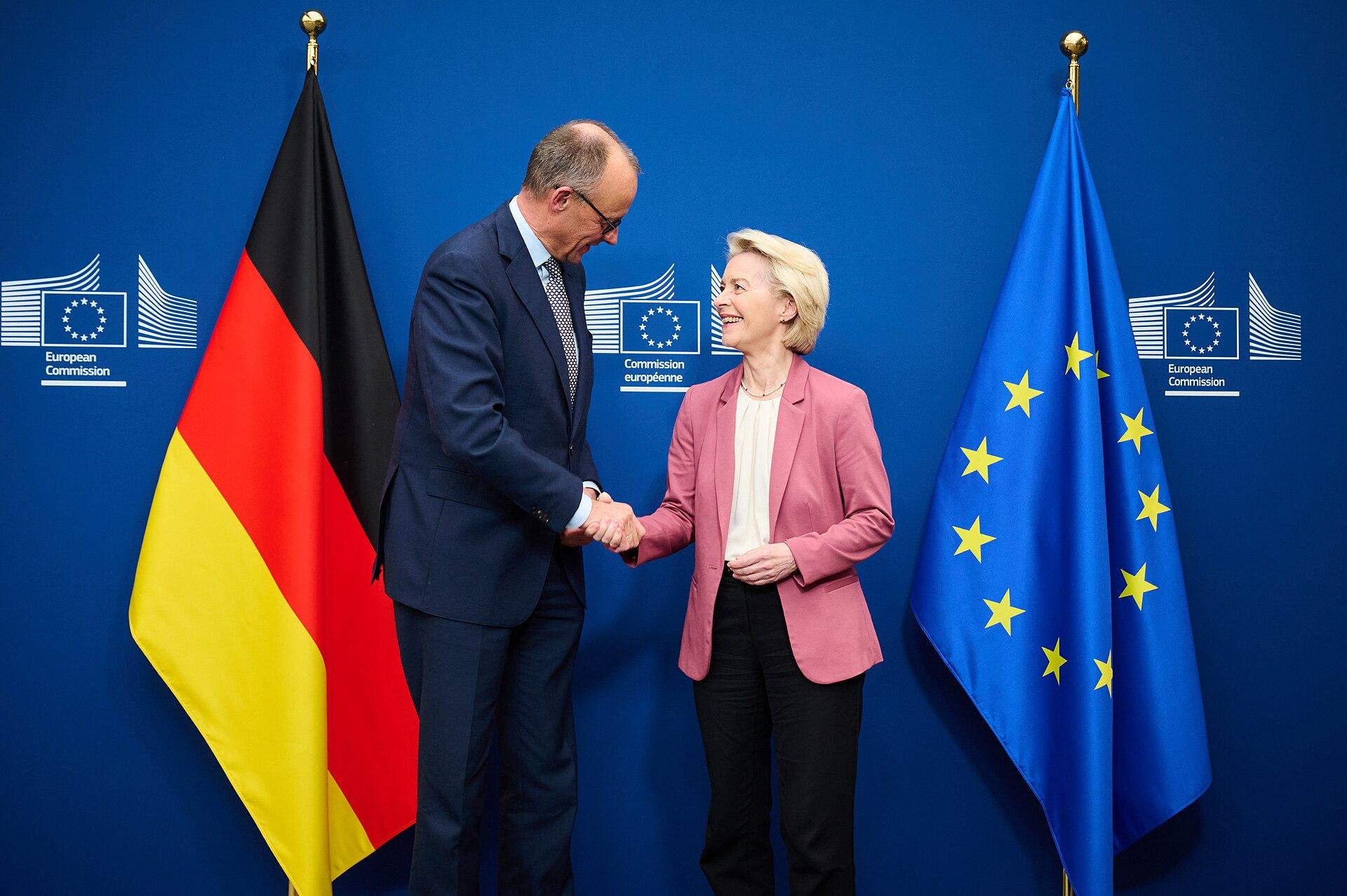
Image: Photo: Dati Bendo / European Union, 2025 / EC Audiovisual Service, CC BY 4.0 (https://creativecommons.org/licenses/by/4.0/), via Wikimedia Commons (https://commons.wikimedia.org/wiki/File:Visit_of_Friedrich_Merz,_Federal_Chancellor_of_Germany,_to_the_European_Commission_-_2025_%281%29.jpg) — 5 December 2025 file photo of Merz and Ursula von der Leyen in Brussels; not taken during the current dispute
About this article: prepared by The Daily Context editorial desk using automated, source-based reporting from the publications linked below. No reporter was on the ground.
Sources
- The Guardian: Merz accused of 'blackmail' by Slovak PM after demand for Ukraine aid in EU budget https://www.theguardian.com/world/2026/nov/10/friedrich-merz-accused-blackmail-ukraine-aid-eu-budget
- Euronews: EU budget battle erupts as four countries defy Merz over Ukraine aid https://www.euronews.com/2026/11/10/eu-budget-battle-erupts-as-four-countries-defy-merz-over-ukraine-aid
- Euronews: Costa seeks to reassure Merz after EU budget ultimatum https://www.euronews.com/2026/11/10/costa-seeks-to-reassure-merz-after-eu-budget-ultimatum
- Rapporteur: Merz ties EU budget deal to new Ukraine loans https://www.rapporteur.com/news/merz-ties-eu-budget-deal-to-new-ukraine-loans/
- Rapporteur: Merz says no MFF without Ukraine https://www.rapporteur.com/news/rapporteur-am-merz-says-no-mff-without-ukraine/
Kabeer Ahmad
Kabeer Ahmad is the founder and editor of The Daily Context. He oversees the site's source-based coverage of world affairs, technology, business, entertainment, lifestyle and sports, and is responsible for its editorial standards, sourcing and corrections.