UN talks on AI 'killer robots' end without treaty mandate as Russia blocks binding rules; work extended to 2028
A week of UN talks in Geneva on lethal autonomous weapons ended on Saturday with a watered-down agreement to keep working on an 'international instrument' until 2028, rather than a mandate to negotiate a legally binding treaty. Campaigners blamed Russia and other military powers.
International talks on controlling AI-powered "killer robots" ended in Geneva on Saturday 21 November without agreement to negotiate a legally binding treaty. Instead, the 128 countries party to the UN's Convention on Certain Conventional Weapons (CCW) settled on a weaker plan to spend the next two years working on an "international instrument" whose legal status remains undecided.
The outcome fell well short of what most governments, the UN secretary-general and campaigners had sought. Diplomats and advocacy groups said Russia blocked a stronger deal, while several other military powers, including the United States, also resisted binding rules.
The conference wrapped up just before 5am local time on Saturday after all-night negotiations, according to The Guardian. Campaign coalition Stop Killer Robots called the result a "watered-down mandate".
What did countries agree in Geneva?
The 128 states "agreed to launch the elaboration of an international instrument on lethal autonomous weapons systems, which should be conducted over the next two years", the conference's Swiss chair, Julien Thöni, told reporters, according to DW and Politico.
The final decision, seen by Politico, proposes to "elaborate" such an instrument in the context of international humanitarian law. A group of governmental experts is to report its conclusions to a meeting of the convention's member states in 2028. The Guardian reported that the mandate asks countries "to elaborate by consensus", wording that leaves open whether the result will carry any legal obligations.
Lethal autonomous weapons systems are generally understood as weapons that can select and attack targets without a human making the final decision to fire. Thöni hailed the result as evidence that multilateral diplomacy could still deliver "concrete results" in "today's deeply divided world".
Izumi Nakamitsu, the UN's high representative for disarmament affairs, called it a "significant achievement" but acknowledged a "glass half full or half empty" situation, the Associated Press reported. UN Secretary-General António Guterres, who leaves office at the end of the year, had set 2026 as the deadline for launching negotiations on a binding agreement.
Why did talks on a binding treaty fail?
The CCW works by consensus, so a single country can block any decision. That rule has meant the forum has not agreed any new weapons law for decades, The Guardian noted, prompting campaigners in the past to pursue treaties elsewhere, such as the 2008 Convention on Cluster Munitions.
According to Politico, Russia used the consensus rule to block formal negotiations all week and refused to let observers, including the European Union, take part, forcing much of the bargaining into informal sessions. Diplomats told The Guardian that Russia had been deliberately filibustering and not negotiating in good faith.
Russia was not alone. Two EU diplomats told Politico that the US, the UK, South Korea, Japan, Turkey and Israel were also resisting a binding regulation. "You can blame Russia, but they are not the only ones. Some people are hiding behind Russia," a Brazilian diplomat said. The Guardian reported that South Korea, Japan, Turkey, the UK, France and Germany were among the countries developing AI-enabled weapons that preferred a non-binding agreement, and that some argued existing international humanitarian law was sufficient.
In search of a compromise, France proposed a "hybrid document" with both binding and non-binding elements, while Germany backed an "international instrument" rather than a legally binding protocol, Politico reported. In the final hours, countries pushing for regulation, among them Ireland, Brazil, Belgium and Austria, softened their positions for fear of "leaving the conference empty-handed", the Brazilian diplomat said.
One European diplomat told The Guardian: "There was no political will to really regulate these weapons. No will commensurate to the urgency and need."
There was also friction over who could take part. The exclusion of several non-member countries prompted a rare protest on the final day, with Egypt's delegation shouting at the conference chair, The Guardian reported.
Who wanted a treaty, and how did they react?
Before the conference, seven countries, Austria, Belgium, Brazil, Ireland, Mexico, New Zealand and Panama, proposed launching negotiations on a binding treaty to be completed within a year. Stop Killer Robots, a coalition of more than 300 organisations, said over 95 states had expressed support for a treaty. Guterres, Pope Leo XIV and the International Committee of the Red Cross had also backed new binding rules, DW reported.
"Technology is moving faster than diplomacy," said Brazil's ambassador, Frederico Meyer. "Diplomats are very slow."
"In the final hours, a small number of states weakened the mandate introducing uncertainty about the legal status of the final document," Stop Killer Robots said. Its executive director, Nicole van Rooijen, said autonomous weapons technology, "including AI in the targeting cycle, is being deployed on the battlefield — delaying the creation of a legally binding instrument puts civilians and humanity at risk."
Verity Coyle, deputy director for arms at Human Rights Watch, called the outcome "disappointing", adding: "It does not provide the urgent action needed to agree new rules, but the technology is racing ahead." Her colleague Bonnie Docherty, who worked on the treaties banning cluster munitions and nuclear weapons, noted that treaties can be negotiated within 15 months, The Guardian reported.
Beatrice Fihn, founder of the advocacy group Lex International, said the decision amounted to "pushing the can down the road for two more years". Max Tegmark of the Massachusetts Institute of Technology, who founded the Future of Life Institute, said: "States have agreed it is sufficient to just talk about the issue, for the 14th year, while these weapons enable atrocities."
Are autonomous weapons already being used?
Governments say humans remain in control. Politico reported that Ukraine, Russia, Israel and others are using drones and robots in warfare while insisting that people retain ultimate control over decisions to fire. Stop Killer Robots says autonomous systems have already been tested or deployed, including in Ukraine and Gaza.
The AP reported that activists say armed drones able to strike targets independently have been deployed in some select instances in conflict zones, but that widespread rollout has not yet happened. The Guardian noted reports that the US military is seeking to scale up AI-assisted targeting decisions.
What happens next?
The two-year process will now run towards the 2028 meeting of CCW member states. But with no reference to a legally binding instrument in the decision, "it remains possible — likely, even — that there will be no treaty by the end of 2028," Rain Liivoja, a director at the Asia-Pacific Institute for Law and Security, told Politico.
Supporters of a treaty could still try to negotiate one outside the CCW, as happened with the bans on landmines and cluster munitions, though no such move was announced in Geneva. For now, the rules governing weapons that can choose their own targets remain those of existing international humanitarian law, while the technology continues to develop on battlefields from Ukraine to the Middle East.
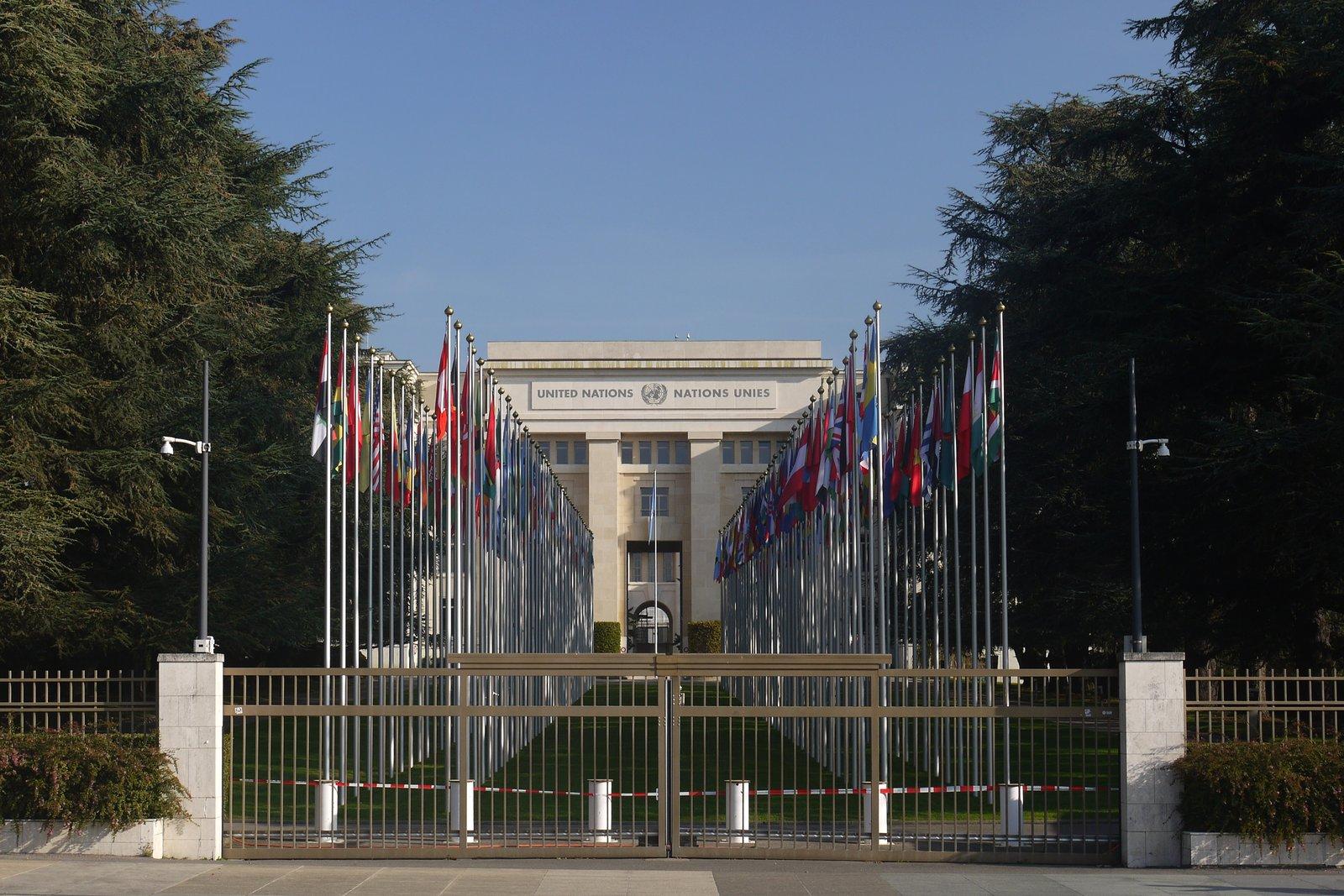
Image: File photo (October 2021) of the Alley of Flags leading to the Palais des Nations, the United Nations office in Geneva; not taken during the November 2026 conference. Photo by Tinux, CC0 (public domain dedication), via Wikimedia Commons (https://commons.wikimedia.org/wiki/File:Alley_of_flags_UNO_Geneva.jpg); cropped and resized
About this article: prepared by The Daily Context editorial desk using automated, source-based reporting from the publications linked below. No reporter was on the ground.
Sources
- The Guardian (21 Nov 2026): https://www.theguardian.com/technology/2026/nov/21/international-talks-control-ai-autonomous-weapons-collapse
- Politico Europe (21 Nov 2026): https://www.politico.eu/article/effort-regulate-killer-robots-delayed-until-2028-ai-un/
- DW (21 Nov 2026): https://www.dw.com/en/killer-robots-talks-at-un-end-with-no-legally-binding-ban/a-80008584
- Associated Press via Arab News (21 Nov 2026): https://www.arabnews.com/world/states-agree-to-un-talks-aiming-to-regulate-killer-robots-by-2028-3013276
- Associated Press (21 Nov 2026): https://apnews.com/article/un-drones-robots-un-lethal-ai-weapons-ebe057d2a47cde53100970c8f648e7fa
- Kyodo News (22 Nov 2026): https://english.kyodonews.net/articles/-/92229
Kabeer Ahmad
Kabeer Ahmad is the founder and editor of The Daily Context. He oversees the site's source-based coverage of world affairs, technology, business, entertainment, lifestyle and sports, and is responsible for its editorial standards, sourcing and corrections.