BepiColombo enters orbit around Mercury after an eight-year journey
The European-Japanese BepiColombo spacecraft was captured into orbit around Mercury on Saturday 21 November 2026, more than eight years after launch. It is only the second mission ever to orbit the innermost planet, and its two orbiters are due to separate in December before science work begins in April 2027.
BepiColombo, a joint mission of the European Space Agency (ESA) and the Japan Aerospace Exploration Agency (JAXA), has entered orbit around Mercury. The spacecraft was captured by the planet's gravity on Saturday 21 November 2026, more than eight years after it left Earth, making it only the second mission ever to orbit the smallest and innermost planet in the Solar System.
ESA's operations team confirmed the result on social media after the spacecraft came back into contact with ground stations. "Flight Dynamics already has confirmed it achieved orbital capture around Mercury," ESA Operations posted, adding that teams at its European Space Operations Centre (ESOC) in Darmstadt, Germany, were still assessing the telemetry and would share the next update early this week.
The arrival is not the end of the manoeuvres. BepiColombo is really two science spacecraft travelling as one, and they still have to separate and reach their own orbits before research can begin in April 2027.
What happened on Saturday?
The orbit insertion burn was scheduled to begin at 18:24 GMT (11:24pm Pakistan time) on 21 November and to last 37 minutes, Space.com reported. According to an ESA animation of the manoeuvre, four thrusters on ESA's Mercury Planetary Orbiter (MPO) fired to slow the spacecraft as it approached Mercury's south pole on the planet's night side, so that it would be captured rather than fly past.
ESA said the initial orbit would be an elongated ellipse of about 590 by 11,640 kilometres. The Associated Press, which put the cost of the mission at about US$2 billion (€1.7 billion), reported that ESA announced the arrival via social media. Nature noted that BepiColombo is only the second mission to orbit Mercury, after NASA's MESSENGER, which orbited the planet from 2011 to 2015.
Why is Mercury so hard to reach?
It sounds backwards, but getting into orbit around Mercury takes more energy than travelling to the outer Solar System. A spacecraft falling towards the Sun speeds up, and it must shed a great deal of that speed to be caught by Mercury's relatively weak gravity. "Energetically, it takes more energy to go to Mercury than to go to the outer Solar System," Emma Bunce, a plasma physicist at the University of Leicester and one of the mission's leading scientists, told Nature.
BepiColombo launched on an Ariane 5 rocket from French Guiana in October 2018. Instead of flying straight in, it used one flyby of Earth, two of Venus and six of Mercury to slow down gradually, Space.com reported. The trip was originally planned to take about seven years, but it was extended by a year after a problem with the solar panels of the Mercury Transfer Module reduced the power available for its electric thrusters.
That transfer module, which provided propulsion for most of the cruise, was released on 3 September 2026. ESA said at the time that its ground stations in Cebreros, Spain, and Malargüe, Argentina, had confirmed the separation and that all systems were nominal. Since then the MPO has steered the combined spacecraft itself, including a trajectory correction on 24 September that changed its speed by 11.4 metres per second.
What are the two orbiters, and what will they study?
The MPO, built by ESA, will map Mercury's surface and study its interior and composition. JAXA's Mercury Magnetospheric Orbiter, known as Mio, will study the planet's magnetic field and how it interacts with the solar wind, the stream of charged particles flowing from the Sun. Flying two spacecraft at the same time lets scientists compare measurements from different places, which matters for a planet whose magnetic environment changes quickly.
ESA has described the mission's goals as covering "all aspects of Mercury, from the structure and dynamics of its magnetosphere and how it interacts with the solar wind, to its internal structure with its large iron core, and the origin of the planet's magnetic field", as quoted by Space.com.
Some of the instruments have already been tested in flight. In mid-September, all of MPO's instruments were switched on together for the first time since the transfer module separated, and ESA said first analyses showed them to be in good health. The BELA laser altimeter fired more than 700,000 pulses during a 21.5-hour test, and the SIMBIO-SYS science camera took its first image in space. Nature reported that the MIXS X-ray instrument, the first X-ray imaging device sent on an interplanetary mission according to Bunce, was pointed at the Crab Nebula during the cruise.
Why does Mercury matter to scientists?
Mercury is a puzzle. It is small but unusually dense, with a very large iron core, and it has a global magnetic field even though it is a small rocky planet. MESSENGER found evidence of water ice in permanently shadowed craters near the poles and surprising amounts of volatile elements on the surface. Understanding how such a planet formed so close to the Sun is relevant beyond our own Solar System, because many planets found around other stars orbit very close to their own suns.
ESA has said the data should help scientists understand "the origin and evolution of a planet located close to its parent star", according to Space.com.
The mission is also a milestone for international cooperation. BepiColombo is ESA's first mission to Mercury and Japan's first to the planet, and it is the first time two spacecraft will orbit Mercury at once.
What happens next?
According to ESA's published timeline, MPO and Mio are due to separate on 9 to 10 December 2026, and the separation of Mio's sunshield and interface structure is scheduled for 16 December. Mio will then settle into a highly elliptical polar orbit; Nature reported altitudes of roughly 500 to 11,000 kilometres. The MPO will carry out a series of further engine burns to lower itself into its final, less elongated polar orbit, which Space.com reported is due to be reached on 10 March 2027, at altitudes Nature put at about 400 to 1,500 kilometres.
Science operations for both orbiters are set to begin in April 2027, with Space.com giving a start date of 6 April. Space.com reported that the whole arrival phase, which began with the transfer module's release in September, is expected to take about six months.
There are still risks. Separating the spacecraft and completing the MPO's lowering burns are complex steps carried out far from Earth, where radio signals take several minutes each way, and ESA had not yet published a full telemetry assessment of Saturday's burn when this article was prepared.
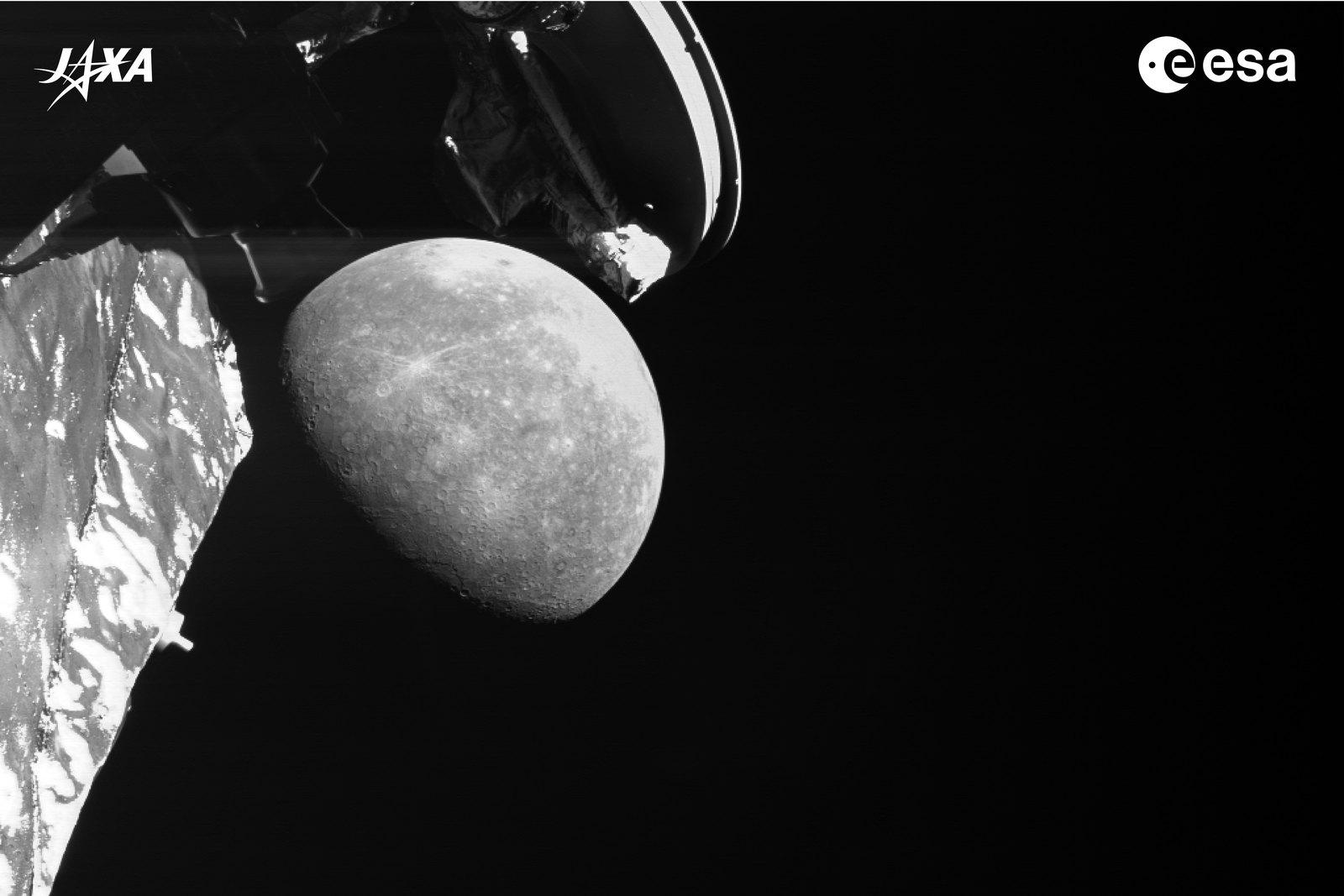
Image: File image: Mercury photographed by BepiColombo's monitoring camera 3 during a flyby on 19 June 2023, with parts of the spacecraft in the foreground; not taken during orbit insertion. Image: ESA/BepiColombo/MTM, CC BY-SA 3.0 IGO, via Wikimedia Commons (https://commons.wikimedia.org/wiki/File:BepiColombo_hugs_Mercury_ESA24939504.png); cropped and resized
About this article: prepared by The Daily Context editorial desk using automated, source-based reporting from the publications linked below. No reporter was on the ground.
Sources
- ESA Operations on Bluesky: confirmation of orbital capture (21 November 2026) https://bsky.app/profile/operations.esa.int/post/3n2uftyw2f22t
- ESA: BepiColombo entering orbit around Mercury (animation and description, 19 November 2026) https://www.esa.int/media/about-us/directorates/science/bepicolombo-entering-orbit-around-mercury
- ESA: Latest updates: BepiColombo's arrival at Mercury https://www.esa.int/articles/about-us/directorates/science/bepicolombo/latest-updates-bepicolombo-s-arrival-at-mercury
- Space.com: European-Japanese BepiColombo arrives in orbit around Mercury today (21 November 2026) https://www.space.com/space-exploration/missions/esa-jaxa-bepicolomobo-mission-mercury-orbit-arrival
- Nature: BepiColombo finally reaches Mercury after eight-year odyssey (21 November 2026) https://www.nature.com/articles/d41586-026-03803-8
- Associated Press: BepiColombo spacecraft enter orbit around Mercury after eight-year cruise (21 November 2026) https://apnews.com/article/mercury-bepicolombo-space-planet-esa-0c80bbf2039ed4f6ee4a34426b3594a0
Kabeer Ahmad
Kabeer Ahmad is the founder and editor of The Daily Context. He oversees the site's source-based coverage of world affairs, technology, business, entertainment, lifestyle and sports, and is responsible for its editorial standards, sourcing and corrections.