Voyager 1 becomes the first spacecraft to reach one light-day from Earth
NASA's Voyager 1 reached one light-day from Earth, about 16.1 billion miles (25.9 billion km), at 5:16 a.m. US Eastern time on 18 November 2026. No other human-made object has gone so far. Radio signals now take 24 hours each way, so engineers will not hear back from the spacecraft from that point until 19 November. Voyager 1 now has only two science instruments running.
NASA's Voyager 1 is now one light-day from Earth. No human-made object has gone this far before. A light-day is how far light travels in 24 hours: 16,094,799,096 miles, or 25,902,068,356 kilometres. NASA calculated that the spacecraft would cross that mark at 5:16:07 a.m. US Eastern time on Wednesday, 18 November 2026. That was 10:16 GMT, or 3:16 p.m. in Pakistan.
Voyager 1 launched on 5 September 1977. It took 49 years, two months and 11 days to get this far. It is now so distant that a radio command from Earth, travelling at the speed of light, takes a full day to reach it, and its reply takes another day to come back. The Voyager team will not receive the spacecraft's first signal sent from beyond one light-day until the same time on Thursday, 19 November, NASA said.
What exactly is a light-day?
It is a measure of distance, not time. Light covers about 186,000 miles (299,000 km) a second. Over 24 hours, that adds up to just over 16 billion miles. NASA offers some comparisons: sunlight takes about eight minutes and 20 seconds to reach Earth, and light from Neptune takes just over four hours. Voyager 1 is now nearly six times as far from us as Neptune is.
Nothing physically changes at the boundary. The milestone is symbolic. But it gives a sense of scale that is hard to get from a 16-billion-mile figure. "I think it's very exciting because it's a tangible distance that people can relate to," Jamie Rankin, Voyager's deputy project scientist, said on NASA's Curious Universe podcast.
Even at about 38,000 mph (61,000 km/h), Voyager 1 is slow compared with light. If it keeps going in a straight line, it will be about one light-year from Earth in roughly 18,000 years, planetary scientist Carolyn Porco has calculated, as quoted by CBS News. It is heading in the general direction of Gliese 445, a dim star in the constellation Ursa Minor, and will pass within about 1.7 light-years of it in about 40,000 years, according to NASA.
Is Voyager 1 still working?
Yes, but only just. The spacecraft runs on a radioisotope generator powered by decaying plutonium-238, which produces a little less electricity every year. CBS News reported that Voyager 1 started with about 470 watts and now has a little more than 210 watts.
To stretch that supply, the team has switched off instrument after instrument. NASA's status table shows that only the magnetometer and the plasma wave subsystem remain on. The cosmic ray subsystem was turned off on 25 February 2025 and the low-energy charged particle instrument on 17 April 2026, both to save power. The cameras were shut down in February 1990, shortly after Voyager 1 took the "Pale Blue Dot" image of Earth as a single pixel in a sunbeam.
The two remaining instruments still send back measurements of the magnetic field and the thin, electrically charged gas, or plasma, between the stars. Rankin said that even out there Voyager can detect "ripples" from big solar eruptions that have travelled all the way from the Sun.
The signal is very faint. Voyager 1 talks to Earth through a 3.7-metre (12-foot) dish. NASA's Deep Space Network uses antennas 70 metres (230 feet) across to pick up a signal that, by the time it arrives, is a tiny fraction of a trillionth of a watt, CBS News reported. "If you want to say 'hello' to Voyager, you send your message and then you go home and you wait two days before you finally get a response," Voyager project manager Suzanne Dodd said in a NASA posting quoted by CBS.
Who keeps a 49-year-old spacecraft alive?
A very small team. CBS News reported that the Voyager team has 13 members. Only three work on it full-time at NASA's Jet Propulsion Laboratory (JPL) in California, and two are retirees who worked on the project at launch and came back to help.
"I feel like this mission is one of the great things that people have ever done, that humans have ever done," Voyager Interstellar Mission Manager Kareem Badaruddin told CBS. He said the team felt the weight of responsibility: making a mistake that harmed the spacecraft would be "crushing".
Rankin described how the team has had to make trade-offs. Turning off heaters bought more time for some instruments to keep working, even though their readings then needed corrections. She said the team was confident it is "not close" to running out of power or having critical parts freeze, while noting that a single unexpected event could end the mission at any time.
Why does Voyager matter?
Voyager 1 and its twin, Voyager 2, launched about two weeks apart in 1977. They are the only spacecraft that have worked outside the heliosphere, the bubble of particles and magnetic fields created by the Sun. Voyager 1 crossed that boundary in August 2012 and Voyager 2 in 2018.
Before that, the pair transformed planetary science. NASA credits them with the first live volcanic eruptions seen on another world, on Jupiter's moon Io. They showed that Jupiter's Great Red Spot is a giant high-pressure storm and that Saturn's rings are far more complex than earlier theories suggested. Voyager 2 remains the only spacecraft to have visited Uranus and Neptune.
Rankin said that one of the surprises beyond the heliopause was the magnetic field. Scientists had expected its direction to switch abruptly to match interstellar space. Instead, the field outside meets the solar system at an angle that squeezes the Sun's bubble into an asymmetric shape. Voyager 1's plasma wave data also showed that the gas beyond the boundary grows denser with distance.
Both spacecraft carry the Golden Record, a phonograph disc with greetings in 55 languages, sounds and images of Earth, and music from many cultures. It was intended as a message to anyone who might one day find the probes.
What happens next?
NASA invited people around the world to "Shine Bright for Voyager's Light-Day" by flashing lights at the night sky on 17 November. JPL is hosting a moderated discussion on the mission at 12 p.m. US Eastern time on Thursday, 19 November (10 p.m. in Pakistan), around the time the first signal from beyond the milestone is due to reach Earth.
Voyager 2 is on track to reach one light-day from Earth in November 2035. It still has three instruments running and a slightly stronger power supply, CBS News reported. Both probes mark 50 years in space in 2027. Nobody knows exactly how long they will keep talking. When the power finally runs out, they will keep drifting through the galaxy, and are expected to last for a billion years or more.
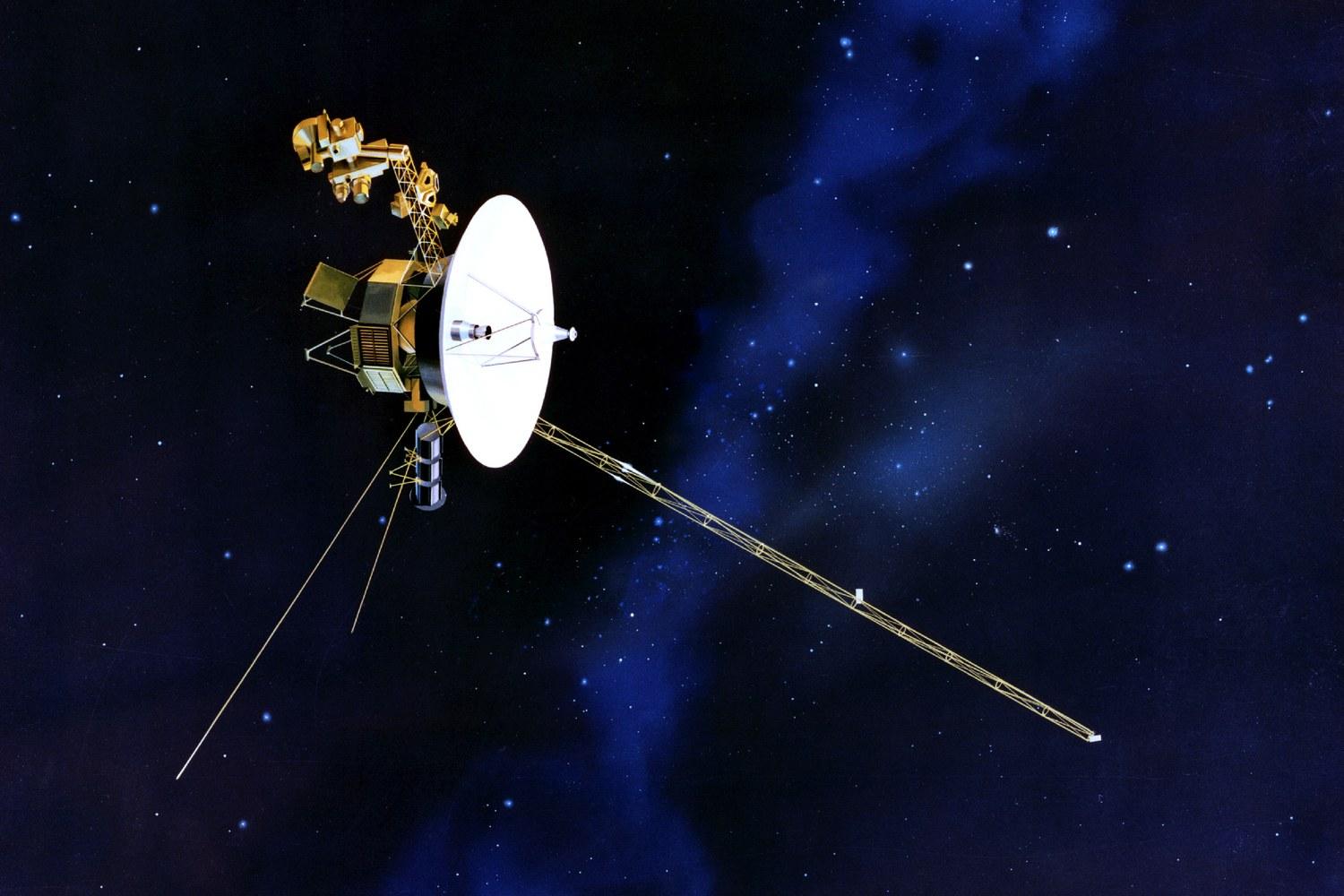
Image: Illustration: NASA/JPL, public domain, via Wikimedia Commons (https://commons.wikimedia.org/wiki/File:Voyager_spacecraft.jpg) — NASA artist's concept of a Voyager spacecraft in flight, not a photograph; cropped and resized
About this article: prepared by The Daily Context editorial desk using automated, source-based reporting from the publications linked below. No reporter was on the ground.
Sources
- NASA Science, "What Is a Light-Day?" (Nov 2026): https://science.nasa.gov/mission/voyager/voyager-1/voyager-1-what-is-a-light-day/
- NASA Science, "Where Are Voyager 1 and 2 Now?" mission status and instrument table: https://science.nasa.gov/mission/voyager/where-are-voyager-1-and-voyager-2-now/
- NASA Science, Voyager One Light-Day Downloads (16 Nov 2026): https://science.nasa.gov/resource/voyager-one-light-day-downloads/
- NASA Jet Propulsion Laboratory media advisory (updated 13 Nov 2026): https://www.jpl.nasa.gov/news/nasa-invites-media-public-to-join-voyager-1-one-light-day-activities/
- NASA Scientific Visualization Studio, interview opportunity (10 Nov 2026): https://svs.gsfc.nasa.gov/15111
- NASA's Curious Universe podcast, "What Voyager Teaches Us From One Light-Day Away" (17 Nov 2026): https://www.nasa.gov/podcasts/curious-universe/voyager-one-light-day/
- CBS News, William Harwood (18 Nov 2026): https://www.cbsnews.com/news/voyager-1-probe-light-day-earth-father-than-anything/
- EarthSky (17 Nov 2026): https://earthsky.org/space/voyager-1-1-light-day-from-earth-november-17-18-2026/
Kabeer Ahmad
Kabeer Ahmad is the founder and editor of The Daily Context. He oversees the site's source-based coverage of world affairs, technology, business, entertainment, lifestyle and sports, and is responsible for its editorial standards, sourcing and corrections.