SS United States sunk off Florida to become world's largest artificial reef
The SS United States, the 990-foot liner that still holds the transatlantic speed record set in 1952, was deliberately sunk in the Gulf of Mexico about 22 nautical miles off Destin, Florida, on Wednesday 11 November. Okaloosa County says it is now the world's largest artificial reef and plans to open it to divers once a survey confirms where it rests.
The SS United States, the fastest ocean liner ever to cross the Atlantic, was deliberately sunk in the Gulf of Mexico on Wednesday 11 November 2026, about 22 nautical miles southwest of Destin-Fort Walton Beach in the Florida Panhandle. Okaloosa County, which bought the ship in 2024, says the 990-foot (302-metre) vessel is now the world's largest artificial reef, overtaking the aircraft carrier USS Oriskany, sunk off Pensacola in 2006.
Crews flooded the ship over several hours rather than using explosives, and the last of the liner slipped beneath the surface at around 9 p.m. Central Time (10 p.m. Eastern), according to local public radio station WUWF, Fox Weather and Axios. That was about 8 a.m. on Thursday in Pakistan and 3 a.m. on Thursday in London. The county had planned the sinking for Thursday but brought it forward a day because of a forecast of strong winds.
How was the SS United States sunk?
No explosives were used. Okaloosa County spokesperson Nick Tomecek told Baird Maritime that federal environmental and explosives rules ruled them out. Instead, contractors spent more than a year preparing the ship in Mobile, Alabama: they removed hazardous materials, cleaned all 128 fuel tanks, took out more than 400 portholes and many interior doors, and cut openings through the decks and hull so that water could get in and air could escape, according to Baird Maritime and Delaware Online.
On the day, crews began the deployment in the early afternoon local time. Fox Weather reported that a fireboat pumped seawater in through a hose, and that officials later opened two valves so the sea could flow in through the ship's original intake pipes. Baird Maritime said the liner was described as fully flooded by late afternoon but had not yet settled. Accounts of how long the final stage took differ, from about four hours to more than five, and WUWF said the whole process ran about eight hours longer than expected. NPR reported that the ship's final moments came quickly, with the hull tilting onto its side as it dipped below the waves.
Tomecek told Fox Weather that the operation needed sustained winds below 17 mph and waves under 3 feet, because the wind could push a vessel of this size off its permitted site. The US Coast Guard kept other boats at least one nautical mile away during the sinking.
Why is the SS United States so famous?
The liner was designed by the American naval architect William Francis Gibbs and built in Newport News, Virginia, where it was launched on 23 June 1951. On its maiden voyage in July 1952 it crossed the Atlantic in about 3 days and 10 hours, winning the Blue Riband, the informal title for the fastest regular passenger crossing. That record for an ocean liner has never been beaten.
The ship was also a Cold War project. The SS United States Conservancy, the nonprofit that owned it from 2011 until 2024, says the US government helped fund it so that it could be converted into a troop carrier able to move about 14,000 service members 10,000 miles without refuelling. Over 17 years in service it carried more than a million passengers, according to the conservancy, including four US presidents, film stars and, on one trip, the Mona Lisa.
The rise of jet travel ended its career. The ship was withdrawn from service in 1969, passed through a series of owners and had its interiors auctioned off and stripped. From 1996 it sat at a pier on the Delaware River in Philadelphia, where plans to turn it into a hotel, casino or restaurant all failed because of cost, Axios reported.
How did a Florida county end up owning it?
In 2024 the ship was evicted from its Philadelphia pier after a rent dispute. Because no other home for it could be found, the conservancy sold it to Okaloosa County for $1 million. Susan Gibbs, the conservancy's head and granddaughter of the ship's designer, told NPR she felt "a complex mix of sorrow but gratitude and pride and hope", and said the group saw reefing as "by far the more dignified solution" than a scrapyard. The ship was towed out of Philadelphia in February 2025.
Its famous red, white and blue funnels, the radar mast and one of its five-bladed propellers were removed before the sinking and are due to go into a land-based museum in the area, according to Axios and conservancy board member Warren Jones, speaking to Fox Weather.
What did it cost, and will it pay off?
Figures vary depending on what is counted. Axios reported that sinking the liner cost at least $13.6 million, plus about $130,000 for security and watch boats on the day. Okaloosa County tourism director Jennifer Adams told NPR the county's investment was about $10 million and that she expects it to be recovered in "a couple of years".
The county already has hundreds of artificial reefs, many of them ships and boats. Adams told NPR they bring in roughly $10 million to $12 million a year in economic benefits, and WUWF reported a separate estimate that the new site could bring in about $3 million a year from visitors. Those are local official projections rather than independent findings. A University of Florida economist, Andrew Ropicki, told NPR that clusters of wrecks help a region capture diving tourism, but warned that building too many could eventually bring diminishing returns. Adams said five or six more reefs are already planned.
When can divers visit the wreck?
The county planned for the liner to settle upright on the seabed at a depth of about 180 feet (55 metres), with its upper decks roughly 55 to 60 feet below the surface. That would put the top of the ship within reach of less experienced recreational divers, while the deeper sections would suit technical divers with specialist training. Compartments judged unsafe were sealed off before the sinking.
Its exact resting position and orientation were still to be confirmed. Tomecek told the Pensacola News Journal that survey teams linked to Destin-Fort Walton Beach and the Woods Hole Oceanographic Institution would dive first to document where the ship lies and pass the coordinates to the US Army Corps of Engineers. The county had said recreational divers could visit from dawn on Thursday 12 November if the deployment went to plan, but advised divers to check for official updates before making plans. Long-term monitoring of the reef is being developed with Woods Hole, the Dauphin Island Sea Lab and Louisiana State University, Baird Maritime reported.
What happens next?
Officials expect fish, turtles and other marine life to begin colonising the hull within days. Parts of the northern Gulf lack natural reefs, and Tomecek told Fox Weather the structure should support a wide variety of species while drawing divers and anglers. The Okaloosa site is about 29 miles from the Oriskany, giving the Florida Panhandle the world's two largest artificial reefs. The survey results, the opening of the land museum and the first dive-season visitor numbers will show whether the ship's last voyage delivers what the county has promised.
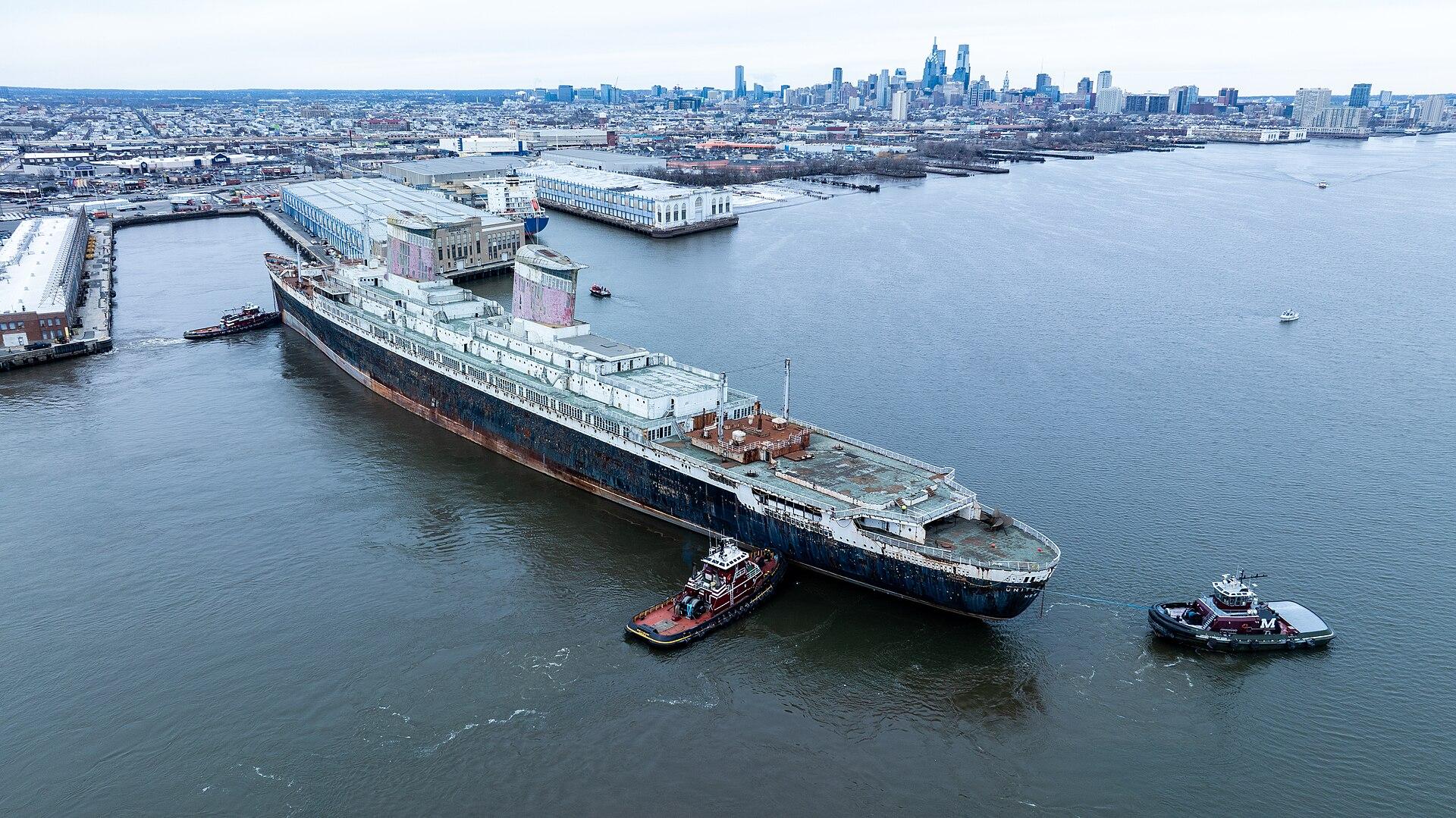
Image: Photo: WSRower, CC0 1.0 public domain dedication (https://creativecommons.org/publicdomain/zero/1.0/), via Wikimedia Commons (https://commons.wikimedia.org/wiki/File:SS_United_States_guided_out_of_pier_80_by_tugs.jpg) — the ship leaving Philadelphia on 19 February 2025, resized; file photo, not taken during the sinking
About this article: prepared by The Daily Context editorial desk using automated, source-based reporting from the publications linked below. No reporter was on the ground.
Sources
- AP: The historic SS United States is sunk after a long goodbye off Florida's coast (11 November 2026): https://apnews.com/article/ss-united-states-ocean-liner-artificial-reef-88773c4030b0e2e12f3d63f5426ad285
- NPR: World's fastest ocean liner is sunk to break another record (11 November 2026): https://www.npr.org/2026/11/11/nx-s1-6030853/ss-united-states-artificial-reef-sinking
- WUWF: SS United States sank off the coast of Destin (11 November 2026): https://www.wuwf.org/local-news/2026-11-11/watch-ss-united-states-deploys-off-the-coast-of-destin
- Fox Weather: Historic SS United States sinks to its new fate as the world's largest artificial reef (11 November 2026): https://www.foxweather.com/lifestyle/historic-ss-united-states-transatlantic-speed-record-sunk-create-world-largest-reef-florida
- Axios Philadelphia: SS United States, long docked in Philly, goes under the waves (12 November 2026): https://www.axios.com/local/philadelphia/2026/11/12/ss-united-states-sunk-florida-okaloosa-county
- Baird Maritime: Contractors begin sinking former liner United States off Florida: https://www.bairdmaritime.com/passenger/ss-united-states-sinking-florida
- Pensacola News Journal: When can divers explore the SS United States after it sinks? (12 November 2026): https://www.pnj.com/story/news/local/escambia-county/2026/11/12/when-can-divers-explore-the-ss-united-states-after-it-sinks/92714731007/
- Delaware Online: SS United States took 4 hours to sink (12 November 2026): https://www.delawareonline.com/story/news/local/2026/11/12/ss-united-states-officially-sank-recap/92731334007/
- Okaloosa County deployment announcement: https://myokaloosa.com/sites/default/files/Users/piouser/SSUSDEPLOYMENT-NOV12.pdf
- Wikipedia: SS United States (background on design and history): https://en.wikipedia.org/wiki/SS_United_States
Kabeer Ahmad
Kabeer Ahmad is the founder and editor of The Daily Context. He oversees the site's source-based coverage of world affairs, technology, business, entertainment, lifestyle and sports, and is responsible for its editorial standards, sourcing and corrections.