Spain election 2026: what to know before Sunday's vote as Sánchez closes the gap on Feijóo
Spaniards vote on Sunday 29 November in a snap general election called by Pedro Sánchez after his housing decrees were voted down. Final polls put Alberto Núñez Feijóo's People's Party narrowly ahead, with the PP and Vox together projected to pass the 176 seats needed for a majority.
Spain holds a snap general election on Sunday 29 November, and the final published polls point to a closer race at the top than many expected when it was called, but not necessarily a closer contest for power. Alberto Núñez Feijóo's conservative People's Party (PP) was narrowly ahead of Prime Minister Pedro Sánchez's Socialists (PSOE) when polling publication stopped, and almost every survey projected the PP and the far-right Vox together winning more than the 176 seats needed for a majority in the 350-seat Congress of Deputies.
The campaign ends at midnight on Friday. Saturday is a legally mandated "day of reflection" with no campaigning, and Spanish law has barred the publication of new polls since the start of the week, so the last numbers voters saw date from Monday 23 November.
Why is Spain voting now?
Sánchez announced the election in a televised address on 5 October, after the PP, Vox and the Catalan pro-independence party Junts voted down two emergency housing decrees in Congress. The measures included a ban on evictions until 2030 and new rules on temporary and room-by-room lettings. The next election had not been due until 2027.
The housing vote came after weeks of protest over rents. Anger spread after the eviction in Madrid of Maricarmen Abascal, an 87-year-old woman who had lived in her flat for about 70 years and said she could not pay the 230% rent increase demanded by the investment fund that bought it. Authorities counted 70,000 people at a Madrid march on 3 October; organisers claimed 500,000, the Guardian reported.
Sánchez, in office since 2018, has led a minority coalition with the left-wing Sumar alliance that has been unable to pass a budget since 2023. He framed the vote as a choice between his government and a "far-right wave". Feijóo welcomed the election, saying it was about "Spain beating Sánchez".
What do the final polls show?
El País's weighted polling average, updated on 24 November, put the PP on 31.5%, about 2.5 points ahead of the PSOE on 29%, with Vox around 18%. The paper said the gap had narrowed from about six points when the election was called and estimated the Socialists had at least a 25% chance of finishing first.
The more important figure may be the split between the blocs. In the same average, the right (PP, Vox and the smaller Se Acabó La Fiesta) stood at 51.2% against 38.7% for the left (PSOE, the Frente Amplio coalitions, Podemos and Adelante Andalucía). At the 2023 election the two camps were close to level, 45.6% to 44%.
Seat projections published on 23 November, the last legal day, told a similar story, according to Reuters:
- 40dB for El País: PP 127–136 seats (31.8%), PSOE 116–127 (30.9%), Vox 51–61 (17.3%).
- Ipsos for La Vanguardia: PP 127 seats (30.3%), PSOE 119 (29.8%), Vox 63.
- GAD3 for ABC: PP 131, PSOE 110, Vox 63.
- NC Report for La Razón: PP 130–133, PSOE 108–111, Vox 64–66.
The state pollster CIS was the clear exception, putting the Socialists on 34.4% against 24.9% for the PP. El País cautioned that the CIS has overestimated the left since 2018. All of the figures are now almost a week old, and polls are approximations rather than forecasts.
What happened in the final debate?
The four main candidates, Sánchez, Feijóo, Vox leader Santiago Abascal and Ada Colau of the left-wing Frente Amplio, met for the only four-way debate of the campaign on Thursday night. The debate was organised by Spain's Television Academy and moderated by its president, María Casado. It ran for two hours across five blocks: housing, tax and the economy, social policy and public services, corruption and democratic standards, and migration and foreign policy.
Spain's public broadcaster RTVE said Sánchez and Colau joined forces against Feijóo and Abascal, who largely avoided attacking each other. Sánchez asked the right-wing leaders whether they would accept Sunday's result, accusing them of casting doubt on the electoral roll and the overseas vote. Feijóo replied that he would accept the result and would leave politics if he lost, and challenged Sánchez to say whether he would step down.
The most discussed moment was Feijóo telling Colau to keep quiet using the Spanish word "calladita". Colau called it sexist. Afterwards Feijóo said he would withdraw the remark "if I have bothered anyone" but complained of "theatrics", according to laSexta's coverage. Abascal called on voters to "reconquer Spain", demanded the "recovery" of Ceuta and said Spain should not co-host the football World Cup with Morocco.
The debate followed a head-to-head between Sánchez and Feijóo on 19 November. In a 40dB snap poll for El País and Cadena SER, 43% of respondents named Feijóo the winner, ten points more than named Sánchez.
Which issues have shaped the campaign?
Housing was meant to be the centre of the Socialist campaign, but other events have competed for attention. On 28 October a high-speed train ran into the back of another near Toledo, killing 69 people. It was Spain's second deadly rail disaster of the year, after 46 people died in a crash near Córdoba in January. Transport Minister Óscar Puente pointed to human error after the signalling system failed and has refused opposition calls to resign, the BBC reported.
Migration is the other dominant theme. About 70,000 people crossed from Morocco into the Spanish exclave of Ceuta within 48 hours this summer, and the right has made the government's response a central attack line. Vox has campaigned on what it calls "remigration".
Corruption cases close to the prime minister have also featured. In July his brother, David Sánchez, was barred from public office for nine years after being found guilty of administrative misconduct over his hiring by a council in Extremadura. His wife, Begoña Gómez, has been charged with offences including embezzlement and influence peddling and is due to stand trial. Both deny wrongdoing, and the prime minister has described the cases as a campaign of harassment against his family.
What happens after the vote?
Results will come in on Sunday night. A prime minister needs an absolute majority of 176 votes in the investiture vote in Congress, or a simple majority of more votes for than against in a second vote.
If the polls are right, the main question is whether Feijóo can reach a deal with Vox, which already governs alongside the PP in four regions. A PP-only government would almost certainly need Vox's votes or abstention. For Sánchez, the path depends on the Socialists outperforming their polls, the left recovering ground lost since Sumar's 12.3% in 2023, and the regional parties that backed his 2023 investiture staying on side.
The El País average put the combined Frente Amplio coalitions at about 6.8%, with Podemos at 1.1% where it runs separately. That is well below Sumar's 2023 result and a key reason the left trails overall even as the PSOE has gained.
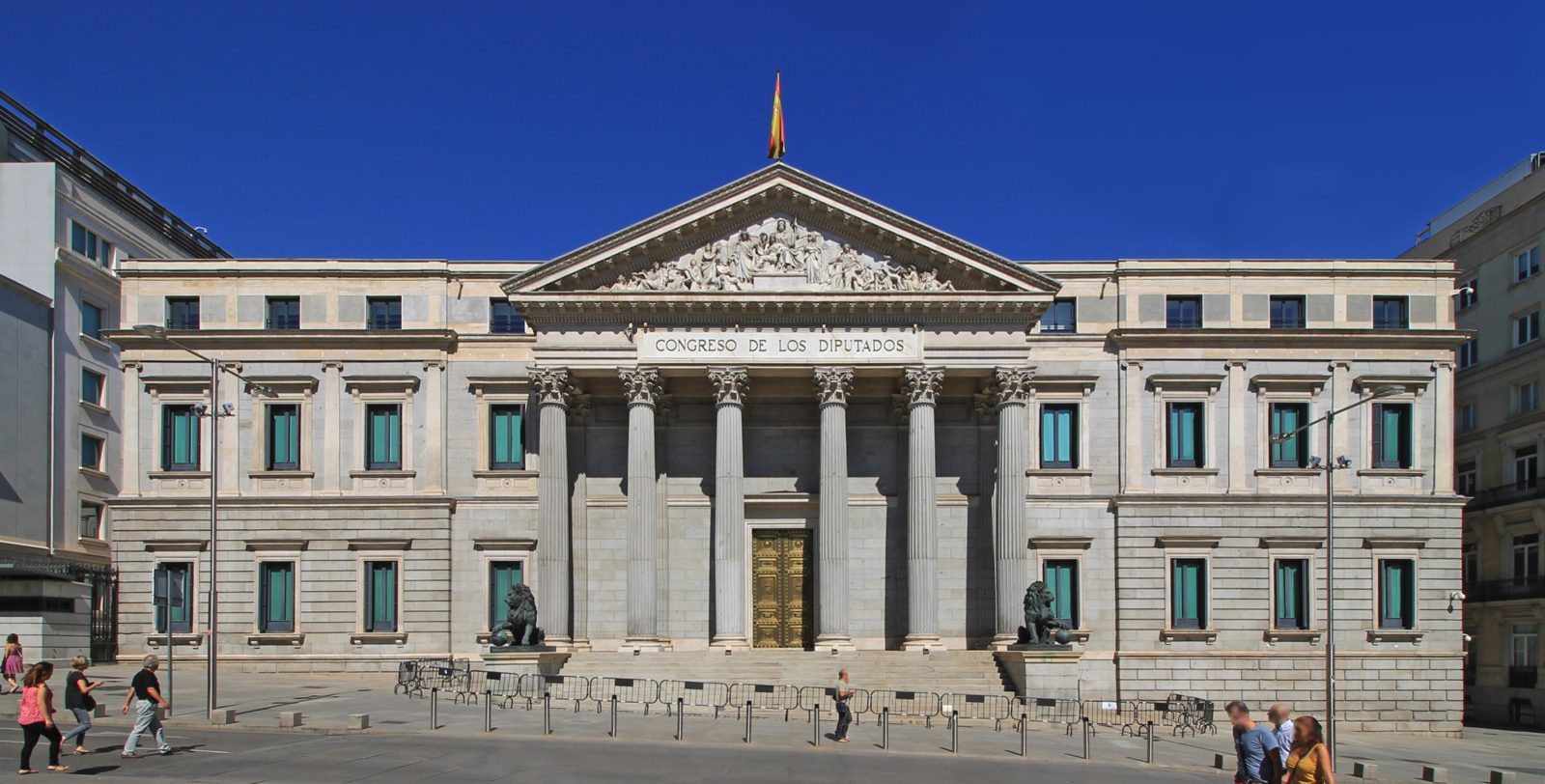
Image: File photo: Congress of Deputies, Madrid, 29 September 2018. Photo: Luis García (Zaqarbal), CC BY-SA 4.0 (https://creativecommons.org/licenses/by-sa/4.0/), via Wikimedia Commons (https://commons.wikimedia.org/wiki/File:Congreso_de_los_Diputados_(Espa%C3%B1a)_17.jpg); resized
About this article: prepared by The Daily Context editorial desk using automated, source-based reporting from the publications linked below. No reporter was on the ground.
Sources
- EL PAÍS English: What do the latest polls show ahead of Spain's general election? (24 November 2026): https://english.elpais.com/spain/2026-11-24/what-do-the-latest-polls-show-ahead-of-spains-general-election.html
- Reuters: Spain's right set to win majority despite Socialist gains, polls show (23 November 2026): https://www.reuters.com/3fec1b0a85a0/world/spains-right-set-win-majority-despite-socialist-gains-polls-show-2026-11-23/
- RTVE: Resumen del debate a cuatro entre Sánchez, Feijóo, Abascal y Colau (26–27 November 2026): https://www.rtve.es/noticias/20261126/debate-cuatro-directo-elecciones-2026-resumen/17329999.shtml
- laSexta: Así ha sido el debate a cuatro (27 November 2026): https://www.lasexta.com/elecciones/generales/debate-electoral-cuatro-sanchez-feijoo-abascal-colau-directo-todo-preparado-debate-decisivo-penultimo-dia-campana-antes-elecciones-29n_202611266b07cf49ff6fec29219b7d13.html
- EL PAÍS: La distancia entre el PP y el PSOE se estrecha al mínimo pese a la victoria de Feijóo en el debate (20 November 2026): https://elpais.com/espana/elecciones-generales/2026-11-20/la-distancia-entre-el-pp-y-el-psoe-se-estrecha-al-minimo-pese-a-la-victoria-de-feijoo-en-el-debate.html
- The Guardian: Spain's PM Pedro Sánchez calls snap election after housing law fails to pass (5 October 2026): https://www.theguardian.com/world/2026/oct/05/spain-prime-minister-pedro-sanchez-snap-election-housing-crisis
- Al Jazeera: Spain's deadly train crash redraws electoral battle lines (30 October 2026): https://www.aljazeera.com/news/2026/10/30/spains-train-crash-redraws-the-electoral-battle-ahead-of-the-elections
- BBC News: Spain train disaster clouds Sánchez chances of re-election (31 October 2026): https://www.bbc.com/news/articles/cmeweppr990qo
Kabeer Ahmad
Kabeer Ahmad is the founder and editor of The Daily Context. He oversees the site's source-based coverage of world affairs, technology, business, entertainment, lifestyle and sports, and is responsible for its editorial standards, sourcing and corrections.