Iran fires drones at Bahrain twice in three days, ending Gulf lull
Iran's Revolutionary Guards say they launched six drones at a US air-defence radar at Bahrain's Riffa air base on Sunday, 15 November 2026, two days after a smaller attack. Bahrain says its air defences destroyed the drones, and the US says Friday's two drones caused no damage. They were the first Iranian attacks on a Gulf state since September.
Iran's Islamic Revolutionary Guard Corps (IRGC) says it launched six drones at a US air-defence radar at the Riffa air base in Bahrain early on Sunday, 15 November 2026. Bahrain's military says its air defences destroyed them before they reached their targets. It was Iran's second attempt to strike the Gulf kingdom in three days, and the strikes end a lull that had lasted since September.
The attacks bring the Middle East war back to the Gulf Arab states at a time when US–Iran diplomacy has stalled. Shipping through the Strait of Hormuz is still heavily restricted, and Washington has sent a third aircraft carrier to the region.
What happened in Bahrain on Sunday?
Bahraini authorities sent an emergency alert before 5 a.m. local time (7 a.m. in Pakistan) telling residents to move to a "safe location," The National reported. Sirens sounded across the country, and the interior ministry urged citizens to go to their nearest shelter point, according to the BBC. It was the first such warning since September.
In a statement shared by Iran's state broadcaster on Telegram, the IRGC said: "The U.S. air defense radar system at the Al-Riffa helicopter base in Bahrain was targeted by six drones belonging to the IRGC Aerospace Force." It claimed the strike had a "precise and successful impact" and warned that "the Strait of Hormuz is closed, and any aggression by the American enemy will be met with an even harsher and more forceful response."
The Bahrain Defence Force gave a different account. It said it had "intercepted and destroyed" the incoming Iranian munitions, and that "Iran continues its systematic hostile approach through its criminal attacks," ABC News reported. No casualties or damage have been reported, and the IRGC has not published evidence to support its claim.
What happened on Friday?
On Friday, 13 November, the IRGC said it had "targeted and destroyed" a US early-warning radar in Bahrain. It said this was retaliation for a strike on a telecommunications tower in Sirik, a town on Iran's Hormozgan coast near the Strait of Hormuz, according to statements carried by Iranian media and reported by Iran International and RFE/RL. Iranian state media did not say who had attacked Sirik.
US Central Command (CENTCOM) rejected the claim. "The IRGC launched two one-way attack drones toward Bahrain and both were shot down by U.S. forces. There were no injuries or damage," it said on X.
The BBC said Friday's launch was Iran's first attack on any Gulf country since September. During the opening months of the war, Bahrain was targeted by hundreds of Iranian drones and missiles, according to The Washington Post. The kingdom hosts the headquarters of the US Navy's Fifth Fleet.
Why is Iran attacking Bahrain now?
Iran says it is answering US military action. US forces have carried out a series of strikes on Iranian targets in recent weeks, including on Qeshm Island in the Strait of Hormuz. US officials described these to CBS as limited and defensive, made in response to the IRGC firing on a US aircraft, the BBC reported.
At a press conference in Tehran, foreign ministry spokesman Esmaeil Baghaei said Iran would keep responding to any military aggression and was "not waiting for anyone," The Guardian reported. Gulf News reported that Baghaei also accused regional states of helping US operations, including by letting aircraft, missiles and drones launch from their bases. Iran has said that countries assisting US-Israeli strikes will be treated as legitimate targets.
On Monday, Kazem Gharibabadi, Iran's deputy foreign minister for legal and international affairs, said Tehran "will not wait for the US to attack first" and suggested Washington might be using diplomacy to buy time, according to Al Jazeera.
The diplomatic track has weakened. A preliminary US–Iran agreement in June opened a 60-day window for talks, but no deal followed, and the US reinstated a naval blockade of Iranian ports, according to the BBC and The National. Last week President Donald Trump said the United States was no longer interested in a deal and told Vice-President JD Vance, who had been involved in efforts to restart negotiations, to focus on domestic politics.
How have Bahrain and its neighbours responded?
Bahrain's foreign ministry said it "condemns in the strongest terms the continued brutal Iranian attacks on its territory and holds Iran fully responsible for their consequences." It rejected "the transformation of its territory into an arena for settling scores," The Guardian reported.
Gulf Cooperation Council secretary-general Jasem Al Budaiwi called the attack a "blatant challenge" to regional peace efforts. The UAE's foreign ministry called it a "flagrant violation" of Bahrain's sovereignty. Qatar, one of the main mediators between Washington and Tehran, warned it was a "dangerous escalation" that could "undermine political and diplomatic efforts," according to The National. Jordan, Egypt and Saudi Arabia also condemned the attacks, The Guardian reported.
The US Embassy in Bahrain has issued a security alert warning American citizens of the risk of attacks from Iran and Yemen's Houthis, Al Jazeera reported. Residents described their unease. "It's exactly what I was hoping wouldn't happen: Iranian attacks starting again, with all the worry and uncertainty that go with them," Hayat Ibrahim, 65, told AFP.
What does it mean for the Strait of Hormuz and markets?
On Sunday the IRGC navy also claimed that two tankers had struck sea mines near the Strait of Hormuz after switching off their tracking systems, and that one, carrying 2 million barrels of oil, had sunk. There was no independent verification, and the US military recently said it had cleared mines from the main shipping routes, The Guardian and The National reported.
Most Gulf stock markets closed lower on Sunday. Saudi Arabia's benchmark index fell 0.7% and Qatar's dropped 1.8%, according to The National.
A US official told ABC News that the USS Theodore Roosevelt carrier strike group entered US Central Command's area of operations on Sunday. It joins the USS George H.W. Bush and USS George Washington, and the three are among more than 20 US Navy ships enforcing the blockade of Iranian ports.
What happens next?
Iranian Foreign Minister Abbas Araghchi is due in Muscat on Tuesday, 17 November, for talks with his Omani counterpart, Iranian state media reported. Iran's parliament speaker, Mohammad Bagher Ghalibaf, said on Sunday that a path to ending the conflict remains open if the United States accepts Iran's "logical conditions." He also warned that Tehran would not stay in a state of "neither war nor peace," according to The National, citing Fars.
The war began with US and Israeli strikes on Iran on 28 February. Whether this weekend's attacks are a one-off reply or the start of a wider resumption of strikes on Gulf states is likely to depend on whether US strikes inside Iran continue.
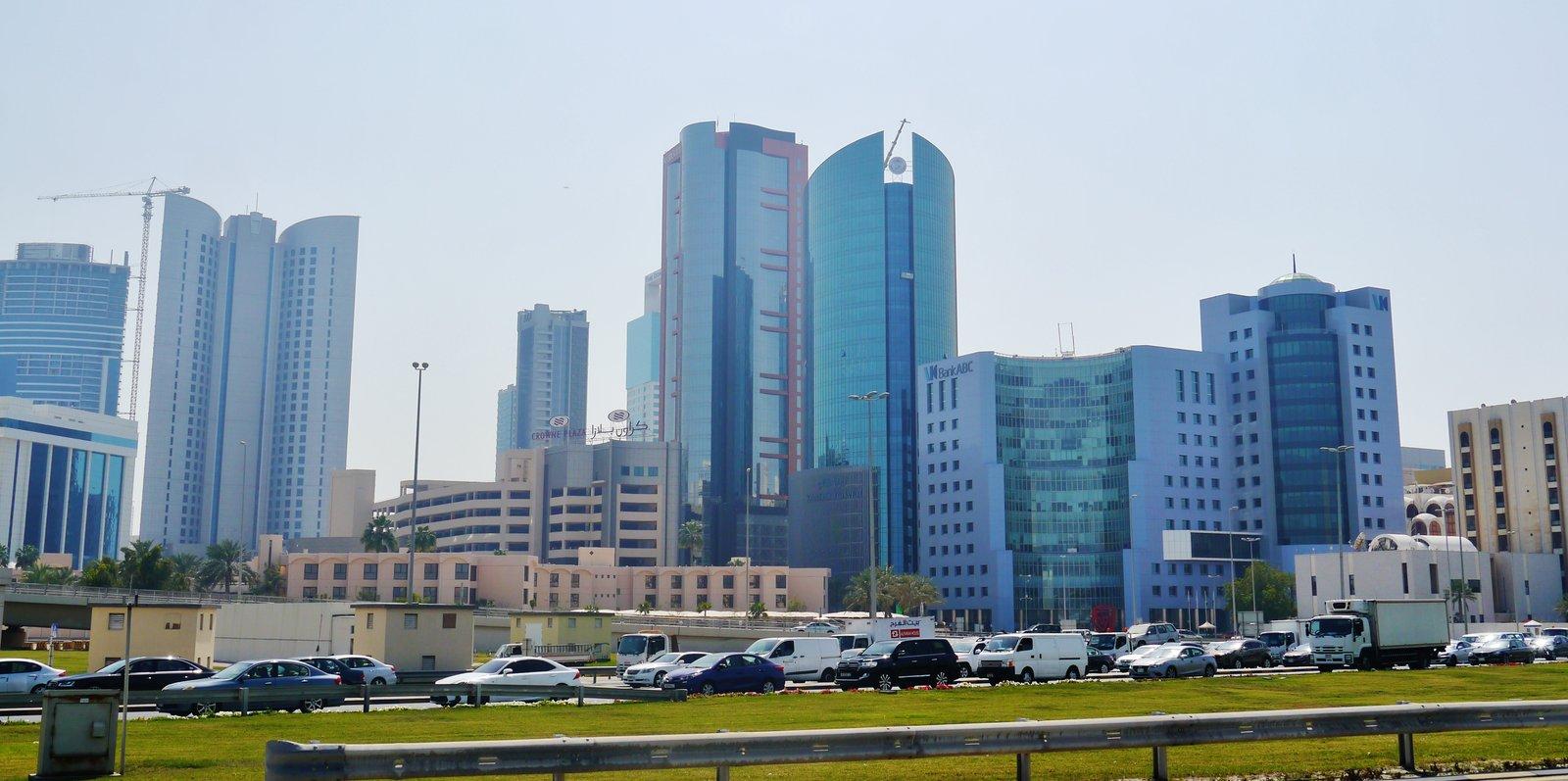
Image: Image: Zairon, CC BY-SA 4.0 (https://creativecommons.org/licenses/by-sa/4.0/), via Wikimedia Commons (https://commons.wikimedia.org/wiki/File:Manama_Manama_Skyline_04.jpg) — February 2020 file photo of Manama, not the Riffa air base or the November 2026 attacks; resized
About this article: prepared by The Daily Context editorial desk using automated, source-based reporting from the publications linked below. No reporter was on the ground.
Sources
- BBC News, "Iran targets US military base in Bahrain with drone attack" (15 November 2026): https://www.bbc.com/news/articles/cqn4e2py48kwo
- The Guardian, "Iran launches drone attacks against US military base in Bahrain" (15 November 2026): https://www.theguardian.com/world/2026/nov/15/iran-launches-drone-attacks-against-us-military-base-in-bahrain
- The National, "Iran attacks Bahrain in 'blatant challenge' to peace push" (15 November 2026): https://www.thenationalnews.com/news/mena/2026/11/15/iran-attacks-bahrain-in-blatant-challenge-to-peace-push/
- ABC News, Iran live updates: Bahrain reports Iranian attack (15 November 2026): https://abcnews.com/International/live-updates/iran-live-updates-americans-tired-forever-wars-araghchi/?id=137967256
- Al Jazeera, Iran war live (16 November 2026): https://www.aljazeera.com/news/liveblog/2026/11/16/iran-war-live-tehran-warns-it-may-strike-first-before-another-us-attack
- The Washington Post, "Iran targets Bahrain twice after months of quiet, claiming retaliation against U.S." (15 November 2026): https://www.washingtonpost.com/world/2026/11/15/iran-targets-bahrain-twice-after-months-quiet-claiming-retaliation-against-us/
- RFE/RL, "CENTCOM denies Iranian claim it struck a US radar in Bahrain" (13 November 2026): https://www.rferl.org/a/iran-us-sirik-bahrain-war-nuclear-talks/33897951.html
- Iran International, "US rejects IRGC report of radar strike in Bahrain, says two drones shot down" (13 November 2026): https://www.iranintl.com/en/202611137645
- Gulf News, Middle East conflict live updates (15 November 2026): https://gulfnews.com/world/mena/middle-east-conflict-saudi-arabia-intercepts-houthi-missiles-targeting-riyadh-as-bahrain-issues-threat-alert-1.500747797
- The New Arab, "Iran threatens escalation, Araghchi set for Oman visit" (15 November 2026): https://www.newarab.com/news/iran-threatens-escalation-araghchi-set-oman-visit
Kabeer Ahmad
Kabeer Ahmad is the founder and editor of The Daily Context. He oversees the site's source-based coverage of world affairs, technology, business, entertainment, lifestyle and sports, and is responsible for its editorial standards, sourcing and corrections.