Wall Street's worst week since 2020: S&P 500 and Dow enter correction as AI sell-off deepens
US stocks ended their worst week in years on Friday 20 November, with the S&P 500 and Dow both closing in correction territory and the Nasdaq wiping out its gains for 2026. Chip and AI-related shares led the fall as worries about the AI build-out combined with expectations of another Federal Reserve rate rise.
US stocks closed out their worst week in more than five years on Friday 20 November. The S&P 500 and the Dow Jones Industrial Average both ended in correction territory, which means a fall of at least 10% from a recent record close. The Nasdaq Composite erased all of its gains for 2026.
The S&P 500 fell 3.7%, or 265.44 points, to 6,910.39 on Friday. The Nasdaq dropped 5.28%, or 1,261.47 points, to 22,617.73, leaving it down 2.7% for the year, according to CNBC. The Dow lost 949.73 points, or 1.93%, to 48,147.33. The Nasdaq-100 fell 5.6% and was briefly in a bear market during the session, 20% below its recent high.
The sell-off was led by chipmakers and other companies tied to artificial intelligence. Investors had hoped this week's Nvidia earnings and Anthropic's record stock market debut would revive the AI trade. Instead, both were followed by heavier selling.
How bad was the week?
CNBC put the Dow's weekly loss at 8%, its worst week since March 2020. The S&P 500 fell 8.6%, its worst week since the April 2025 sell-off that followed President Donald Trump's sweeping tariff announcement. The Nasdaq Composite lost about 10%, its biggest one-week drop in more than six years. The small-cap Russell 2000 fell 7.5% on the week, according to investingLive's end-of-day figures.
The damage built through the week. On Thursday, all three major averages fell more than 2%, and the Dow closed below 50,000 for the first time since June. By Friday's close, the S&P 500 had fallen for seven straight sessions, its longest losing run since February 2020, Charles Schwab said.
The Cboe Volatility Index (VIX), often called Wall Street's fear gauge, rose from about 20 on Monday to above 37 at Friday's close, according to Schwab.
Which stocks fell the most?
Technology was the weakest sector, falling more than 7% on Friday, Schwab said. Only consumer staples finished higher. CNBC said defensive names such as Walmart, Costco, Johnson & Johnson and Procter & Gamble each gained around 1%.
Among the biggest movers on Friday:
- Nvidia fell about 14% (13.8% in investingLive's figures). According to CNBC, it also had its longest weekly losing streak since the 2008 financial crisis.
- Advanced Micro Devices dropped 13.3% and Micron Technology almost 14%. The Philadelphia Semiconductor Index fell 10.7%.
- AI cloud providers Nebius and CoreWeave fell 16.1% and about 12%. Bloom Energy, which supplies power systems used by data centres, lost 15.3%.
- Anthropic, in only its second day of trading after Thursday's Nasdaq debut, fell about 9%. Reports put the drop at between 8.5% and 9.1%, with the close at about $88.30, still above its $83 offer price.
- JPMorgan Chase and Bank of America fell more than 3% and Citigroup 4%, Schwab said, a sign the selling spread beyond tech.
The fall was not limited to the US. Germany's DAX lost 2.6% on Friday and 7.3% over the week, according to investingLive. The FTSE 100 fell 5.1% and the CAC 40 5.3% over the week.
Why are investors selling AI stocks?
Analysts pointed to several worries arriving at once rather than to a single trigger.
The first is the AI build-out itself. Investors are questioning whether the huge spending on data centres can continue at the same pace and how it will be financed. "The stock market is going through an AI repricing, reflecting an environment of slowing data center buildouts, reduced funding sources for AI-related projects and a slower trajectory of technology-related earnings growth," Richard Saperstein, chief investment officer at Treasury Partners, told CNBC.
The second is politics. Schwab said the Democrats' sweeping wins in the 3 November midterm elections had increased fears of growing local and state opposition to data-centre construction. Regulatory scrutiny of the chip industry, including over exports to China, has also weighed on the sector.
The third is interest rates. A strong October jobs report, hot inflation data and hawkish minutes from the Federal Reserve's last meeting have pushed traders to expect higher borrowing costs. By late Friday, futures implied a 92% chance of a rate rise at the Fed's December meeting, according to Schwab, citing the CME FedWatch tool. Fed Governor Lisa Cook said on Friday that the central bank's September rate rise had done too little to curb inflation, investingLive reported.
"This is not just a valuation-driven correction. It's becoming broader," Massimo Santicchia, head of US equities at Procyon, told CNBC. "Right now, it's definitely risk-off."
Kevin Gordon of the Schwab Center for Financial Research described a "rock-and-a-hard-place backdrop" for stocks: markets are pricing in both a Fed fighting sticky inflation and the risk of slower growth if AI spending falls.
What happened in bonds, commodities and crypto?
Investors moved into government bonds. The 10-year Treasury yield fell about 11 basis points to 4.94%, back below 5%, and the 2-year yield fell 13 basis points to 4.65%, investingLive reported.
Gold did not benefit. It fell for a second day, to around $3,500 to $3,540 an ounce depending on the measure used, after touching a 14-month low on Thursday. Silver and copper also fell. Bitcoin dropped below $60,000 and was near $58,900 late in the session.
Oil moved the other way. Renewed US-Iran tensions kept attention on supply through the Strait of Hormuz, and US crude rose about 1.5% to $83.70 a barrel. Brent was near $92.60.
Who is affected?
The fall hits a wide range of investors, not just traders in tech stocks. AI-related companies make up a large share of the main US indexes, so the decline affects index funds and many retirement and pension portfolios. Companies hoping to raise money for AI projects may face tougher conditions, and the sell-off came just as Anthropic's listing tested investor appetite for new AI shares.
This article reports market moves and is not investment advice.
What should markets watch next?
The coming week is short in the US. Markets are closed on Thursday 26 November for Thanksgiving and close early, at 1 pm New York time, on Friday 27 November.
According to Schwab's calendar, Monday brings flash purchasing managers' index (PMI) data and results from Hewlett Packard Enterprise and Zoom. Dell and Analog Devices report on Tuesday, alongside November consumer confidence data. Wednesday brings the October personal consumption expenditures (PCE) price index, the Fed's preferred inflation gauge, together with the second estimate of third-quarter GDP, durable goods orders and the Fed's Beige Book. Inflation data that runs hotter than expected could strengthen the case for a December rate rise.
It is not yet clear whether this is a pause in the AI rally or a deeper reassessment. A rebound is possible after such a steep week. However, several of the concerns behind the sell-off, including Fed policy, data-centre politics and the financing of AI spending, are unlikely to be resolved in the next few days.
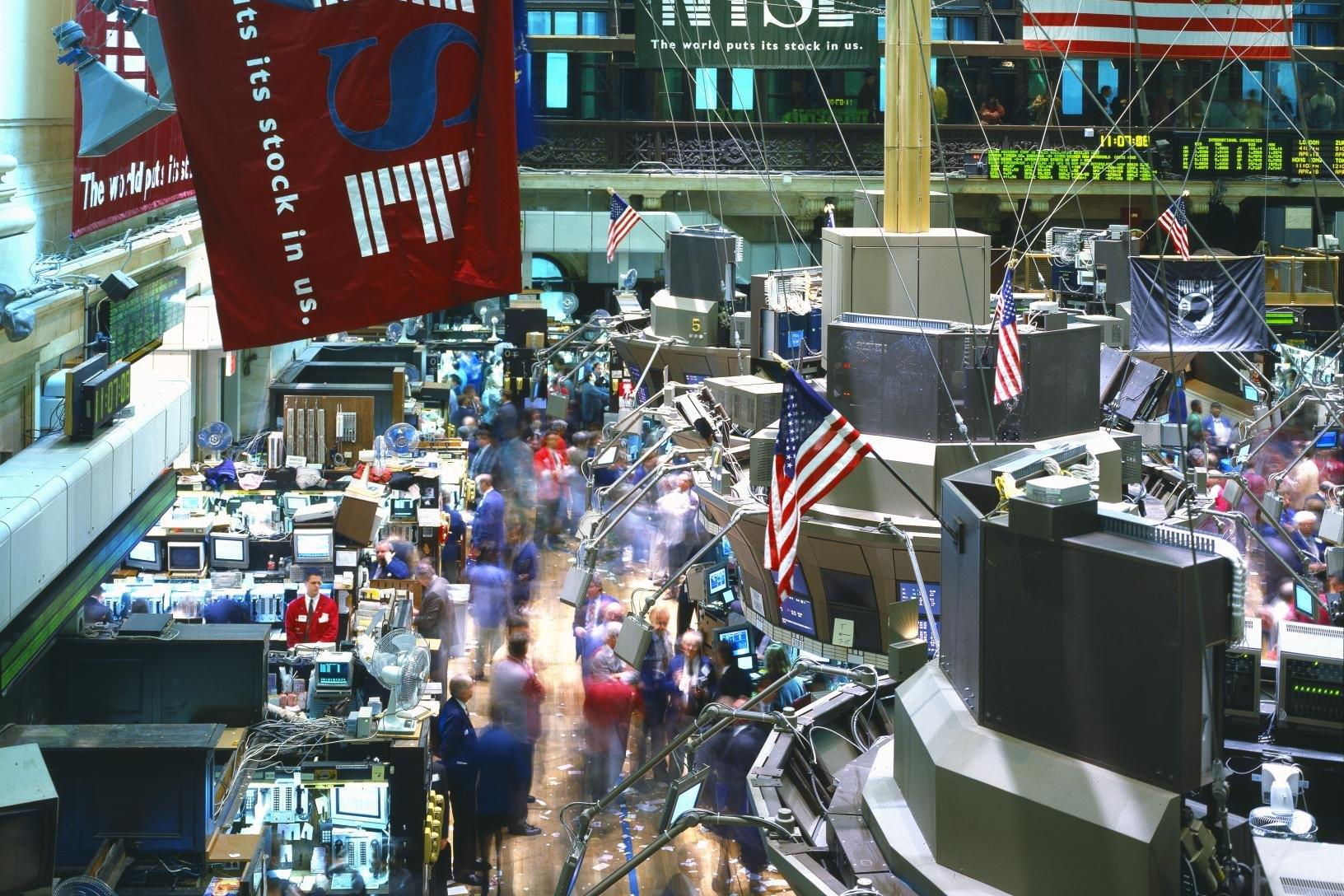
Image: Undated file photo of the New York Stock Exchange trading floor; not taken during the November 2026 sell-off. Photo by Carol M. Highsmith, Library of Congress Prints and Photographs Division, public domain (no known restrictions), via Wikimedia Commons (https://commons.wikimedia.org/wiki/File:No_Known_Restrictions_Trading_Floor,_New_York_Stock_Exchange_(Highsmith_LOC)_(6718386525).jpg); cropped
About this article: prepared by The Daily Context editorial desk using automated, source-based reporting from the publications linked below. No reporter was on the ground.
Sources
- CNBC (20 Nov 2026): https://www.cnbc.com/2026/11/19/stock-market-today-live-updates.html
- Charles Schwab (20 Nov 2026): https://www.schwab.com/learn/story/market-volatility
- investingLive (20 Nov 2026): https://investinglive.com/news/investinglive-americas-fx-news-wrap-20-nov-stocks-get-hammered-as-nasdaq-plunges-5-28/
- AP (20 Nov 2026): https://apnews.com/article/wall-street-stocks-dow-nasdaq-c10b797a17c2acf37924d834efebe135
Kabeer Ahmad
Kabeer Ahmad is the founder and editor of The Daily Context. He oversees the site's source-based coverage of world affairs, technology, business, entertainment, lifestyle and sports, and is responsible for its editorial standards, sourcing and corrections.