US Army detonates degraded lead azide at Iowa ammunition plant after court fight
The US Army detonated about 68 drums of degraded lead azide, more than 9,700 pounds of explosive, at the Iowa Army Ammunition Plant in Middletown shortly after 9am local time on Wednesday 25 November. Officials say early reports show the mitigation worked, but residents near the plant were told to keep sheltering until an all-clear, and sampling for lead dust is continuing.
The US Army has detonated its stockpile of degraded lead azide at the Iowa Army Ammunition Plant in Middletown, ending weeks of delays, a federal court challenge and evacuations in south-east Iowa. Two blasts were heard shortly after 9:00am local time on Wednesday 25 November 2026 (around 8:00pm Pakistan time), according to the BBC, which carried live footage of grey smoke rising over the site.
The Army had said about 68 drums of lead azide, holding more than 9,700 pounds (roughly 4.4 tonnes) of net explosive weight, had crystallised in storage and could explode on their own. The Associated Press described it as the nation's entire stockpile of the compound. Early official assessments were positive, but residents within 20 miles were told to keep sheltering until officials gave the all-clear, and environmental sampling for lead dust is continuing.
What happened on Wednesday morning?
The detonation took place inside two concrete, earth-covered magazines at the plant, the storage bunkers where the drums had been kept. Before the blast, the Army said it had surrounded the bunkers with sand-filled barriers about two storeys high, walls of 16,000-gallon water tanks, foam and gel blocks, and misting units intended to soak the soil and air so that escaping particles would fall back inside the installation.
Within half an hour, a senior administration official told CBS News that the explosion had "exceeded all expectations" and that "maximum mitigation efforts" had been achieved, the BBC reported. President Donald Trump wrote on Truth Social that early reports showed the Army's mitigation efforts had "far exceeded expectations". The Washington Post reported that data on an Environmental Protection Agency monitoring site showed no lead detected at four air-sampling stations south-west of the plant in the 30 minutes after the blast.
Missouri Governor Mike Kehoe, whose state lay within the Army's outer modelling area, said initial analysis shared by federal partners and Iowa emergency managers indicated that "the mitigation measures appear to have been successful and the explosion was well-contained."
These are early findings. The full picture will depend on soil, water and surface-wipe samples taken over the coming days.
Why did the Army choose to blow it up?
Lead azide is a highly sensitive primary explosive used to set off larger munitions such as grenades and artillery shells. According to a federal appeals court ruling, the drums had been stored for more than two decades in a water and ethanol solution meant to keep the compound stable. A routine inspection on 11 March 2026 found that the material had partly recrystallised, making it far more sensitive to friction, shock and cold.
The Army says it considered chemical neutralisation, thermal treatment, moving the drums and continued storage, and rejected each as too dangerous because they required opening, mixing or moving the material. Colonel Aaron Teller, commander of the 71st Explosive Ordnance Disposal Group, told reporters on Tuesday that crystallised lead azide had built up on the outside of the barrels and their lids, so they could not be safely moved or opened.
That account has been contested. Iowa Public Radio, citing Army court filings and records from the company, reported that the Army hired MuniRem Environmental in March after a panel recommended chemical neutralisation, but that the then Army secretary chose detonation on 8 May, four days after the firm submitted its treatment plan. MuniRem's chief executive, Valentine Nzengung, told the broadcaster he still believes neutralisation was viable. The Army has said its working group unanimously ruled it out on safety grounds.
What did the courts and officials decide?
The EPA issued an emergency hazardous-waste permit on 13 November that, for the first time, authorised detonating the material in place, with conditions on weather, barriers, monitoring and clean-up. The Iowa Environmental Council and the Sierra Club challenged it and won a brief administrative stay from the Eighth Circuit Court of Appeals. On 23 November the court denied their emergency motion and lifted the stay, finding the groups unlikely to show the EPA had acted arbitrarily. The judges wrote, as quoted by ABC News, that "every day of delay increases the risk of an uncontrolled explosion." The groups' underlying petition remains pending.
Mr Trump said on Monday that he had told the military to hold off until the court and Iowa's incoming governor, Democrat Rob Sand, agreed, according to ABC News. Mr Sand deferred to the administration but demanded transparency about how the situation arose. Outgoing Governor Kim Reynolds declared a disaster emergency on 24 November for Des Moines, Lee and Van Buren counties.
What are the health risks from lead dust?
The explosion breaks down the lead azide, but the lead itself does not disappear. Lead is a neurotoxin, and the US Centers for Disease Control and Prevention says no safe level of exposure has been identified. Young children and pregnant women are most at risk. The Army's own advisory warned of "potential exposure to toxic lead dust" in areas downwind and said children under six were especially vulnerable.
Federal agencies recommended that residents of Middletown and of a five-mile cone extending south-west of the plant relocate from Tuesday. On Wednesday morning, the Federal Emergency Management Agency told people within 20 miles to shelter in place, keep windows and doors shut and turn off fans that draw in outside air. ABC News reported that evacuees had been advised to stay away until Friday at the earliest and would be told by phone when they could return.
The EPA says it had more than 100 staff and contractors in the area and took more than 1,000 air, water and soil samples before the blast to establish a baseline. Under the permit, the Army must start specified sampling within 24 hours and propose a clean-up plan where needed.
What happens next?
The immediate questions are when officials will lift the shelter-in-place advice and whether sampling finds lead above background levels in homes, farmland or waterways. The EPA has said it will publish results as they become available.
The political questions are likely to last longer. Iowa's Senator-elect Josh Turek, Republican Representative Ashley Hinson, Mr Sand and Representative-elect Christina Bohannan have all called for answers about why the stockpile was allowed to degrade and why the chemical-treatment contract was dropped. Environmental groups say they still want the Army to explain publicly how the emergency came about.
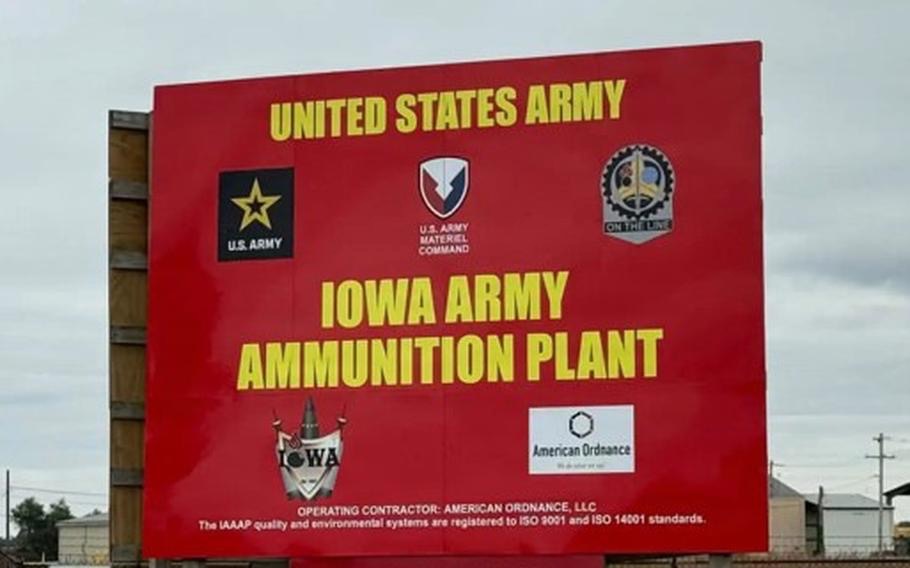
Image: File photo: the entrance sign at the Iowa Army Ammunition Plant in Middletown, Iowa, 2026. Image: Lori McFate, Iowa Army Ammunition Plant / US Army Sustainment Command Public Affairs, public domain (US government work), via Wikimedia Commons (https://commons.wikimedia.org/wiki/File:2026_United_States_Army_Iowa_Ammunition_Plant_sign.jpg)
About this article: prepared by The Daily Context editorial desk using automated, source-based reporting from the publications linked below. No reporter was on the ground.
Sources
- BBC News: Blasts heard as US Army carries out controlled detonation of degraded explosives in Iowa, live coverage (25 November 2026): https://www.bbc.com/news/live/c6y0xw9y87nzt
- US Army: Army announces controlled detonation of degraded explosive material at Iowa Army Ammunition Plant (24 November 2026): https://www.army.mil/article/297069/army_announces_controlled_detonation_of_degraded_explosive_material_at_iowa_army_ammunition_plant
- US Army: Public Safety Advisory, controlled mitigated detonation of unstable lead azide: https://www.army.mil/article/297039
- US EPA: EPA, Army and other federal partners provide public update on Iowa Army Ammunition Plant (24 November 2026): https://www.epa.gov/newsreleases/epa-army-and-other-federal-partners-provide-public-update-iowa-army-ammunition-plant
- US Court of Appeals for the Eighth Circuit: Iowa Environmental Council v. EPA, No. 26-3374, order denying stay (23 November 2026): https://ecf.ca8.uscourts.gov/opndir/26/11/263374P.pdf
- The Washington Post: Army detonates lead-based explosives in Iowa (25 November 2026): https://www.washingtonpost.com/climate-environment/2026/11/25/iowa-town-awaits-us-armys-planned-detonation-lead-azide-stockpile/
- AP: The Latest: Army detonates entire US stockpile of lead azide in Iowa (25 November 2026): https://apnews.com/article/iowa-lead-detonation-77fa69b9e88b46c5d1adc29841d2b4cc
- ABC News: Army says Iowa lead explosives detonation will proceed after appeals court denies bid to stop it: https://abcnews.com/Politics/trump-ordered-military-hold-off-iowa-explosives-detonation/story?id=138384845
- Iowa Public Radio: Records show a timeline of the Army's decision against chemical treatment for lead explosives (24 November 2026): https://www.iowapublicradio.org/environment/2026-11-24/army-blast-unstable-lead-azide-contractor-chemical-treatment-plan
- Iowa Homeland Security and Emergency Management: Gov. Reynolds issues disaster emergency proclamation (24 November 2026): https://homelandsecurity.iowa.gov/disaster-proclamation/2026-11-24/gov-reynolds-issues-disaster-emergency-proclamation-provides-pre-detonation-update
Kabeer Ahmad
Kabeer Ahmad is the founder and editor of The Daily Context. He oversees the site's source-based coverage of world affairs, technology, business, entertainment, lifestyle and sports, and is responsible for its editorial standards, sourcing and corrections.