UN tribunal overturns UNRWA sacking of Gaza teacher Israel accused over 7 October
The UNRWA Dispute Tribunal has rescinded the agency's January 2024 dismissal of Gaza teacher Abdel Rahman Abu Awad, finding the Israeli-supplied evidence too thin to justify it. The judge stressed the ruling does not clear him of the allegations.
A United Nations tribunal has overturned the dismissal of a Palestinian teacher whom UNRWA, the UN agency for Palestine refugees, sacked in January 2024 after Israel accused him of involvement in the 7 October 2023 attacks. The UNRWA Dispute Tribunal found that the agency had not produced enough reliable evidence to justify the decision, and that the case against him rested almost entirely on intelligence held by Israel that UN investigators could not independently verify.
The judgment, dated 11 November 2026 and published on UNRWA's website, concerns Abdel Rahman Abu Awad, a teacher and deputy school principal in Gaza with more than 10 years' service. It was first reported by the Guardian on 25 November. The judge was explicit that the ruling does not establish that Mr Abu Awad is innocent of the allegations, only that UNRWA failed to prove it had a sound basis for firing him.
What did the tribunal decide?
Judge John Murphy, sitting at the tribunal's Amman registry, rescinded the termination of 26 January 2024. Under the tribunal's statute, UNRWA may choose to pay compensation instead of reinstating him; the judge set that alternative at 12 months' net base salary. He also ordered the agency to pay Mr Abu Awad US$5,000 for moral harm, citing uncontested psychiatric evidence that he developed severe post-traumatic stress disorder and depression after losing his job. Both sums accrue interest at the US prime rate until paid.
The core finding was that UNRWA "failed to discharge its evidentiary burden" to show it had "a rational bona fide reason" to end his employment in the interest of the agency. The judge added a significant caveat: "this Judgment does not find that the Applicant is not a Hamas operative or that he was not involved in the events of 7 October 2023." Rather, he wrote, there was "simply insufficient evidence" to sustain the dismissal.
What was he accused of?
According to the judgment, Israel alleged that Mr Abu Awad was a platoon commander in the Nuseirat Battalion of Hamas's armed wing, and that on the morning of 7 October 2023 he received a phone call, intercepted by Israeli intelligence, in which he was updated on the incursion into Israel in real time and told to follow events over push-to-talk radio. He was not accused of crossing into Israel or taking part in the killings. He denied the allegations and submitted statements from two colleagues saying he had travelled to work on an UNRWA staff bus that morning.
The judge described that alibi as beside the point, since the allegation concerned a call received as he apparently woke up, but said the more basic problem was that nothing on record established he was the person using the phone in question.
Why did the judge find the evidence weak?
The decisive material was the 31 July 2024 report by the UN Office of Internal Oversight Services (OIOS), which investigated 19 UNRWA staff members named by Israel. The tribunal noted that OIOS could not interview any of them because of safety and security concerns, and that most of the evidence was photocopies of "collected enemy materials" or Israeli summaries of them, which OIOS could not authenticate. Israel played OIOS audio of intercepted calls but declined to hand over copies, citing their "highly classified" nature.
The judgment quotes OIOS's own reservations at length. In at least one case, a staff member accused on the basis of "high confidence" intelligence was later cleared when Israeli authorities concluded his SIM card had probably been duplicated. Voice comparisons in that case were "inconclusive", leading OIOS to warn that "caution is warranted in placing any reliance on voice identification". OIOS also said that when it listened to some intercepts, it "drew different conclusions" from those in Israeli dossiers.
On that basis OIOS dropped its inquiry into 10 of the 19 staff. For the remaining nine, including Mr Abu Awad, it said only that the evidence "if authenticated and corroborated" could provide a basis to conclude they "may have" engaged in misconduct. The tribunal said OIOS never confirmed the caller was a Hamas operative, that the phone was Mr Abu Awad's, or why the number was "associated" with him.
When ordered in September to substantiate its case, UNRWA filed five documents, among them an Israeli government report, a UN Watch report and a Times of Israel article. The judge noted that all five postdated the 26 January 2024 decision, so they "could not have been before" the commissioner-general when he made it.
Why did UNRWA fire the staff in the first place?
The judgment sets out the pressure the agency faced. On 18 January 2024, a senior Israeli foreign ministry official gave then commissioner-general Philippe Lazzarini the names of 12 staff alleged to have taken part in the attacks. When the allegations became public, several donors suspended or conditioned funding, freezing roughly US$450 million. Mr Lazzarini, in consultation with UN Secretary-General António Guterres, terminated the contracts to protect the agency's ability to operate, and the secretary-general asked OIOS to investigate.
Judge Murphy accepted that this context was "compelling" and that the considerations were "self-evidently relevant" — but only if the allegations were sustainable on the evidence. He also addressed UNRWA's argument that keeping staff identified by Israel as Hamas members could expose colleagues to targeted strikes. He called that concern "by no means fanciful", but said the agency still had to show the threat was real and that it had considered less drastic options, such as exceptional leave, before dismissal. There was no evidence that it had.
Mr Lazzarini, who left UNRWA in March, told the Guardian he could not discuss the case in detail because it might be appealed. In February 2024 he had acknowledged that dismissing staff before an investigation amounted to "reverse due process". UNRWA did not respond to the Guardian's request for comment.
How does this fit the wider dispute over UNRWA?
The ruling is the latest in a series of findings that have questioned the strength of Israel's broader case against the agency. An independent review led by former French foreign minister Catherine Colonna reported in April 2024 that UNRWA had some "neutrality-related issues" but that Israel had yet to provide supporting evidence for its claim that a significant number of staff belonged to armed groups. In October 2025 the International Court of Justice said in an advisory opinion that Israel "has not substantiated its allegations that a significant part of UNRWA's employees are 'members of Hamas … or other terrorist factions'". Israel rejected that opinion and has continued to say the agency is compromised; its parliament voted in October 2024 to bar UNRWA from operating on Israeli territory.
The 7 October attacks killed about 1,200 people in Israel and some 250 were taken hostage, the judgment notes. UNRWA has been the main humanitarian organisation working in Gaza during the war that followed, and its funding crisis has been a recurring concern for the UN.
What happens next?
The decision applies to one person, not to all nine staff whose dismissals were confirmed after the OIOS report, though its reasoning could be cited in other challenges. UNRWA can appeal to the UN Appeals Tribunal, and has the choice between reinstating Mr Abu Awad and paying the compensation set by the court. We found no public statement on the judgment from UNRWA or the Israeli government at the time of writing. The tribunal's register lists other recent cases brought by former Gaza staff, but it is not yet clear whether any concern the same January 2024 dismissals.
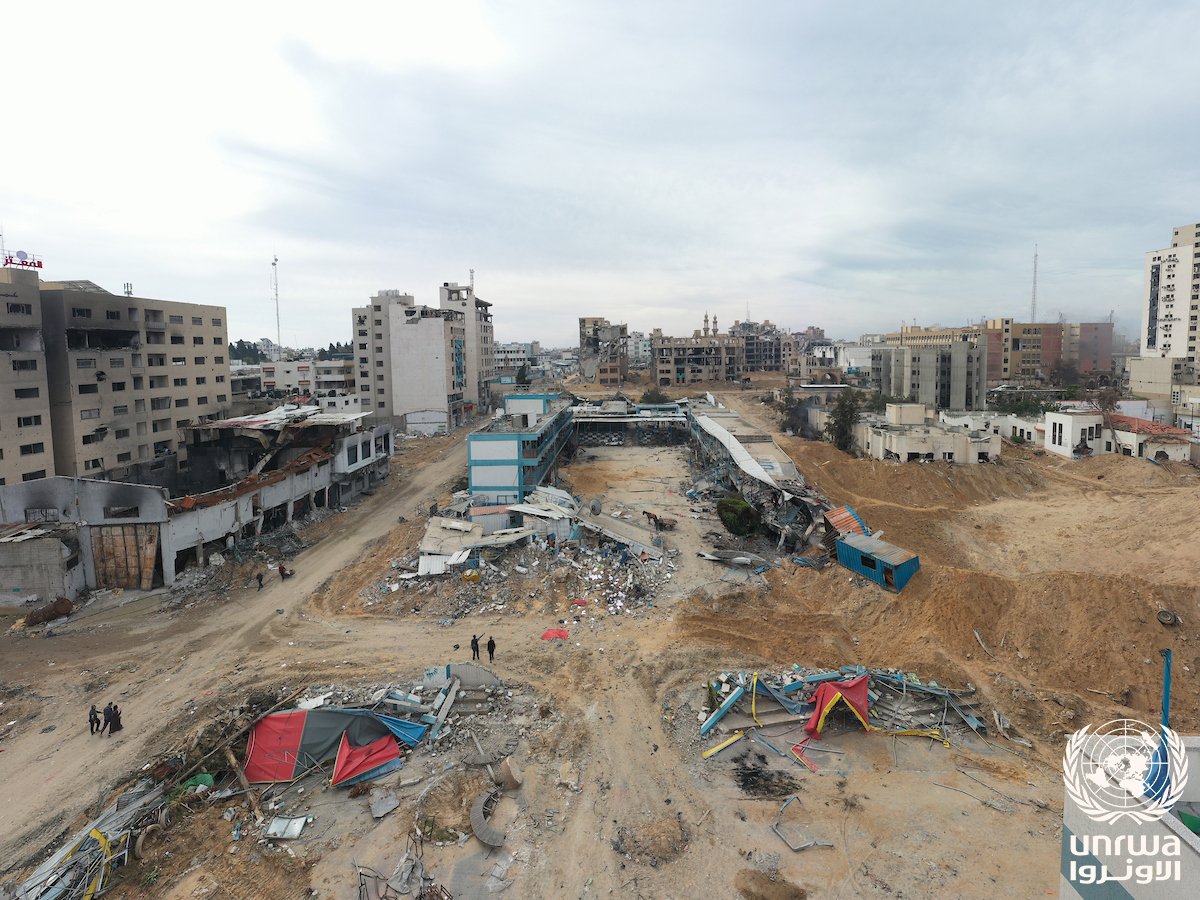
Image: File photo: UNRWA Zaitoun Boys School, Gaza City, 12 February 2024 (not connected to the case). Photo: Abedallah Alhaj/UNRWA, CC BY-SA 3.0 IGO (https://creativecommons.org/licenses/by-sa/3.0/igo/), via Wikimedia Commons (https://commons.wikimedia.org/wiki/File:UNRWA_Zaitoun_Boys_School,_February_2024.jpg)
About this article: prepared by The Daily Context editorial desk using automated, source-based reporting from the publications linked below. No reporter was on the ground.
Sources
- UNRWA Dispute Tribunal: Judgment UNRWA/DT/2026/070/Corr.01, Abu Awad v. Commissioner-General of UNRWA (11 November 2026): https://www.unrwa.org/media/79292/download?attachment
- UNRWA: Judgments register: https://www.unrwa.org/judgments
- The Guardian: UN sacked Palestinian staff on back of unproven Israeli allegations, tribunal rules (25 November 2026): https://www.theguardian.com/world/2026/nov/25/un-sacked-palestinian-staff-on-back-of-unproven-israel-allegations
- Anadolu Agency: UN tribunal questions evidence behind dismissal of Palestinian aid workers (26 November 2026): https://www.aa.com.tr/en/world/un-tribunal-questions-evidence-behind-dismissal-of-palestinian-aid-workers/4138123
- UN: Summary of the ICJ Advisory Opinion of 22 October 2025: https://www.un.org/unispal/document/summary-advisory-opinion-icj-22oct25/
- The Times of Israel: ICJ: Israel has not backed up claims many UNRWA staff are Hamas (22 October 2025): https://www.timesofisrael.com/liveblog_entry/icj-israel-has-not-backed-up-claims-many-unrwa-staff-are-hamas/
Kabeer Ahmad
Kabeer Ahmad is the founder and editor of The Daily Context. He oversees the site's source-based coverage of world affairs, technology, business, entertainment, lifestyle and sports, and is responsible for its editorial standards, sourcing and corrections.