Trump, Xi and Putin's Shenzhen 'peace declaration': what it says and what it leaves out
The first-ever summit of the US, Chinese and Russian leaders ended in Shenzhen with a four-point declaration on UN reform, fuel supply, the International Criminal Court and nuclear risk. It did not mention Ukraine or Iran and set no arms-control talks.
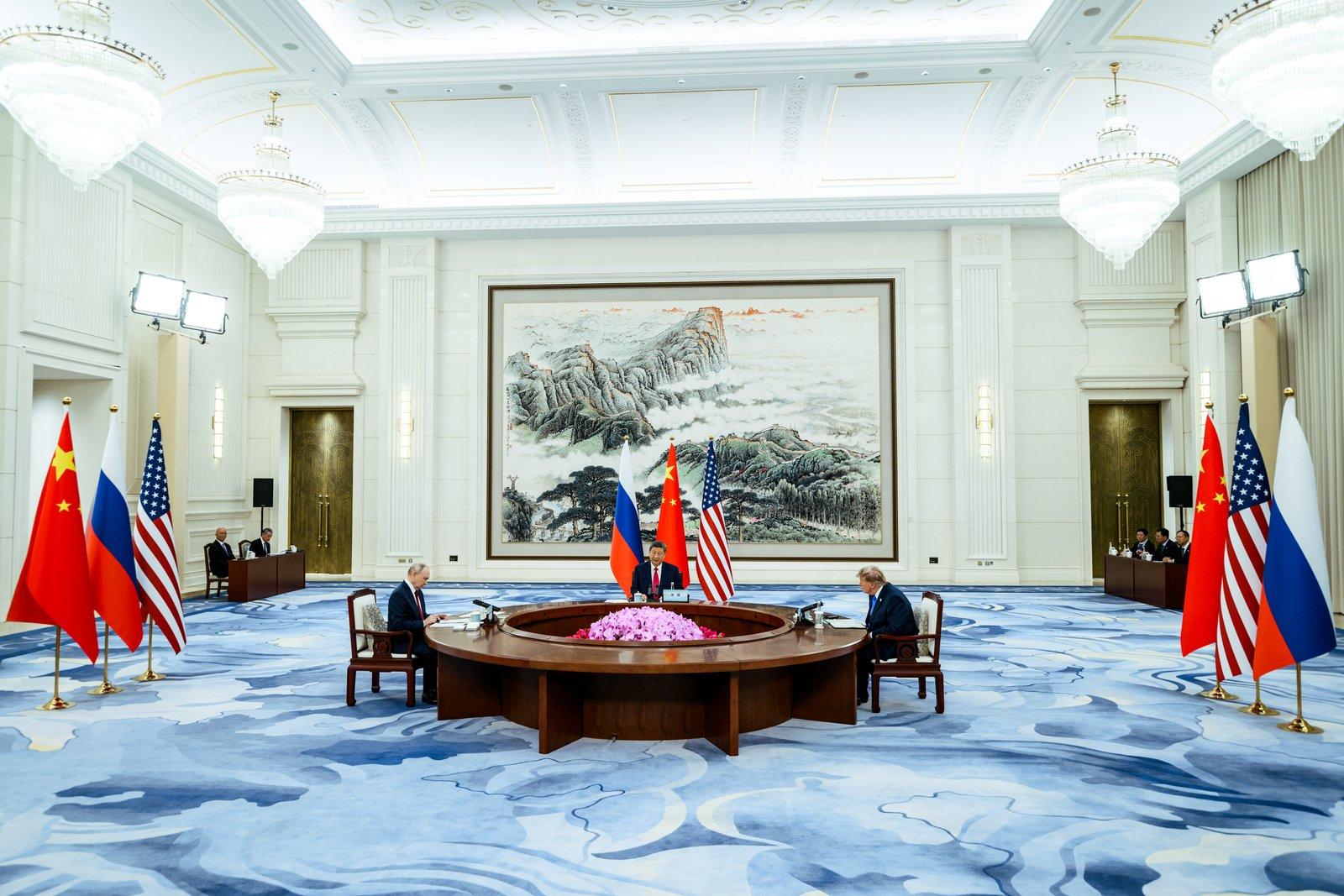
The first summit ever held between the leaders of the United States, China and Russia ended with a short "peace declaration" and few concrete results. Donald Trump, Xi Jinping and Vladimir Putin met behind closed doors at Kylin Villa in Shenzhen on Thursday, 19 November 2026, on the sidelines of the Asia-Pacific Economic Cooperation (APEC) leaders' meeting.
The four-point text, published by the White House, commits the three governments to reform the United Nations, to raise output of refined petroleum products, to push back against the International Criminal Court (ICC), and to hold a dialogue on reducing nuclear risks. It does not mention Russia's war in Ukraine or the US conflict with Iran. It also sets no date or format for the trilateral nuclear arms-control negotiations Trump has sought since his first term.
Two days later, the summit's main legacy looks symbolic: three nuclear powers on one stage, warm words between their leaders, and a declaration that critics say leans towards shielding leaders from international courts.
What does the Shenzhen declaration actually say?
The text, titled "U.S.-Russia-China Heads of State Declaration toward Peace", is brief. After noting that the US and Russian leaders thanked China for hosting, it says the three "committed to maintaining strategic stability and international security". It then makes four commitments.
- UN reform. As permanent members of the UN Security Council, the three countries "committed to reform the UN" so that it can respond more effectively to global challenges.
- Fuel supply. The three "plan to increase the production and supply of refined petroleum products for the benefit of all nations" and reaffirmed the importance of stable energy flows.
- International courts. The leaders said the principle of state consent and respect for the immunities of state officials are "of paramount importance". They agreed that the ICC "and other similar bodies must not abuse their jurisdiction".
- Nuclear risk. They reaffirmed that "a nuclear war cannot be won and must never be fought" and said their countries "will conduct a dialogue on reducing nuclear risks and preventing the proliferation of nuclear weapons".
Reuters noted that the declaration gave no time frame for that nuclear dialogue. China's foreign minister, Wang Yi, said the three countries would keep coordinating at working level after the summit.
Why is the ICC passage drawing so much attention?
The ICC issued an arrest warrant for Putin in March 2023, accusing him of the unlawful deportation and transfer of Ukrainian children from occupied territory to Russia. Moscow rejects the allegations. Neither the US nor China is a party to the Rome Statute that created the court, so neither is bound to carry out its warrants.
The Guardian reported that Trump called the court "out of control" during the meeting. It said the declaration's emphasis on state consent and officials' immunity could be read as a challenge to the legal basis of the warrant against Putin. Jonathan Eyal of the Royal United Services Institute told Reuters the pushback against international norms and courts was "the most interesting aspect" of the text. "The big powers dictate, the small powers suffer," he said.
The passage was also noticed by US allies. Japan's prime minister, Sanae Takaichi, said after a phone call with Trump that she did not think Japan's interests would be harmed by the summit. But she said the two countries differed on the court. "Japan has consistently supported the ICC. The U.S. and Japan have different views," she said, according to South Korea's Financial News, citing NHK and the Nikkei.
The declaration was issued on the same day that the International Court of Justice, a separate UN court that rules on disputes between states, found that Myanmar had committed genocide against the Rohingya.
Did the summit make progress on nuclear weapons or Ukraine?
Not in any measurable way. The talks took place as the New START treaty, which caps US and Russian deployed strategic warheads at 1,550 each, approaches its expiry in February. The Guardian recalled that Putin proposed in September 2025 that both sides keep to those limits voluntarily for another year. Trump rejected that and called instead for a new agreement that includes China. China has long refused, arguing its arsenal is much smaller.
At the start of the meeting Trump said the three countries were "uniquely positioned" to discuss reducing the number of nuclear weapons, according to the BBC. He also acknowledged the difficulty. "It's not an easy thing to do – give them up," he said, as quoted by Reuters. Xi called for nuclear weapons to be "completely prohibited and thoroughly destroyed", the Guardian reported. But no arms-control process was announced. Daryl Kimball of the Arms Control Association told Reuters the "never be fought" language was "positive", but added: "We need much more than rhetoric."
On Ukraine, Putin said the three countries had "numerous shared interests in the settlement of regional conflicts, including obviously the conflict in Ukraine". In a news conference afterwards he said Ukraine and Europe were not yet ready to compromise, and that Russia had invited EU representatives to Moscow, according to the BBC. He also brushed aside comparisons with the 1945 Yalta conference: "Nobody divided up the world at Yalta. It simply codified the realities that had emerged after WW2," he said, adding that "the realities on the ground will have to be accepted". The BBC reported that Kyiv was under Russian drone attack while the talks were under way.
Accounts of the meeting's length differ: AP put the closed-door session at roughly 70 minutes, the BBC at 90 minutes, and the Guardian at more than an hour.
How did the three leaders describe the meeting?
All three called it a success. "We are really making history," Trump told the other two leaders at the start, according to Reuters. Asked about it by NBC afterwards, he said: "On a scale of zero to 10, I think it was a 12." He told Reuters the summit was "bigger than Yalta" and defended calling Putin a friend: "It's nice to have people that have 4,000 nuclear weapons as a friend as opposed to an enemy."
Xi said that "when major powers live in harmony, the world is at peace", and Chinese state broadcaster CCTV quoted him describing the meeting as "positive, constructive, and highly productive". The Kremlin released video of Putin telling Xi: "I don't think anyone even expected everything to go so well." The BBC reported that the trilateral meeting was reportedly Putin's idea. It was also the first time since Russia's full-scale invasion of Ukraine that he attended an international gathering with leaders from countries such as Canada, Japan and Australia.
At a White House news conference on Friday, 20 November, Trump said the US had entered the trip "from a position of unmatched economic and diplomatic strength", NPR reported. NPR noted that the trip produced agreements to keep talking rather than concrete changes. The one new item Trump announced was that he and Xi had agreed to set up "joint guardrails" on artificial intelligence. No details were given on what they would cover or when they would be agreed.
What has the reaction been?
Criticism in Washington crossed party lines. Senate Democratic leader Chuck Schumer called the summit "a historic embarrassment" and "a betrayal of the United States", Reuters reported. Republican senator John Curtis, who sits on the Senate foreign relations committee, told the BBC he was encouraged by the commitment that nuclear war must never be fought, but warned that "Vladimir Putin and Xi Jinping are not our friends". Democratic senator Jeanne Shaheen wrote on X that "President Trump's 'friend' is a murderous war criminal".
In Europe, leaders meeting in Berlin on the same day warned against settling Ukraine's fate over their heads. "A 'Yalta' format will not bring peace," German chancellor Friedrich Merz said, according to Reuters, which also reported that he called Shenzhen "a photo opportunity". Trump's envoy Jared Kushner, standing beside Merz, said Trump wanted a peace deal with Europe at his side and that Russia had agreed to multilateral talks involving Europe.
Eyal's verdict to Reuters was blunter: Putin "gained credibility and escape from pariah status", while Trump "gained a photo opportunity he didn't need".
What happens next?
The next test comes within weeks. Trump hosts the Group of 20 summit at his golf resort in Florida, where he is expected to meet Xi again. Putin said he would consider attending, Reuters reported. Any follow-up on the promised nuclear-risk dialogue, the AI "guardrails" or UN reform will show whether the Shenzhen text was the start of a process or a one-off piece of summit theatre.
Image: Official White House photo of the trilateral meeting at Kylin Villa, Shenzhen, 19 November 2026 (P20261119DT-0920). Public domain (work of the US federal government), via Wikimedia Commons (https://commons.wikimedia.org/wiki/File:Xi%E2%80%93Putin%E2%80%93Trump_summit_-_P20261119DT-0920_(55662874343).jpg); resized
About this article: prepared by The Daily Context editorial desk using automated, source-based reporting from the publications linked below. No reporter was on the ground.
Sources
- The White House: U.S.-Russia-China Heads of State Declaration toward Peace (19 November 2026): https://www.whitehouse.gov/briefings-statements/2026/11/u-s-russia-china-heads-of-state-declaration-toward-peace/
- Reuters: Trump, Xi and Putin release 'peace declaration' from unprecedented summit: https://www.reuters.com/5f374b32b07b/world/china/trumps-historic-meeting-with-xi-putin-headlines-asia-trip-2026-11-18/
- BBC News: Trump, Putin and Xi release 'peace declaration' after historic meeting: https://www.bbc.com/news/articles/c623j4ln97x7o
- The Guardian: Global courts under attack and four more takeaways from the Trump, Xi, Putin meeting: https://www.theguardian.com/world/2026/nov/19/five-takeaways-from-putin-trump-xi-apec-shenzhen-summit
- AP: Takeaways from the historic summit among Trump, Xi and Putin: https://apnews.com/article/trump-xi-putin-china-apec-25e17ec8d9c55fbff960d5631eaba71d
- AP: Trump, Xi and Putin hold rare 3-way talks on nuclear risks but deliver no breakthroughs: https://apnews.com/article/trump-xi-putin-nuclear-ukraine-iran-a04dc76ed8e786b087e2c1ea9598783a
- NPR: Trump touts meeting with Xi and Putin but offers few results: https://www.npr.org/2026/11/20/nx-s1-6047594/trump-asia-trip-xi-putin-press-conference
- Financial News (fnnews): Takaichi says Japan's national interests 'will not be harmed,' but differs with Trump on ICC: https://en.fnnews.com/news/202611200715123540
Kabeer Ahmad
Kabeer Ahmad is the founder and editor of The Daily Context. He oversees the site's source-based coverage of world affairs, technology, business, entertainment, lifestyle and sports, and is responsible for its editorial standards, sourcing and corrections.