Mexico captures 'El Chapo Isidro', one of the FBI's 10 most wanted, setting off a night of violence in Sinaloa
Mexican special forces arrested Fausto Isidro Meza Flores, known as 'El Chapo Isidro', in Guasave, Sinaloa, on the night of 20 November, using intelligence shared by the United States. The raid set off gunfights, burning roadblocks and panic across northern Sinaloa, and Washington is seeking his extradition.
Mexican special forces have captured Fausto Isidro Meza Flores, the cartel leader known as "El Chapo Isidro", who was on the FBI's list of its 10 most wanted fugitives. Mexico's defence ministry (known as Sedena or Defensa) said he was arrested in Guasave, in the northern part of Sinaloa state, on the night of Friday, 20 November. It said the operation followed co-ordination between its intelligence services and those of the United States.
The arrest set off hours of violence across northern and central Sinaloa. Gunmen fought federal forces, lorries and cars were set on fire to block highways, and a baseball game in Guasave was abandoned as spectators fled the sound of gunfire. Meza Flores, his alleged second-in-command and an alleged financial operator were flown to Mexico City early on Saturday. The United States, which had offered up to $5 million for information leading to his capture, wants him extradited.
What happened in Guasave?
In a statement released early on Saturday, 21 November, the defence ministry said National Guard special forces known as "Lobos" and Army special forces known as "Murciélagos" carried out the arrest, alongside Army special forces seconded to Sinaloa's state public security ministry. It said the target had been located precisely "through the use of various technological means", and described the operation in three phases.
First, the troops approached the area by several land routes "using stealth and surprise". Second, they set up an inner and outer security cordon to stop anyone escaping or reinforcements arriving. According to the ministry, the troops were then attacked "with firearms and explosives", and the arrest team entered the house and detained the three men. Third, once their identities had been confirmed, the detainees were flown to Mexico City on a Mexican Air Force aircraft and handed to federal prosecutors.
Besides Meza Flores, the ministry named the detainees as Germán "N", alias "Serafín", whom it called the organisation's second-in-command, and José "N", described as a financial operator. Mexican authorities withhold the surnames of suspects who have not been convicted.
The ministry did not say which US agencies had helped, or how. Euronews and the BBC both reported that the intelligence on his whereabouts came from the United States. Mexico's government has not given further details of the co-operation.
How bad was the violence after the arrest?
The defence ministry acknowledged roadblocks in four municipalities, Ahome, Guamúchil, Guasave and Navolato, and said it had activated an "anti-blockade plan" to reopen roads. By midnight on Friday, local authorities had counted at least 11 roadblocks, 13 places where spikes had been thrown on the roads to puncture tyres, and three vehicle thefts, El País reported.
Videos shared on social media, described by the BBC, El País and Euronews, appeared to show helicopters firing towards the ground in Guasave, trucks in flames on the highways and spectators at a baseball game running for cover. Reuters photographs showed burning vehicles on a highway near Los Mochis. Sinaloa's public security ministry told residents to stay indoors and avoid the main coastal highway north of the state capital, Culiacán.
In Ahome, hundreds of workers at a maquiladora, a factory that assembles goods for export, were left without a way home after their company suspended its transport because of the violence, Diario de México reported. Sinaloa's interim governor, Graciela Domínguez Nava, said people were stranded at several points on the highways and that security forces were working to restore safe movement so they could return home.
No official figure for deaths or injuries had been published in the reports reviewed for this article, and Euronews noted that no reliable casualty count had emerged.
Who is Fausto Isidro Meza Flores?
Meza Flores is 44. According to the FBI, he leads the Meza-Flores Transnational Criminal Organization, also known as the Guasave Cartel, which US authorities describe as "heavily armed" and based in Sinaloa. US officials say the group has smuggled large quantities of heroin, methamphetamine, cocaine, fentanyl and marijuana into the United States for more than two decades, and has used murder, kidnapping, torture and extortion to hold territory.
He began as a senior member of the Beltrán Leyva Organization, a cartel that split from the Sinaloa Cartel in 2008. After rival factions fell out, he set up his own group by around 2013, the BBC reported. Mexico's defence ministry still calls him the head of the "Beltrán Leyva" organisation and says he is allied with "Los Mayos", the faction linked to the family of jailed Sinaloa Cartel co-founder Ismael "El Mayo" Zambada.
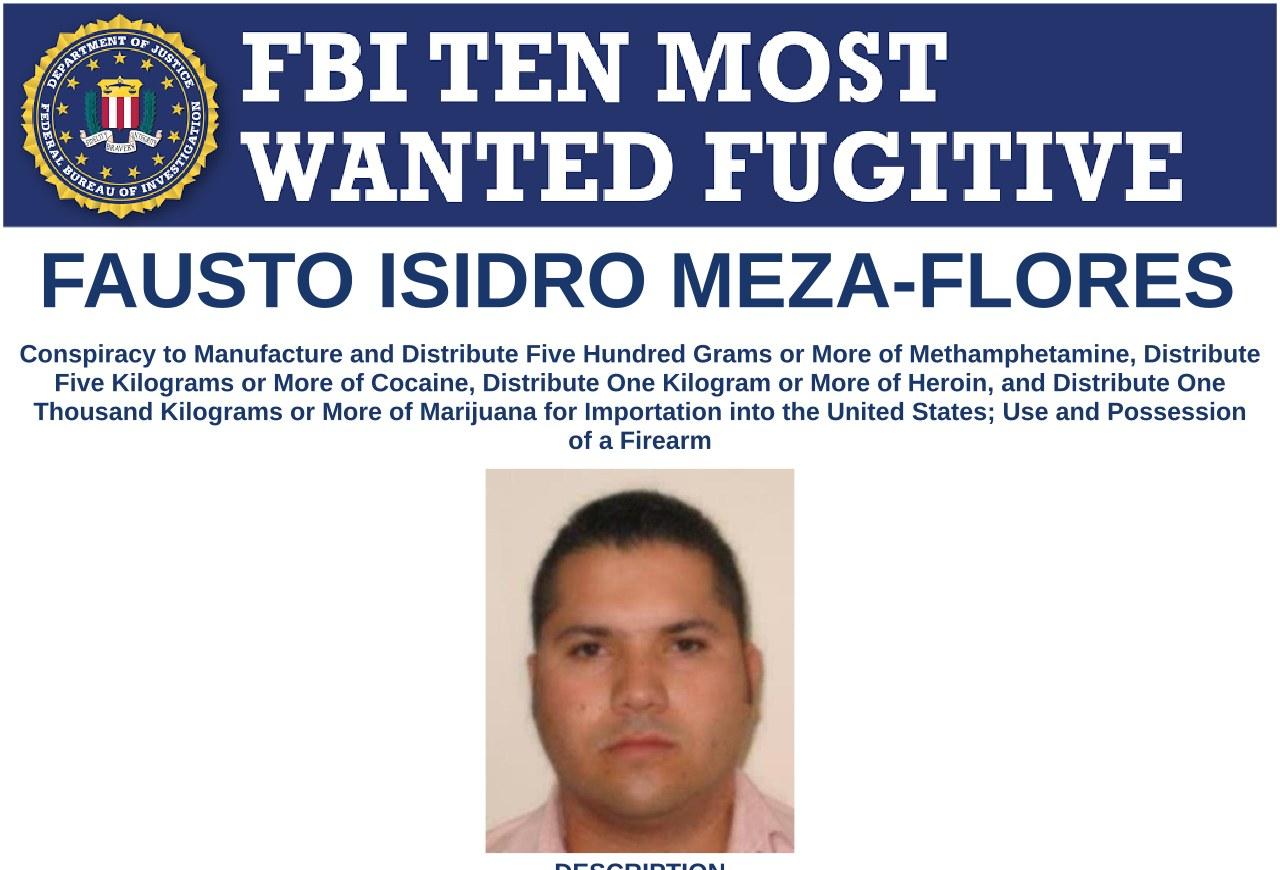
US prosecutors in the District of Columbia first indicted him on 2 May 2012. A superseding indictment followed on 26 November 2019, charging him with conspiring to manufacture and distribute cocaine, heroin, methamphetamine and marijuana for import into the United States, and with use and possession of a firearm. The State Department first offered a reward of up to $5 million in September 2017. The FBI added him to its Ten Most Wanted list on 4 February 2025, when it accused his network of "heinous crimes" including kidnapping and torture.
El País reported that a Mexican Navy seizure of more than a tonne of fentanyl in Guasave in late 2024, the largest fentanyl seizure in Mexico's history, was in his area of influence. The BBC said Mexican authorities had linked his group to about 20 million fentanyl pills seized that year. Mexican security sources told El País earlier this year that he "exports more drugs than all the others".
Why does this arrest matter?
The capture is one of the biggest blows against a Mexican trafficker this year. It comes as President Claudia Sheinbaum's government is under heavy pressure from US President Donald Trump to act against cartels. Trump said at the White House on Friday that he was working with Sheinbaum on a trade agreement and on fighting cartels, and that in his view "the cartels are controlling Mexico", Bloomberg Línea reported. The two leaders had met on 18 November on the sidelines of the APEC summit in Shenzhen, China.
Sheinbaum's government has welcomed closer intelligence sharing with Washington but has rejected US troops on Mexican soil, the BBC noted. An arrest that used US intelligence but was carried out entirely by Mexican forces fits that approach.
Security Secretary Omar García Harfuch praised the soldiers and National Guard members involved for their "courage and professionalism". In a later message he expressed regret for the violence Sinaloa families had lived through. He said the intensity of the fighting showed the firepower the group had built up over years, and called the arrests an important step towards pacifying the state, according to Diario de México.
The arrest also lands in the middle of a war within the Sinaloa Cartel. For about two years, factions loyal to the sons of Joaquín "El Chapo" Guzmán, known as "Los Chapitos", have been fighting those loyal to Zambada. El País reported that Meza Flores had used that conflict to expand his own share of the drug trade. Removing him could leave a vacuum that rivals try to fill.
What happens next?
Meza Flores faces a Mexican arrest warrant for organised crime and drug offences, and an arrest warrant for extradition to the United States, according to the defence ministry. As of Saturday, no date had been announced for any handover to the United States, Prensa Libre reported. Mexico has sent dozens of alleged cartel figures to the United States in mass transfers over the past two years, but extradition of a single defendant usually goes through Mexican courts and can take months or years.
The immediate question in Sinaloa is security. Federal forces remain deployed across the state, García Harfuch said. Past arrests of senior figures, such as the capture of Ovidio Guzmán in Culiacán in January 2023, were followed by days of unrest. A failed attempt to detain him in 2019 ended with soldiers releasing him after his group's violent response. This time, as El País noted, the detainee was flown out of the state the same night.
As Euronews pointed out, arresting a leader does not necessarily dismantle the organisation he runs. Whether the Guasave group fragments, is absorbed by rivals or carries on under new leadership will shape violence in northern Sinaloa in the weeks ahead.
Image: File image: FBI Ten Most Wanted Fugitive poster for Fausto Isidro Meza-Flores, issued 4 February 2025, not a photo of the arrest. Federal Bureau of Investigation, public domain (US government work), via Wikimedia Commons (https://commons.wikimedia.org/wiki/File:Fausto_Isidro_Meza-Flores_Top_Ten_Wanted_Poster.svg); cropped to the top section
About this article: prepared by The Daily Context editorial desk using automated, source-based reporting from the publications linked below. No reporter was on the ground.
Sources
- Mexico Ministry of National Defence (Defensa), statement on the arrest (21 November 2026), as published by Prensa Libre: https://www.prensalibre.com/internacional/disparos-explosivos-y-bloqueos-en-sinaloa-lo-que-se-sabe-de-la-captura-del-chapo-isidro/
- BBC News: Mexican drug lord on FBI's 10 most wanted list arrested in shoot-out: https://www.bbc.com/news/articles/ckz749ey0r75o
- El País: Detenido El Chapo Isidro en un operativo que desata el terror en Sinaloa: https://elpais.com/mexico/2026-11-21/detenido-el-chapo-isidro-en-un-operativo-que-desata-el-terror-en-sinaloa.html
- Euronews: Mexico captures FBI's most-wanted cartel boss 'El Chapo Isidro', triggering violence: https://www.euronews.com/2026/11/21/mexico-captures-fbis-most-wanted-cartel-boss-el-chapo-isidro-triggering-violence
- Bloomberg Línea: México captura a capo de los más buscados por el FBI mientras Sheinbaum y Trump avanzan en acuerdo comercial: https://www.bloomberglinea.com/latinoamerica/mexico/mexico-captura-a-capo-buscado-por-el-fbi-mientras-sheinbaum-y-trump-avanzan-en-acuerdo-comercial/
- Diario de México: Captura de 'El Chapo Isidro': así fue el operativo y el caos que desató en Sinaloa: https://www.diariodemexico.com/mi-nacion/captura-chapo-isidro-fue-operativo-caos-desato-en-sinaloa
- FBI Ten Most Wanted: Fausto Isidro Meza-Flores: https://www.fbi.gov/wanted/topten/fausto-isidro-meza-flores
- AP: Mexico detains top cartel boss 'El Chapo Isidro,' setting off a burst of violence in Sinaloa: https://apnews.com/article/mexico-cartels-el-chapo-isidro-sinaloa-violence-7301b67a1b1b974bc6bd20c9d030ce07
Kabeer Ahmad
Kabeer Ahmad is the founder and editor of The Daily Context. He oversees the site's source-based coverage of world affairs, technology, business, entertainment, lifestyle and sports, and is responsible for its editorial standards, sourcing and corrections.