South Africa local elections 2026: ANC falls to 30.8% as coalition talks begin
The ANC remained South Africa's largest party in the 4 November 2026 local elections but won only 30.76% of the national vote, its worst local result since apartheid ended, according to final results declared by the Electoral Commission on 8 November. Most municipal councils, including Johannesburg, Pretoria and Durban, now face coalition talks.
South Africa's African National Congress (ANC) is still the country's largest party at local level, but only just. In final results for the 4 November 2026 municipal elections, declared by the Electoral Commission of South Africa (IEC) on Sunday 8 November, the ANC won 30.76% of the national vote, down from about 46% in 2021. The Democratic Alliance (DA) was second with 24.64%, and former president Jacob Zuma's uMkhonto weSizwe (MK) Party was third with 9.76% in its first local election.
The result leaves most of the country's 213 municipal councils without a single party in control, so the next fortnight will be dominated by coalition negotiations, especially in the big cities of Gauteng province and in Durban.
What were the final national results?
According to the IEC's declaration, as reported by the government news agency SAnews, the top five parties were:
- ANC: 30.76% of the vote and 3,246 council seats
- DA: 24.64% and 1,695 seats
- MK Party: 9.76% and 785 seats
- Economic Freedom Fighters (EFF): 6.22% and 588 seats
- ActionSA: 5.67% and 313 seats
Other parties and independent candidates together took 22.97%. A total of 521 parties and 636 independent candidates contested the elections, fielding roughly 137,000 candidates for 10,526 council seats.
The ANC achieved outright control of 53 municipalities and was the largest party in 128. The DA won outright control in 12 and led in 32. The Inkatha Freedom Party (IFP) won five outright and led in 19, and the MK Party won three outright and led in 19.
How bad is this for the ANC?
The BBC described it as the ANC's worst showing in local elections since the end of apartheid. Its share fell by roughly a third from the 46% it won in 2021 and is less than half of the 64.82% it took two decades ago. According to the BBC, the party won a majority in only one of the nine provinces, Limpopo, compared with six in 2021, and topped the poll in only two of the eight metropolitan municipalities, down from six.
ANC secretary-general Fikile Mbalula called the outcome "very catastrophic", telling reporters that "the cost of living of our people was too high" and that "the middle class have turned on the ANC in big numbers". President Cyril Ramaphosa, who leads the party, said the ANC accepted "the will of the people however concerning it might be".
The local result follows the 2024 national election, when the ANC lost its parliamentary majority for the first time and formed the multi-party Government of National Unity (GNU), in which the DA is its largest partner. Political analyst Susan Booysen told the BBC that poor delivery of basic services, such as water, electricity and sanitation, was the main driver of the decline.
The DA's national share rose only slightly, from 21.83% in 2021, and remained below the 26.9% it won in 2016. But it gained ground in the cities, where much of South Africa's economic activity is concentrated.
Who won the big cities?
South Africa has eight metropolitan municipalities, or metros. Final vote shares reported by The Citizen show the DA kept an outright majority only in Cape Town, with 56.42%. Elsewhere the picture is fragmented:
- Johannesburg: DA 34.79%, ANC 20.25%, ActionSA 16.27%
- Tshwane (Pretoria): DA 34.37%, ActionSA 22.07%, ANC 20.22%
- Ekurhuleni: DA 30.68%, ANC 22.11%, ActionSA 18.5%
- eThekwini (Durban): MK 38.29%, DA 25.45%, ANC 16.43%, IFP 6.79%
- Nelson Mandela Bay: DA 44.17%, ANC 25.48%
- Mangaung: ANC 33.91%, DA 33.49%
- Buffalo City: ANC 41.93%, UDM 18.39%, DA 16.85%
That means the ANC topped the poll only in Mangaung, by less than half a percentage point, and Buffalo City. In Durban, MK displaced the ANC as the largest party but fell well short of a majority.
What is a hung council, and how many are there?
A hung council is one in which no party holds more than half of the seats, so a mayor and executive can only be elected with the support of other parties. The IEC chair, Mosotho Moepya, said only a minority of councils returned an outright majority. Published counts differ slightly: SAnews reported 72 councils with a majority party and 127 hung, while The Witness reported 74 with a majority and 139 without one, which adds up to the full 213. The precise figure may become clearer as councils are constituted.
According to the BBC, parties now have 14 days from the announcement of results to negotiate coalitions.
What did the IEC say about turnout and fairness?
The IEC declared the elections free and fair. About 14.9 million of the 29.2 million registered voters cast ballots, a turnout of 52%, up 6.1 percentage points from 45.9% in 2021, when voting took place during the Covid-19 pandemic. Spoilt ballots made up 1.84% of the total.
The commission cited a Human Sciences Research Council survey in which 90% of voters regarded the procedures as free and 91% as fair. Trust in the IEC stood at 81%, which the survey said had gradually declined from 93% in 2016. The survey also flagged intimidation, impartiality, inclusive voting and gaps in voter information as areas needing improvement. Moepya paid tribute to an IEC staff member who died at a voting station in Mahikeng on election day.
Why does this matter beyond local government?
Municipalities deliver many of the services that shape daily life in South Africa, including water, electricity distribution, refuse collection and local roads, so unstable coalitions can directly affect residents. Johannesburg and Tshwane have both experienced frequent changes of mayor under coalition governments since 2016.
Analysts quoted by the BBC also read the result as a signal for the 2029 national election. William Gumede said the ANC "could be the second biggest rather than the biggest party" by then and described the outcome as "the end of the liberation movement era". Those are forecasts, not results. The ANC is also due to elect a new leader next year, as Ramaphosa reaches the end of his term as party president; he is expected to remain the country's president until 2029.
What happens next?
Attention now turns to coalition talks. The key questions are whether the DA can assemble majorities in Johannesburg, Tshwane and Ekurhuleni, whether ActionSA and the ANC instead combine with smaller parties, as The Citizen noted they could in Tshwane, and whether other parties unite to keep MK out of power in Durban. The Daily Context will update this article if significant mayoral or coalition agreements are confirmed.
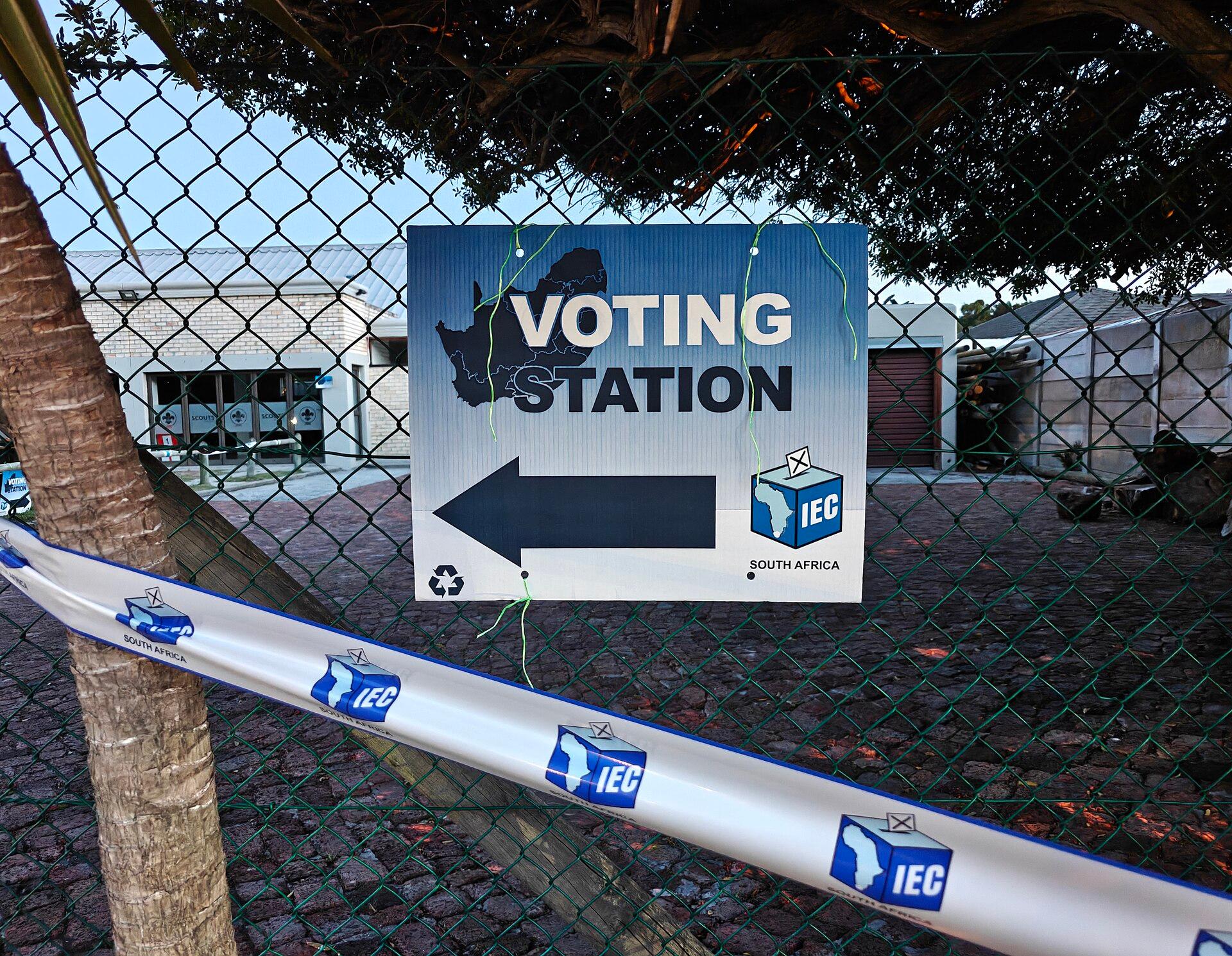
Image: Photo: Husskeyy / Wikimedia Commons, CC BY-SA 4.0 (https://commons.wikimedia.org/wiki/File:Voting_Station_Signage_in_Cape_Town,_for_the_2026_Local_Government_Elections.jpg) — voting station signage in Cape Town, taken 3 November 2026, the day before polling
About this article: prepared by The Daily Context editorial desk using automated, source-based reporting from the publications linked below. No reporter was on the ground.
Sources
- SAnews (South African Government News Agency): IEC declares LGE 2026 Free and Fair (8 November 2026): https://www.sanews.gov.za/south-africa/iec-declares-lge-2026-free-and-fair
- BBC News: South Africa's ANC records worst-ever results in local elections (8 November 2026): https://www.bbc.com/news/articles/cwrkygrxp11mo
- The Citizen: Here are the final 2026 local government election results for SA's eight metros (8 November 2026): https://www.citizen.co.za/news/south-africa/elections/final-2026-local-government-election-results-eight-metros/
- The Witness: 2026 local election results: IEC confirms 14,9 million voters cast ballots (8 November 2026): https://witness.co.za/news/kzn/2026/11/08/2026-local-election-results-iec-confirms-149-million-voters-cast-ballots/
- Xinhua: Daily World Briefing, Nov. 9 (9 November 2026): https://english.news.cn/20261109/e1d906afa36f4aa7b8e1eed37bad74d3/c.html
Kabeer Ahmad
Kabeer Ahmad is the founder and editor of The Daily Context. He oversees the site's source-based coverage of world affairs, technology, business, entertainment, lifestyle and sports, and is responsible for its editorial standards, sourcing and corrections.