Shenzhou-24 takes Pakistan's Muhammad Zeeshan Ali to Tiangong as China's first foreign astronaut
China's Shenzhou-24 docked with the Tiangong space station on 25 November, carrying Pakistani payload specialist Muhammad Zeeshan Ali, the first foreign astronaut to fly on a Chinese crewed mission and the first Pakistani in orbit. He is due to spend five to ten days on the station running experiments before returning to Earth.
Pakistan's Muhammad Zeeshan Ali has become the first foreign astronaut to board China's Tiangong space station. The Shenzhou-24 spacecraft carrying him and two Chinese crewmates lifted off from the Jiuquan Satellite Launch Center in north-west China at 08:18 Beijing time on Wednesday 25 November (05:18 Pakistan time), docked with the station about three and a half hours later and the crew floated aboard at 14:35 Beijing time, according to China's crewed space agency and Reuters.
Ali, a 40-year-old former fighter pilot, is also the first Pakistani to reach orbit. He is flying as a payload specialist and is expected to stay on Tiangong for five to ten days before returning to Earth, while his Chinese colleagues begin a six-month stay. China's crewed space programme described the flight as its first crewed mission involving a foreign astronaut and said the launch was "a complete success".
What happened on launch day?
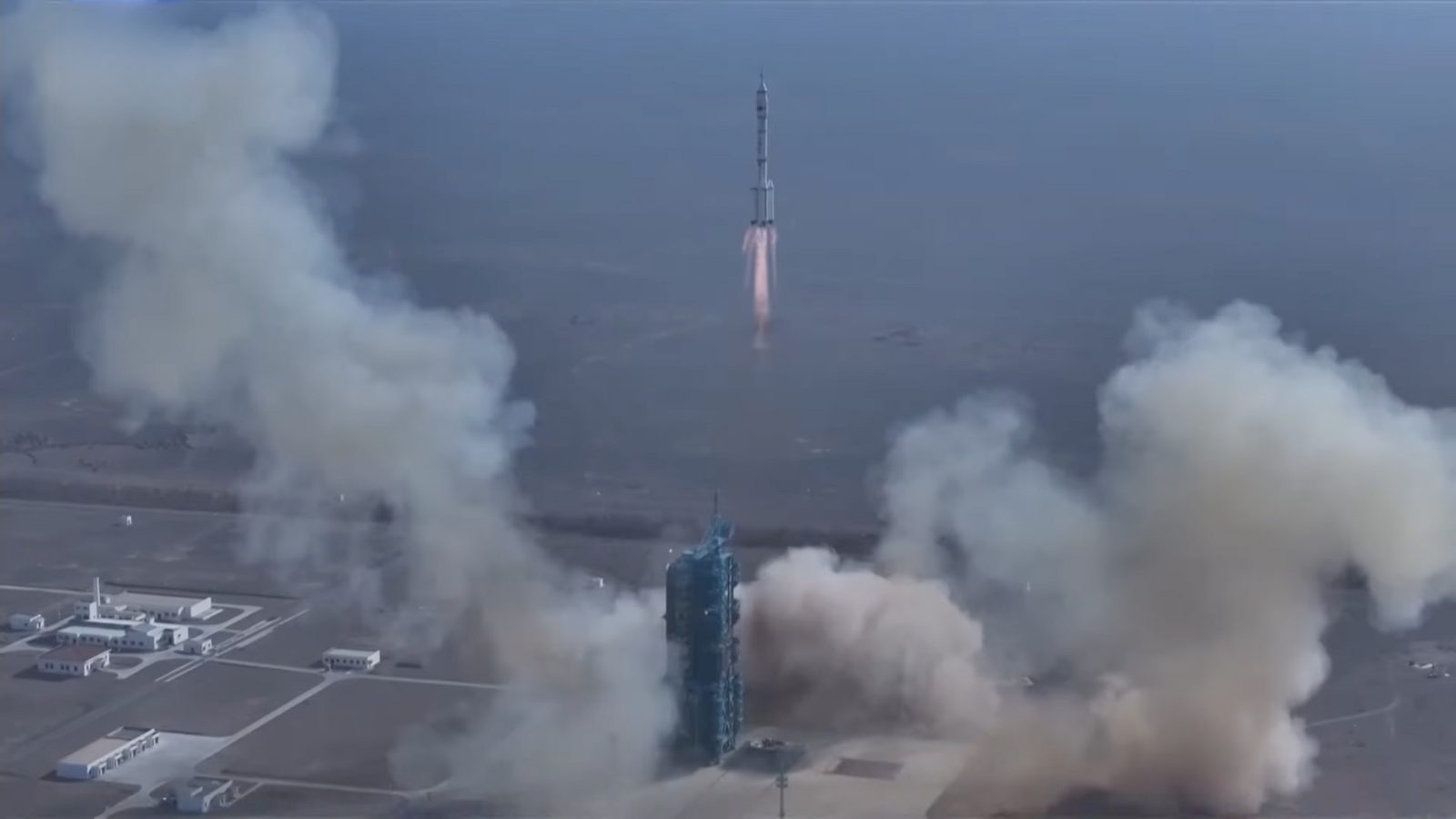
The Long March 2F rocket left the launch pad in the Gobi desert early on Wednesday morning; hundreds of people had gathered at the launch centre before dawn waving Chinese and Pakistani flags, the BBC reported. The spacecraft separated from the rocket about ten minutes into the flight and reached its planned orbit, the China Manned Space Agency said, adding that the crew were in good condition.
Shenzhou-24 then carried out an automated fast rendezvous and docked with the forward port of Tiangong's Tianhe core module at 11:56 Beijing time, Xinhua reported, a process that took about three and a half hours. A few hours later the three new arrivals were greeted with hugs by the Shenzhou-23 crew already on board, who had prepared a cake for the occasion, according to Reuters.
The crew is commanded by Tang Hongbo, 51, with flight engineer Wu Yi, 39, and Ali, 40, according to the Associated Press.
Who is Muhammad Zeeshan Ali?
Ali is a former fighter pilot who was selected from a shortlist that also included Khurram Dawood, the other candidate to reach the final stage of crew selection, the BBC said. Both trained in China under the supervision of Chinese specialists.
Reuters reported that Ali spent seven months training in Beijing, including intensive Chinese-language classes, learning Chinese songs and reading poetry, and that he also practised calligraphy and table tennis. Pakistani media quoted him as saying that learning the language was one of his "biggest challenges".
Before the flight he told reporters at Jiuquan that he was "carrying the name of Pakistan on my shoulder, the hopes of 250 million Pakistanis", the BBC reported. After boarding the station he said in Chinese, according to state broadcaster CCTV as quoted by Reuters: "As the first foreign crew member to board the China Space Station, I am incredibly excited."
What will he do on Tiangong?
Pakistan's space agency SUPARCO said its research on the station includes work on lightweight graphene-based hybrid composite materials intended to improve radiation protection for spacecraft, and a study of "self-healing" carbon-fibre composites designed to repair micro-cracks automatically and extend the structural life of spacecraft, according to FlightGlobal.
The BBC reported that Ali will also run studies on photosynthesis in bacteria and on how radiation and microgravity affect seeds. More broadly, the Shenzhou-24 crew is due to carry out experiments in aerospace medicine, combustion and space biology, including research into how the space environment affects ageing that Chinese scientists hope could inform new treatments for age-related vascular disease. China's crewed space agency said several of the planned experiments are Sino-foreign cooperation projects.
Ali's stay is far shorter than the usual six-month rotation for Chinese astronauts. The BBC said he is due to return to Earth with two members of the Shenzhou-23 crew who have been on the station since May.
Why does this matter for China and Pakistan?
For China, the flight is a step towards presenting Tiangong as an international research platform rather than an exclusively national facility. Reuters noted that Beijing is promoting the station as a hub for cooperation at a time when the NASA-led International Space Station faces possible retirement around 2030. China is also pursuing a goal of landing astronauts on the Moon by 2030 and plans a lunar research base with Russia by 2035.
For Pakistan, which has no crewed spacecraft of its own, the mission is a symbolic milestone. Prime Minister Shehbaz Sharif wrote on X that it was "not just one astronaut's journey, but the journey of 240 million Pakistanis" and called it "living proof of the ironclad friendship between Pakistan and China", Reuters reported. Chinese President Xi Jinping and Pakistani President Asif Ali Zardari exchanged congratulatory messages after the crew entered the station, according to Chinese state media.
Space cooperation between the two countries dates back to the early 1990s. China has launched Pakistani satellites, and a Pakistani-built rover is due to fly on a Chinese lunar mission around 2028, Reuters said. Planning and Development Minister Ahsan Iqbal, speaking at the launch centre, said he hoped the flight would lead to further cooperation, potentially including a joint lunar mission, and described it as an example of how "developing countries can cooperate" in strategically important technologies. Beijing said the flight comes as the two countries mark 75 years of cooperation in space, according to the BBC.
What happens next on the station?
The handover between crews is unusual this time. Shenzhou-23 commander Zhu Yangzhu will remain on Tiangong for a full year to support research into how the human body copes with long-duration spaceflight, Reuters reported, which will give him the record for the longest single stay in orbit by a Chinese astronaut. Tang and Wu will spend about six months on the station alongside him, the BBC said.
Tiangong has been fully operational since late 2022 and can host up to six astronauts during crew handovers. The timing of Ali's return flight and the publication of any early results from his experiments are the next milestones to watch.
Image: File photo: launch of the earlier Shenzhou-22 mission on a Long March 2F rocket from Jiuquan, 25 November 2025 (video still); not the Shenzhou-24 launch. Image: China News Service, CC BY 4.0 (https://creativecommons.org/licenses/by/4.0/), via Wikimedia Commons (https://commons.wikimedia.org/wiki/File:Shenzhou_22_CZ-2F_Y22_launch_10.png); resized
About this article: prepared by The Daily Context editorial desk using automated, source-based reporting from the publications linked below. No reporter was on the ground.
Sources
- Reuters: Pakistani astronaut becomes first foreigner to board China's Tiangong space station (25 November 2026): https://www.reuters.com/3fec1b0a85a0/science/chinas-shenzhou-24-space-flight-takes-off-with-pakistani-national-first-foreign-2026-11-25/
- BBC News: China's Shenzhou-24 carries Pakistan's first astronaut into space (25 November 2026): https://www.bbc.com/news/articles/c6x2e0j3kx28o
- FlightGlobal: China's Shenzhou-24 docks with Tiangong after launching with first international crew (25 November 2026): https://www.flightglobal.com/space/2026/11/chinas-shenzhou-24-docks-with-tiangong-after-launching-with-first-international-crew/
- Associated Press: China launches Shenzhou 24 spacecraft carrying 2 Chinese and 1 Pakistani astronaut (25 November 2026): https://apnews.com/article/china-space-shenzhou-24-543306bfe17419395d10fae107500564
- Xinhua (Chinese): Shenzhou-24 completes autonomous fast rendezvous and docking with the space station (25 November 2026): https://www.news.cn/20261125/1b798e77784340ebb180e06eb8c3de09/c.html
Kabeer Ahmad
Kabeer Ahmad is the founder and editor of The Daily Context. He oversees the site's source-based coverage of world affairs, technology, business, entertainment, lifestyle and sports, and is responsible for its editorial standards, sourcing and corrections.