Quad leaders meet in Manila for first summit in two years as Trump signs US-Thailand trade statement
Donald Trump, Narendra Modi, Sanae Takaichi and Anthony Albanese held the first Quad leaders' summit in more than two years in Manila on Tuesday 17 November 2026, announcing an AI accelerator, critical minerals deals and a 2027 business forum. Trump also signed a joint statement with Thailand's Anutin Charnvirakul concluding the main terms of a reciprocal trade deal.
The leaders of the United States, India, Japan and Australia met in Manila on Tuesday, 17 November 2026, for the first leader-level summit of the Quad in more than two years. US President Donald Trump, Indian Prime Minister Narendra Modi, Japanese Prime Minister Sanae Takaichi and Australian Prime Minister Anthony Albanese gathered at the Solaire resort on the sidelines of the Association of Southeast Asian Nations (ASEAN) summit, hours after Trump landed in the Philippine capital.
It was the first Quad leaders' summit Trump has attended in either of his terms, according to Anadolu Agency, and the first since then-President Joe Biden hosted the group in Delaware in September 2024. A summit planned for India in 2025 never took place.
"Our countries are the four corners of a free, open, stable, and prosperous Indo-Pacific," Trump said before the talks, according to Reuters.
Later the same evening, Trump and Thai Prime Minister Anutin Charnvirakul signed a joint statement saying the two countries had reached "substantial conclusion" of negotiations on a reciprocal trade agreement.
What did the Quad leaders announce?
Most of the announcements came in Trump's remarks at the start of the meeting, and several build on plans Quad foreign ministers set out in Atlanta on 31 October:
- An AI accelerator. Trump said the Quad would launch a new "Super Intelligence" accelerator, using his administration's term for artificial intelligence, and announced more than $85 million to widen access to "trusted" AI across the Indo-Pacific, according to Anadolu Agency and The Japan Times. The foreign ministers had already announced their intention to provide more than $85 million in technical and financial assistance "including through the Quad SI Accelerator" in their 31 October statement. "We want to ensure that the future of this critical technology is dominated by nations that share our values and our common interests," Trump said.
- Critical minerals. Trump said the four countries had signed new agreements on critical minerals and rare earths so that none of them would be "vulnerable to coercion by any single foreign supplier", Gulf News and Anadolu reported. He did not name China. Reports differed on whether this was one agreement or several, and no text, partners or volumes had been published at the time of writing. Trump also claimed the US would "catch" China in rare earths production "within 10 months".
- A business forum. Trump said the first Quad Business Leaders Forum would launch in 2027. The foreign ministers first announced the forum in October.
- Military exercises. The Guardian reported that Trump and Albanese spoke of plans for new joint Quad exercises involving maritime patrol aircraft, building on the recent Malabar naval exercise near Japan. Quad countries had already said their first exercise under the Indo-Pacific Maritime Surveillance Collaboration, launched in New Delhi in May, would take place at the Sea Dragon exercise in 2027.
Hindustan Times reported that India released a joint press statement of the four leaders that "strongly oppose[d] any destabilizing or unilateral actions that seek to change the status quo, including by force or coercion" and voiced "grave concerns about economic coercion, including through arbitrary export restrictions". Similar wording appeared in the Quad foreign ministers' statements in May and October. Other outlets said no joint statement had been published by the evening, and we had not been able to read a full text at the time of publication.
What did Modi, Takaichi and Albanese say?
Modi called the Quad a "constructive and trusted partnership" covering maritime security, supply chains, new technologies and disaster response. He noted that Manila was where officials of the four countries first met in 2007 and where the dialogue was revived in 2017, and said Quad foreign ministers had met five times since January 2025. "I am confident that our meeting today will help us set concrete goals for the next phase of our cooperation," he said.
Takaichi said the group would help realise a free and open Indo-Pacific "by strengthening resilience of countries in the region", naming maritime security, economic security, energy and critical and emerging technologies as priorities, according to The Guardian.
Albanese said that "when we work together for our common view in the Indo-Pacific of peace, security, stability, and prosperity, then the world will be a safer and more secure place". He listed critical minerals, rare earths and artificial intelligence as key issues. Australia will chair the Quad next year, according to Anadolu.
As the leaders posed for a photo, Trump described Modi and Takaichi as "tough", before turning to Albanese and adding: "We're OK too."
Why does the Quad meeting matter now?
The Quad, an informal grouping of four democracies, has its roots in the joint response to the 2004 Indian Ocean tsunami. China has long objected to it as an attempt to contain Beijing; members say it is not aimed at any one country.
The timing is significant. Trump is due in Shenzhen for the Asia-Pacific Economic Cooperation (APEC) summit hosted by Chinese President Xi Jinping, including a three-way meeting with Xi and Russian President Vladimir Putin on Thursday. Kurt Campbell, a former US deputy secretary of state, told Reuters that holding the Quad meeting first was "probably the best possible signal if you're going to go into a trilateral meeting".
The group's cohesion has been tested. Gulf News noted that relations were strained last year when Trump raised tariffs on Indian goods to 50% over India's purchases of Russian oil. Reuters reported that the trip also follows the Republican Party's defeat in the US midterm elections and new US curbs on Chinese access to AI chips.
Albanese said before the meeting that he would raise the war involving Iran with Trump, The Guardian reported. Albanese is due to meet Xi in Shenzhen on Friday.
What is in the US-Thailand trade deal?
The joint statement signed in Manila, published by the White House, says Trump and Anutin "confirmed" that the two countries "have reached substantial conclusion" in negotiations on an Agreement on Reciprocal Trade. Both governments will now begin their internal processes to prepare the agreement "for signature and entry into force". The statement itself contains no tariff rates or specific commitments.
Trump said Thailand would eliminate tariffs on US exports and remove substantial non-tariff barriers, Hindustan Times and The Washington Times reported, and the South China Morning Post reported that Thailand would buy $2.6 billion of US agricultural products. Thai officials have previously discussed about $2.6 billion a year in US farm purchases, including feed corn and soybean meal, according to the Thai Examiner.
Thailand's foreign minister, Sihasak Phuangketkeow, said most of the negotiations concerned Thai purchases of US goods, Thai investment in the US and opening up services, the Thaiger reported. Anutin said on 5 November that Thailand expected a US tariff of about 19% on its goods under the agreement, and that existing arrangements would stay in place until the main agreement is signed. Under a framework announced in October 2025, Thailand agreed to remove tariffs on about 99% of goods from the US.
The US is Thailand's largest export market, taking 24% of its shipments this year, according to Reuters.
Were there protests?
Yes. Around 2,000 demonstrators faced riot police in Manila on Tuesday, according to AFP as reported by Hindustan Times, carrying banners reading "Trump out now" and "Reject Pax Silica", a reference to a US-led technology supply chain initiative. Reuters said it was the fifth day of protests, which have included the burning of Trump effigies and calls for an end to the war in the Middle East.
What happens next?
Trump was due to join a US-ASEAN special summit and dinner on Tuesday evening and to meet Philippine President Ferdinand Marcos Jr on Wednesday before travelling to Shenzhen. Quad export credit agencies meet in Tokyo on Wednesday, 18 November. Key things to watch are whether the full text of a leaders' statement and the critical minerals agreements are published, and when the US-Thailand agreement is formally signed.
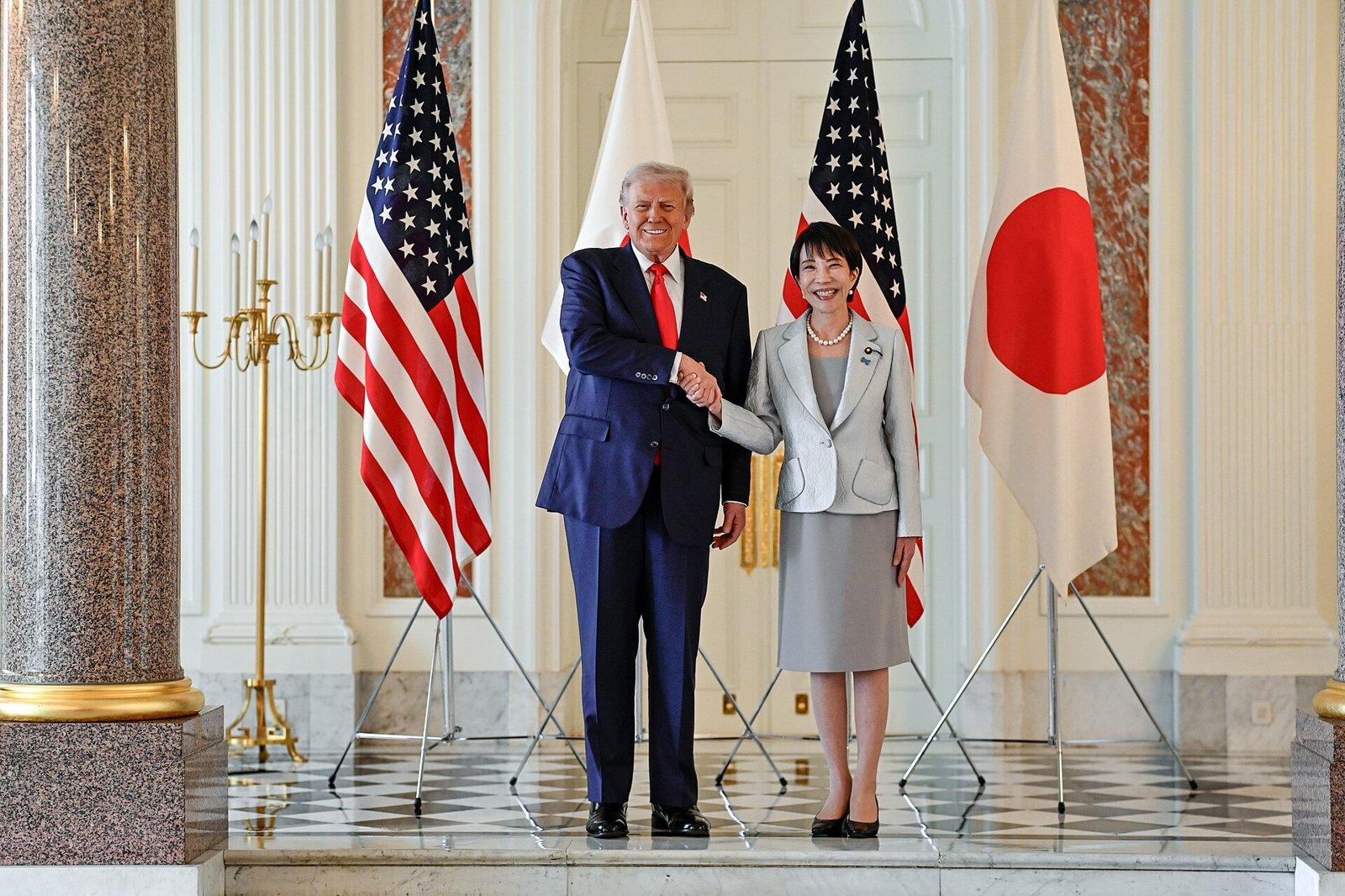
Image: Official White House Photo by Daniel Torok, public domain, via Wikimedia Commons (https://commons.wikimedia.org/wiki/File:President_Donald_Trump_participates_in_a_bilateral_meeting_with_Japanese_Prime_Minister_Sanae_Takaichi_(54888898880).jpg) — Trump and Takaichi at Akasaka Palace, Tokyo, October 2025 file photo; not taken at the Manila summit; resized
About this article: prepared by The Daily Context editorial desk using automated, source-based reporting from the publications linked below. No reporter was on the ground.
Sources
- Reuters (via Investing.com): Trump meets regional allies in Manila ahead of China visit (17 November 2026) https://www.investing.com/news/economic-indicators/trump-to-kick-off-asia-trip-with-quad-talks-in-manila-ahead-of-china-visit-5031428
- Anadolu Agency: 1st leader-level Quad meeting in 2 years brings US, Australia, India, Japan together (17 November 2026) https://www.aa.com.tr/en/politics/1st-leader-level-quad-meeting-in-2-years-brings-us-australia-india-japan-together/4127683
- The Guardian: 'Peace through strength': Albanese and Trump hail progress on Quad alliance (17 November 2026) https://www.theguardian.com/us-news/2026/nov/17/peace-through-strength-albanese-and-trump-hail-progress-on-quad-alliance
- The Japan Times: Trump joins 'Quad' summit for first leaders' meeting in two years (17 November 2026) https://www.japantimes.co.jp/news/2026/11/17/japan/politics/quad-leaders-summit-takaichi-trump/
- Gulf News: Quad's big critical minerals push: What Trump just announced in Manila (17 November 2026) https://gulfnews.com/business/energy/quads-big-critical-minerals-push-what-trump-just-announced-in-manila-1.500750526
- Hindustan Times: Quad Summit live updates (17 November 2026) https://www.hindustantimes.com/india-news/asean-summit-2026-live-updates-manila-narendra-modi-india-east-asia-quad-donald-trump-putin-xi-jinping-meet-china-101794884409156.html
- US Department of State: Quad Joint Press Release on Economic Prosperity and Security (31 October 2026) https://www.state.gov/releases/2026/10/quad-joint-press-release-on-economic-prosperity-and-security
- The White House: Joint Statement on an Agreement Between the United States of America and the Kingdom of Thailand on Reciprocal Trade (17 November 2026) https://www.whitehouse.gov/briefings-statements/2026/11/joint-statement-on-an-agreement-between-the-united-states-of-america-and-the-kingdom-of-thailand-on-reciprocal-trade/
- The Washington Times: Trump signs trade pact with Thai leader (17 November 2026) https://www.washingtontimes.com/news/2026/nov/17/donald-trump-signs-trade-pact-thai-leader/
- South China Morning Post: Thailand to drop US tariffs, buy US$2.6b in agricultural products under new trade deal (17 November 2026) https://www.scmp.com/news/asia/southeast-asia/article/3374740/donald-trump-arrives-manila-speak-asean-summit-heading-china
- Thaiger: US tariff deal done, Thailand says, Manila signing due (16 November 2026) https://thethaiger.com/news/business/us-tariff-deal-done-thailand-says-manila-signing-due
- Thai Examiner: Substantial US Thai trade deal ready to be finalised (10 September 2026) https://www.thaiexaminer.com/thai-news-foreigners/2026/09/10/substantial-us-thai-trade-deal-ready-to-be-finalised-by-a-call-between-anutin-and-trump-says-minister/
Kabeer Ahmad
Kabeer Ahmad is the founder and editor of The Daily Context. He oversees the site's source-based coverage of world affairs, technology, business, entertainment, lifestyle and sports, and is responsible for its editorial standards, sourcing and corrections.