Putin meets Witkoff and Kushner in Kremlin, proposes Kostiantynivka evacuation
Vladimir Putin met US envoys Steve Witkoff and Jared Kushner at the Kremlin for about two and a half hours on 12 November, a day after the Abu Dhabi talks. In public remarks he proposed a humanitarian evacuation of civilians from Kostiantynivka in Donetsk region and repeated hard lines on territory and foreign troops, while the envoys said they hoped to announce a new round of talks that could include Europe.
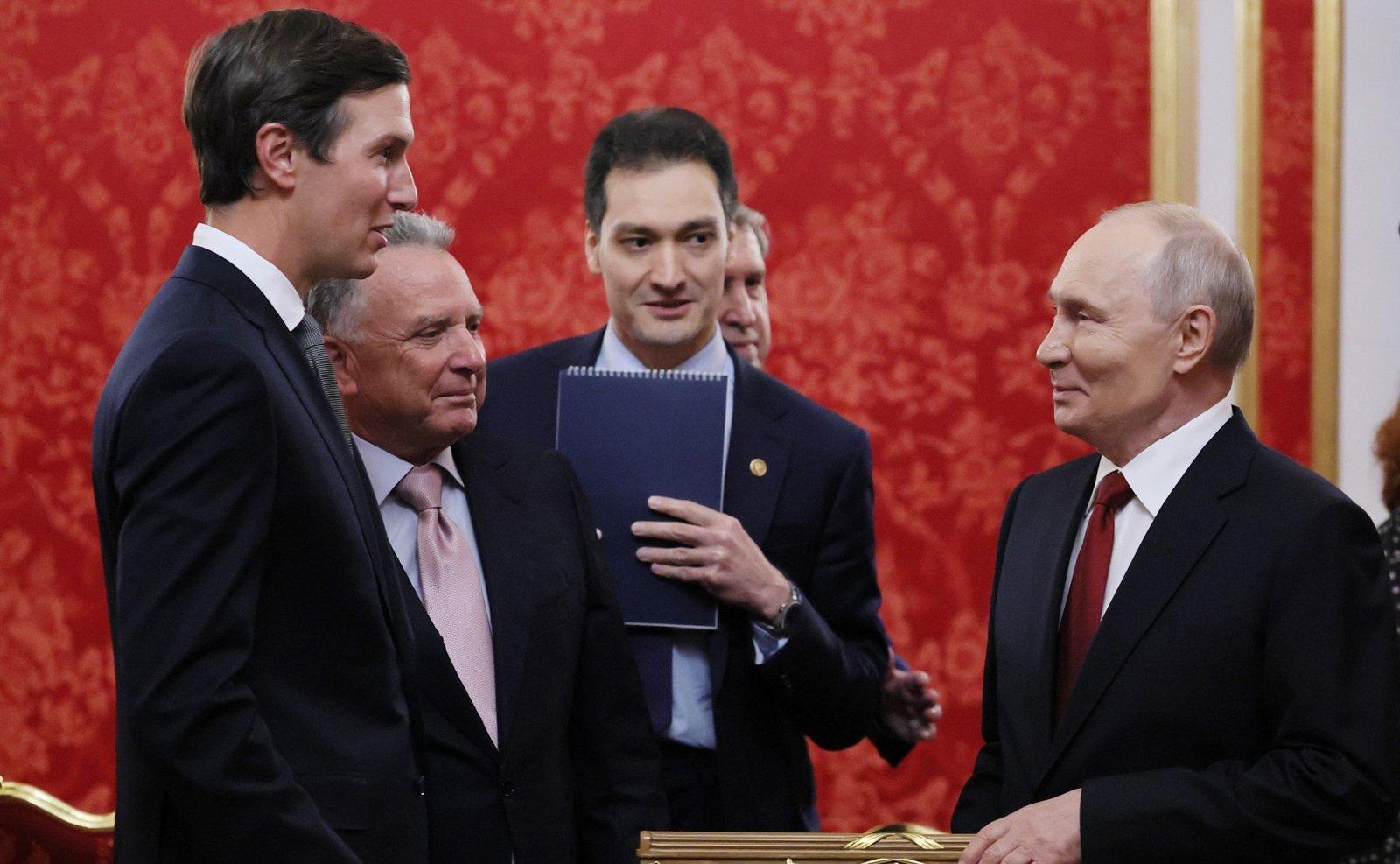
Russian President Vladimir Putin met US special envoys Steve Witkoff and Jared Kushner at the Kremlin on Thursday, 12 November, for about two and a half hours, the day after the first trilateral Russia-Ukraine-US talks in nine months ended in Abu Dhabi. Neither side announced a breakthrough. In the public part of the meeting Putin proposed a new humanitarian evacuation of civilians from the frontline town of Kostiantynivka in Ukraine's Donetsk region, while the Americans said they hoped to announce a new round of talks that would "hopefully include the Europeans".
The envoys then left for Dublin, where Ukrainian President Volodymyr Zelensky is attending the European Political Community summit and was due to receive a briefing from them on Thursday evening.
Who was at the Kremlin meeting and how long did it last?
According to the Kremlin's official transcript, Putin was joined by his foreign policy aide Yury Ushakov, aide Vladimir Medinsky, who led Russia's delegation in Abu Dhabi, and Kirill Dmitriev, head of the Russian Direct Investment Fund and Putin's special envoy for economic cooperation. TASS reported that the talks began at about 3:05 p.m. Moscow time (about 5:05 p.m. in Pakistan and 12:05 p.m. GMT) and lasted more than two hours; RIA Novosti put the length at about two and a half hours. Ushakov had held preliminary consultations with the two Americans at their hotel that morning, TASS and APA reported.
It was not the envoys' first visit: the Kremlin also hosted Witkoff and Kushner on 5 September 2026.
What did Putin propose?
In his remarks, as reported by RIA Novosti and BBC News Russian, Putin suggested repeating the kind of humanitarian operation carried out earlier in Oleshky (which Russia calls Aleshki) in occupied Kherson region. "In Donbas there is a town, Konstantinovka, where there are still about 400 to 500 civilians," he said, according to RIA Novosti's report in Russian. "Let us do the same as we did in Aleshki, and invite representatives of the foreign press, including the American press."
Putin said Russia would need five days to clear mines around the town, and proposed that Russia's human rights commissioner, Yana Lantratova, and Ukraine's ombudsman, Dmytro Lubinets, organise the mission. He claimed Russia controls Kostiantynivka and would guarantee security; "if, as the Ukrainian authorities claim, they control this city, let them provide security," he added. Control of the town is disputed, and The Daily Context could not independently verify battlefield claims by either side.
Kyiv was sceptical. Dmytro Lytvyn, an adviser to Zelensky, told BBC News Russian that Russia had used the Oleshky operation to rotate troops and bring in equipment, "so it is clear what they want in Kostiantynivka. But we need to find out all the details."
In the opening exchanges published by the Kremlin, Putin also thanked President Donald Trump for arranging contacts with Ukraine and US First Lady Melania Trump for her involvement in the Oleshky issue, and said "another important step" on prisoner exchanges was being planned.
What did Putin say about territory, Europe and foreign troops?
RIA Novosti summarised several further statements from Putin. He said that for Russia there is only one dividing line with Ukraine, the "state border" line. Russia's constitution now claims four Ukrainian regions, Donetsk, Luhansk, Kherson and Zaporizhzhia, as Russian territory, BBC News Russian noted, which Ukraine and most of the world reject. Putin also said any peace must be lasting, that the presence of foreign troops in Ukraine would be unacceptable and that such troops would be "legitimate targets" for the Russian army.
On Europe, Putin said Moscow had never opposed dialogue and that Europeans had cut off contact themselves. He said he would like the United States to work with Europe so it could decide "whether it wants peace or war".
What did Witkoff and Kushner say?
Witkoff told Putin, in the Kremlin's English transcript: "We are resetting the trilateral talks." He called the Abu Dhabi meetings "very positive" and said the planned prisoner exchange "will be the largest one ever done" and "underscores the progress that we have been making". He added that European officials had been in the UAE, though "not at the table directly with us", and had been briefed. "We are hopeful that we can announce shortly – hopefully, even at the end of this meeting – the next trilateral meeting that will hopefully include the Europeans," he said.
Kushner said the Russian, Ukrainian and European delegations in Abu Dhabi "all agreed that they want the war to end" and "agreed on many of the principles but are still apart on some of the ways to accomplish that". He said that if talks "move to a multilateral format, we will continue to make progress", and that a conversation on long-term security between Russia, Ukraine and Europe had begun.
At the time of writing, no date or venue for a new round had been published, and BBC News Russian reported that neither side had issued a statement on the results of the closed part of the meeting. RIA Novosti's summary of Witkoff's remarks said a new round had been agreed in principle; readers should treat that as unconfirmed until a date is announced.
Why is Europe's role such a sticking point?
The US approach has shifted toward a wider "security architecture" for Europe alongside a Russia-Ukraine settlement. Citing Axios sources, BBC News Russian reported that the envoys told Moscow that serious discussion of European security would require Europeans at the table, and asked Russia to set out new proposals, including "symmetric steps" toward de-escalation. Moscow has resisted: Medinsky called European officials in Abu Dhabi "tourists", and Deputy Foreign Minister Sergei Ryabkov said on Thursday that involving Europeans could derail useful efforts. Before the meeting Ushakov said of the EU's search for a single negotiator, "I think this is really going to be difficult," TASS reported.
In Dublin, Zelensky told the summit's first plenary session that "we need to make sure that Europe becomes a regular part of these negotiations", RTÉ reported, warning that the talks were "not just about security guarantees for Ukraine" but about "some kind of new security framework between Europe and Russia", according to Politico Europe. German Chancellor Friedrich Merz said he expected Moscow "to finally agree to these joint talks", while EU foreign policy chief Kaja Kallas said she had seen no goodwill from Moscow and that a ceasefire must come first. Taoiseach Micheál Martin said Europe's representation would be discussed on the summit's margins and more formally at the EU leaders' meeting on Friday.
What happens next?
- Dublin briefing: Witkoff and Kushner were due to brief Zelensky in Dublin on Thursday evening. Zelensky had said he was sceptical the Americans would "come back to Dublin with something concrete", Meduza reported.
- Prisoner exchange: All three delegations say a large swap has been agreed in principle, but its size and timing have not been officially published.
- Europe's negotiator: EU leaders are expected to discuss on 13 November who could speak for the bloc. Finnish President Alexander Stubb has said a technical meeting including Ukraine, Russia, the US and Europe will take place in the coming weeks, according to Meduza.
- Kostiantynivka: Kyiv has not formally responded to Putin's evacuation proposal.
Meanwhile the fighting continues. Meduza reported that a Russian drone struck an apartment building in Kyiv's Solomianskyi district on Thursday morning, killing one woman and injuring seven people.
For what was agreed in Abu Dhabi, see our earlier report: https://www.thedailycontext.com/article/abu-dhabi-talks-end-prisoner-exchange-kushner-witkoff-putin-moscow-november-2026
Image: Photo: kremlin.ru, CC BY 4.0 (https://creativecommons.org/licenses/by/4.0/), via Wikimedia Commons (https://commons.wikimedia.org/wiki/File:Kushner_Witkoff_Putin.jpg) — file photo from the envoys' 5 September 2026 Kremlin visit, resized; not taken at the 12 November meeting
About this article: prepared by The Daily Context editorial desk using automated, source-based reporting from the publications linked below. No reporter was on the ground.
Sources
- Kremlin, official transcript (12 Nov 2026): http://en.kremlin.ru/events/president/news/81246
- RIA Novosti, in Russian (12 Nov 2026): https://ria.ru/20261112/putin-2131176365.html
- BBC News Russian (12 Nov 2026): https://www.bbc.com/russian/articles/c3qj5lkv900ko
- TASS (12 Nov 2026): https://tass.com/politics/2217255
- TASS (12 Nov 2026): https://tass.com/politics/2216955
- Associated Press (12 Nov 2026): https://apnews.com/article/russia-ukraine-war-putin-kushner-witkoff-683810203340077f33611fd1d1757b23
- RTÉ (12 Nov 2026): https://www.rte.ie/news/ireland/2026/1112/1598960-epc-meetings-dublin/
- Politico Europe (12 Nov 2026): https://www.politico.eu/article/zelenskyy-demands-europe-become-regular-part-of-ukraine-talks/
- Meduza (12 Nov 2026): https://meduza.io/en/feature/2026/11/12/kushner-and-witkoff-hold-talks-with-putin-before-heading-to-meet-zelensky-as-europe-seeks-a-seat-at-the-peace-talks
- APA (12 Nov 2026): https://en.apa.az/cis-countries/putins-aide-holds-preliminary-consultations-with-witkoff-and-kushner-535654
Kabeer Ahmad
Kabeer Ahmad is the founder and editor of The Daily Context. He oversees the site's source-based coverage of world affairs, technology, business, entertainment, lifestyle and sports, and is responsible for its editorial standards, sourcing and corrections.