Sudan war: drone strikes on Khartoum kill four and damage a UN building with staff inside
Drone strikes before dawn on Sunday 22 November 2026 killed at least four civilians in and around Khartoum and damaged a United Nations building while UN staff were inside. The attacks were blamed on the Rapid Support Forces, and a Sudanese army source claimed, without verifiable evidence, that the drones were launched from Ethiopia.
Drone strikes on Sudan's capital region before dawn on Sunday 22 November 2026 killed at least four civilians, wounded at least nine others and damaged a United Nations building while UN staff were inside, according to the UN and local reports. The attacks were blamed on the paramilitary Rapid Support Forces (RSF), which has been at war with the Sudanese army since April 2023. A Sudanese army source claimed the drones had been launched from an airport in neighbouring Ethiopia, an allegation that has not been independently verified and that Addis Ababa has denied in the past.
The strikes are the latest sign that the war, now in its fourth year, is increasingly being fought from the air with long-range drones, putting cities that had begun to recover, including Khartoum, back within reach of the fighting.
What happened in Khartoum on Sunday?
Witnesses quoted by the news agency AFP said explosions were heard around Khartoum airport and in other parts of the city from about 2am until about 4:30am local time (00:00 to 02:30 GMT, or 5am to 7:30am in Pakistan) as Sudanese air defences tried to intercept the drones. Reports said the drones appeared to be aimed at government buildings and the airport, but several came down on or struck residential areas.
Al Jazeera's correspondent in Omdurman, the city across the Nile from central Khartoum, reported that three people were killed and nine wounded when a drone hit a home in northern Omdurman. A child was killed in a separate strike south of the capital, Al Jazeera reported. In the village of Jebel Aulia, roughly 45km south of the city centre, a witness told AFP that a drone had hit the home of a mosque muezzin, the official who calls worshippers to prayer, and that people were trying to rescue relatives trapped under the rubble.
Authorities did not immediately publish an official casualty count, so the figure of four dead rests on local and media reports and may change.
What did the UN say about its building?
Denise Brown, the UN Resident and Humanitarian Coordinator in Sudan, said in a statement on Sunday that "a UN premises, with UN colleagues in the building, was damaged" and that this "occurred in a civilian neighborhood". She said civilians "are not a legitimate target in a war" and that it was "unacceptable" for UN humanitarian staff to be put at such risk. Under international humanitarian law, she noted, humanitarian personnel and assets are protected.
The UN did not say which building was hit, whether any staff were hurt, or which side it held responsible. The UN Office for the Coordination of Humanitarian Affairs (OCHA), which organises the relief effort, repeated the message on social media.
Who is being blamed, and what is the Ethiopia claim?
Local reports and Sudanese officials blamed the RSF, which has repeatedly used drones against army-held cities since it lost control of Khartoum. The RSF had not publicly responded to Sunday's attacks in the reports reviewed for this article.
A Sudanese army source told AFP the attack was "a continuation of Ethiopian aggression against Sudanese territory" and said the drones had taken off from Bahir Dar airport in Ethiopia's Amhara region. AFP and other outlets said the claim could not be independently verified. Ethiopia has previously denied allowing the RSF to operate from its territory, and has in turn accused Sudan's military of backing rebels linked to the Tigray People's Liberation Front, which Khartoum denies.
The accusation is not new. On 1 November, Sudan's foreign ministry said it had filed complaints with the UN Security Council and the African Union's Peace and Security Council. A report from the army-led Transitional Sovereignty Council alleged 70 attacks between 15 February and 27 October involving 187 one-way attack drones launched from Ethiopian soil, naming Asosa airport, the Kurmuk-Gizen border area and Bahir Dar airbase as launch sites, and said the strikes had killed or wounded 484 civilians. Those figures are Sudanese government claims and have not been independently confirmed.
Why are drones now so central to Sudan's war?
The UN Human Rights Office (OHCHR) said on 17 November that it had confirmed the killing of more than 2,230 civilians in Sudan between January and the end of October 2026, more than 1,630 of them in drone strikes. Its mid-year report found that drones caused more than 80 per cent of documented civilian casualties in the first half of the year and killed at least 1,120 civilians, with markets, hospitals, schools, fuel depots and water sources among the targets. The UN children's agency UNICEF has said drone attacks accounted for about two-thirds of children killed or injured in Sudan between January and September.
Both the army and the RSF use drones. They allow either side to hit targets hundreds of kilometres away without risking ground troops, which has spread the war far beyond the front lines in Darfur, Kordofan and Blue Nile state. UN Secretary-General António Guterres said on 31 October that he strongly condemned the escalating drone attacks "by the parties to the conflict", after a strike on a market in RSF-held Darfur killed more than 100 people.
Why does an attack on Khartoum matter?
Khartoum was the main prize of the war's first two years. The army pushed the RSF out of central Khartoum in March 2025 and later declared the wider capital region cleared. Since then, UN agencies and some foreign missions have gradually returned, and the UN refugee agency says about 2.5 million people had returned to the capital area as of October 2026. Repeated drone strikes on the city undermine that recovery, threaten power stations and other infrastructure, and raise the risk for aid workers who use Khartoum as a base.
The wider toll is immense. Aid agencies estimate that more than 200,000 people have been killed since April 2023, more than 13 million have been forced from their homes, and parts of the country have slipped into famine.
What is still unclear, and what happens next?
Key questions remain open: an official death toll, whether the UN building was a specific target or was hit while drones were aimed elsewhere, and where the drones were launched from. The Ethiopia allegation, if substantiated, would sharpen an already tense regional dispute; for now it rests on a single army source.
Separately on Sunday, Sudan's government accused RSF fighters of executing captured soldiers in Blue Nile state near the Ethiopian border, a claim that has also not been independently verified. Diplomatic efforts to secure a ceasefire have repeatedly stalled, and the OHCHR report urges all parties to stop attacks on civilian infrastructure and calls on outside states to halt arms transfers used in violation of international law.
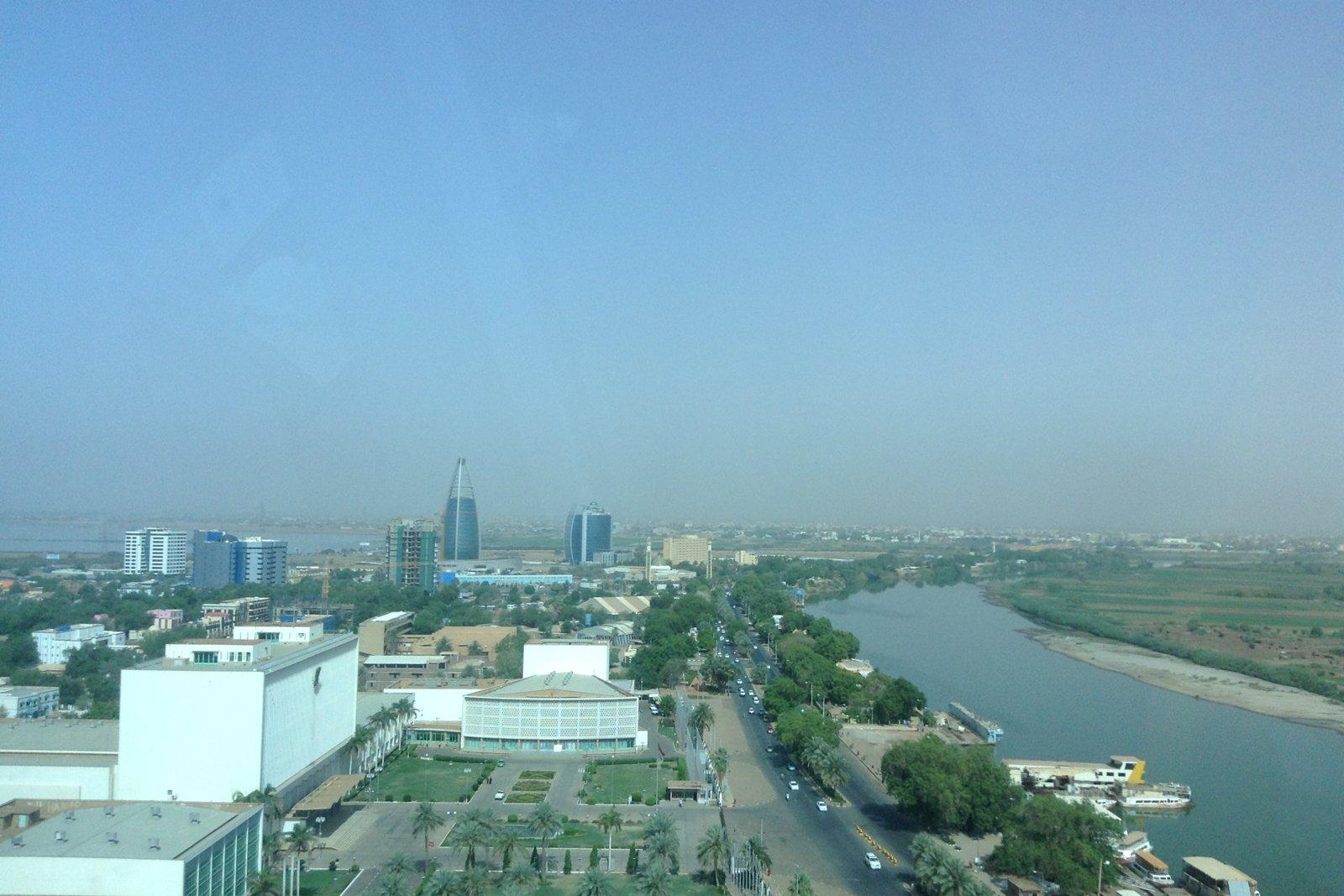
Image: File photo: central Khartoum and the Nile seen from the Corinthia Hotel, May 2013; it does not show the November 2026 attacks. Image: AbhiSuryawanshi, CC BY-SA 3.0 (https://creativecommons.org/licenses/by-sa/3.0/), via Wikimedia Commons (https://commons.wikimedia.org/wiki/File:Khartoum_aerial_view_from_Corinthia_Hotel.JPG); cropped and resized
About this article: prepared by The Daily Context editorial desk using automated, source-based reporting from the publications linked below. No reporter was on the ground.
Sources
- United Nations in Sudan: Statement by Resident and Humanitarian Coordinator Denise Brown (22 November 2026): https://sudan.un.org/en/326492-statement-united-nations-resident-and-humanitarian-coordinator-sudan-denise-brown-drone
- Al Jazeera/AFP, "Drone attacks kill four near Sudan's capital, damage UN building" (22 November 2026): https://www.aljazeera.com/news/2026/11/22/rsf-drones-kill-four-in-khartoum
- ABC News (Australia), "Drone strikes kill four in Khartoum and damage UN building" (23 November 2026): https://www.abc.net.au/news/2026-11-23/deadly-drone-strikes-in-khartoum-sudan-war/107415908
- Arab News/AFP, "Drone strikes hit homes, UN premises in Sudan's capital" (22 November 2026): https://www.arabnews.com/middle-east/drone-strikes-hit-homes-un-premises-in-sudans-capital-3013486
- DW, "Sudan: Drones hit UN building, residential area in Khartoum" (22 November 2026): https://www.dw.com/en/sudan-khartoum-drone-strike-un-building/a-80015122
- Al Jazeera, "Sudan files complaints against Ethiopia with UN over deadly drone spree" (2 November 2026): https://www.aljazeera.com/news/2026/11/2/sudan-files-complaints-against-ethiopia-with-un-over-deadly-drone-spree
- OHCHR, "Sudan: A fourth year of war brings mounting suffering for civilians" (20 November 2026): https://www.ohchr.org/en/stories/2026/11/sudan-fourth-year-war-brings-mounting-suffering-civilians
- UN Geneva newsroom, OHCHR briefing on Sudan (17 November 2026): https://www.unognewsroom.org/story/en/3329/un-human-rights-office-spokesperson-marta-hurtado-and-un-human-rights-office-representative-li-fung-on-conflict-in-sudan
- UN Secretary-General statement on drone attacks in Sudan (31 October 2026): https://press.un.org/en/2026/sgsm23353.doc.htm
Kabeer Ahmad
Kabeer Ahmad is the founder and editor of The Daily Context. He oversees the site's source-based coverage of world affairs, technology, business, entertainment, lifestyle and sports, and is responsible for its editorial standards, sourcing and corrections.