India pledges $1.62bn package for flood-hit Nepal as Balendra Shah and Modi sign eight agreements
Indian Prime Minister Narendra Modi announced a 240 billion Nepalese rupee (about $1.62bn) development package for flood-hit Nepal on 23 November 2026 after talks with Nepal's Prime Minister Balendra Shah, as the two sides signed eight agreements and launched rail, road, fuel and hydropower projects. The loan-grant mix and long-running border disputes were not addressed publicly.
India will give Nepal a development package worth 240 billion Nepalese rupees, about $1.62 billion, Prime Minister Narendra Modi said on Monday 23 November 2026 after talks in New Delhi with his Nepali counterpart, Balendra Shah. The money is meant to help Nepal rebuild after a catastrophic flood in August and to support longer-term development.
The two governments also signed eight memorandums of understanding (MoUs), opened a new passenger train between Ayodhya in India and Janakpur in Nepal, inaugurated a cross-border road bridge and the second phase of a fuel pipeline, and laid foundation stones for a hydropower plant, a fuel terminal and a border checkpoint. What was not announced publicly is just as important for many Nepali commentators: how much of the package is grant and how much loan, and any movement on the two countries' long-standing boundary disputes.
What did Modi announce?
Speaking to the media after the talks at Hyderabad House, with Shah beside him, Modi said: "Today, to give fresh impetus to Nepal's reconstruction and long-term development, we are announcing a development cooperation package worth 24,000 crore (240 billion) Nepalese rupees," according to Reuters. He said the aim was to help affected families "get their lives back on track, create new opportunities and further strengthen Nepal's capacity to deal with future disasters".
The Nepali news site Setopati noted that it had not yet been disclosed how much of the package would come as loans and how much as grants. Before the visit, Nepali media reported that Kathmandu had asked for assistance of about $2 billion and that a package of around $1.5 billion was expected, Nepal News reported, citing earlier coverage by the Kantipur Media Group.
Modi also said India would set up a start-up or enterprise promotion centre, an innovation hub and an offshore campus of an Indian Institute of Technology in Nepal, according to The Economic Times and The Rising Nepal. The Economic Times added that the two sides plan more scholarships in law and technology for Nepali students in India and an agro-industrial park in Nepal.
What did the two countries sign?
The eight MoUs, as listed by the Hindustan Times and Business Standard, cover:
- academic and research collaboration between India's National Forensic Sciences University in Gandhinagar and Nepal Police's Crime Investigation Department;
- cooperation between India's Rashtriya Raksha University and Nepal's National Police Academy;
- training for Nepali civil servants by India's National Centre for Good Governance and Nepal's Administrative Staff College;
- cooperation on Ayurveda and other traditional systems of medicine;
- a satellite communication network for Nepal using the South Asia Satellite, between the Indian Space Research Organisation and Nepal's Ministry of Information and Communication;
- technical cooperation on sustainable urban development;
- cooperation on health and medicine between the two health ministries;
- cooperation on livestock and fisheries development.
The leaders also took part, virtually, in a series of project launches. These were the new Saryu-Kamala Express train between Ayodhya Cantonment in Uttar Pradesh and Janakpur Dham; a motorable bridge between Dharchula in India's Uttarakhand state and Darchula in far-western Nepal; the second phase of the Motihari-Amlekhgunj petroleum pipeline; and foundation stones for an integrated check post at Banbasa in Uttarakhand, a petroleum storage terminal in Jhapa in eastern Nepal linked to a proposed Siliguri-Jhapa pipeline, and the 669-megawatt Lower Arun hydropower project, the Kathmandu Post and Business Standard reported.
According to The Rising Nepal, Modi also said India would give Nepal access to the ports of Kandla in Gujarat and Paradip in Odisha for its transit trade, would speed up work on an integrated check post at Dodhara Chandani, and remained committed to completing the Arun-III hydropower project on schedule.
Why does the package matter for Nepal?
Nepal is still recovering from the flood of 26 August 2026. Reuters reported that it was caused by a glacier collapse on Nepal's border with China, which sent a mass of mud and rock into the Trishuli river, washing away villages, highways, bridges and power lines. Some 1,500 people were killed and about 5,200 others are missing and presumed dead. Mint, citing Nepali authorities, put losses at an estimated $4.7 billion, and reported that the UN Fund for Responding to Loss and Damage had pledged about $20 million.
Set against those losses, India's package is substantial, though its real value depends on its terms. Nepal News argued that the share of grants, the interest rates and repayment periods of any concessional loans, and the choice of projects will determine whether it eases Nepal's recovery or adds to its debt burden.
Shah thanked India for consistently acting as a first responder for Nepal "in times of natural disasters and difficult hours", Reuters reported, and said: "I warmly welcome Indian investors to Nepal to partner in the economic prosperity of our two countries in the coming days." He invited Modi to visit Nepal. Business Standard quoted Shah as saying that "mutual respect, steadfast trust and unbroken goodwill are the bedrock of India-Nepal relations", and Modi as saying: "We will together write a golden chapter of India-Nepal relations."
Who is Balendra Shah and why is this visit significant?
Shah, a former mayor of Kathmandu widely known as Balen, became prime minister in March 2026, after the youth-led "Gen Z" protests of 8 and 9 September 2025 brought down the previous government and a new political force came to power, Nepal News reported. This two-day trip, from 22 to 23 November, is his first bilateral visit abroad as prime minister.
His delegation included Finance Minister Swarnim Wagle and Foreign Minister Shisir Khanal, while the Indian side included External Affairs Minister S Jaishankar and National Security Adviser Ajit Doval, according to the Kathmandu Post. Nepal News reported that the talks, a one-to-one meeting followed by delegation-level discussions, lasted about 100 minutes. Shah received a ceremonial welcome at Rashtrapati Bhavan and paid tribute at Rajghat, the Mahatma Gandhi memorial, before the talks.
India is one of Nepal's largest trading partners and a major supplier of its fuel, and an open border lets hundreds of thousands of Nepalis live and work in India. Modi said India had kept supplies of fuel, fertiliser and other essentials flowing to Nepal despite supply challenges this year, according to Business Standard and The Rising Nepal.
What was left unresolved?
Several issues that Nepali politicians had urged Shah to raise did not feature in the public announcements.
The two countries disagree over territory at Kalapani, Lipulekh and Limpiyadhura in the far west, and at Susta in the south. Nepal News reported that no public details showed any concrete understanding on these disputes during the visit. Nepal's opposition and the Kathmandu Post's editorial board had also urged Shah to press India to formally receive the report of the Eminent Persons' Group, a joint panel that finished its review of bilateral ties and treaties, including the 1950 Treaty of Peace and Friendship, in July 2018. India has never formally accepted it, and there was no public word on it on Monday.
Nepal has also long asked India for additional air entry routes so that its new international airports at Bhairahawa and Pokhara can operate more fully. Nepal News reported that this demand remains unresolved, and that India offered access to Kandla and Paradip after Nepal had asked to use the privately run port of Mundra in Gujarat.
The Kathmandu Post noted before the visit that many past prime ministerial trips to New Delhi ended with similar promises on the boundary, the 1950 treaty and the long-delayed Pancheshwar multipurpose project that were not followed through.
What happens next?
The details of the package, including its financing terms and which projects it will fund, have yet to be published. Commercial use of the two additional ports will depend on transit fees, customs procedures and rail and road links to the Nepali border. The Saryu-Kamala Express and the new Darchula bridge are expected to ease travel for pilgrims and border communities, and the Lower Arun and Arun-III projects are central to Nepal's hopes of exporting more electricity to India.
This article is based on statements reported by Indian and Nepali media and Reuters on 23 November. A full joint statement had not been located at the time of writing, and some figures, including the size of Nepal's original request, come from pre-visit media reports rather than official documents.
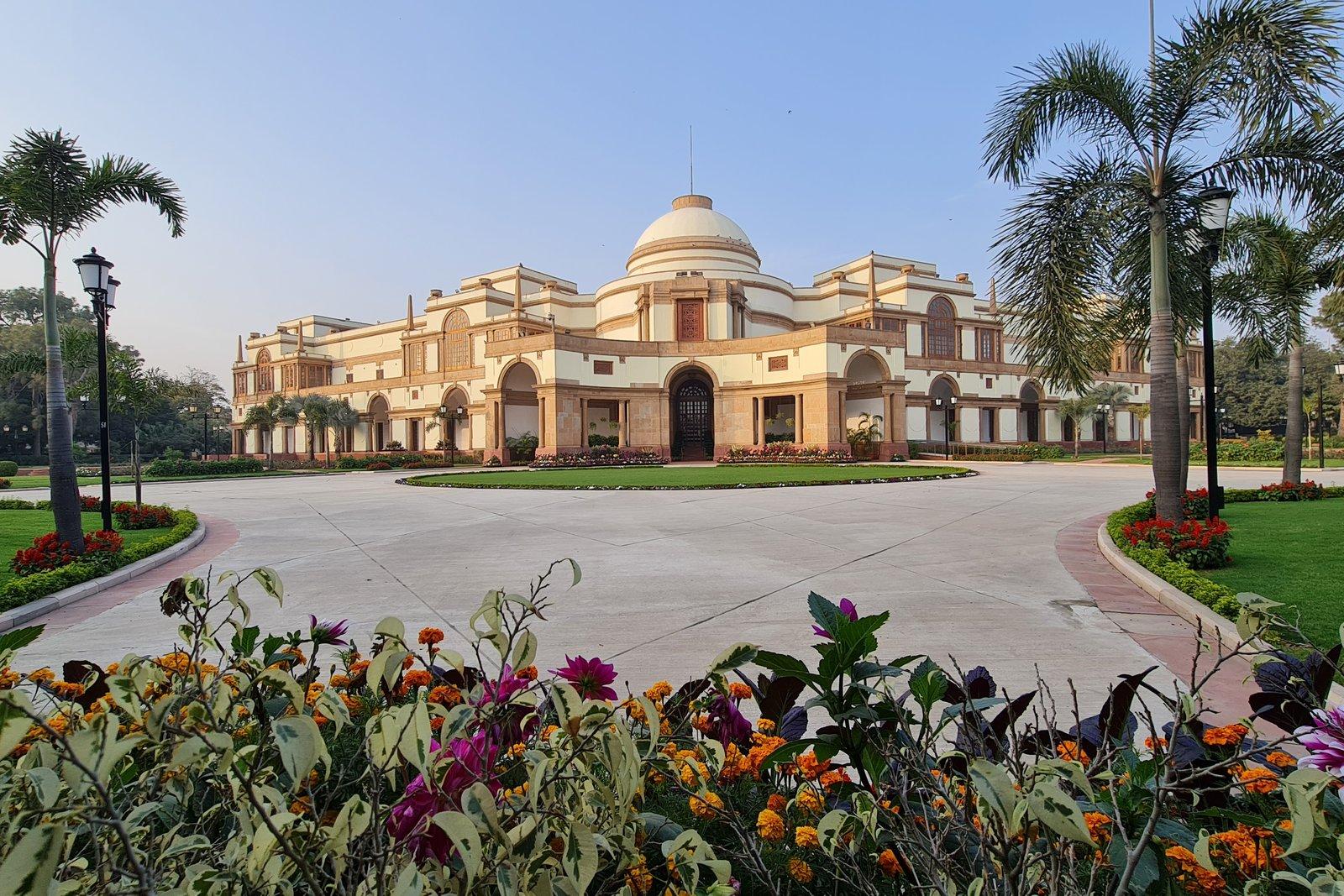
Image: File photo: Hyderabad House, New Delhi, where the two prime ministers held talks, February 2022; not taken during the 23 November 2026 visit. Image: Aloofmanish, CC BY-SA 4.0 (https://creativecommons.org/licenses/by-sa/4.0/), via Wikimedia Commons (https://commons.wikimedia.org/wiki/File:Hyderabad_House,_India_Gate,_New_Delhi.jpg); cropped and resized
About this article: prepared by The Daily Context editorial desk using automated, source-based reporting from the publications linked below. No reporter was on the ground.
Sources
- Dawn (Reuters): India to give $1.62bn economic package to flood-hit Nepal (23 November 2026): https://www.dawn.com/news/2046531
- Business Standard: India, Nepal sign 8 MoUs, advance six projects to deepen bilateral ties (23 November 2026): https://www.business-standard.com/external-affairs-defence-security/news/india-nepal-sign-8-mous-advance-six-projects-to-deepen-bilateral-ties-126112300546_1.html
- The Kathmandu Post: Nepal and India sign eight MoUs on cooperation in multiple sectors (23 November 2026): https://kathmandupost.com/national/2026/11/23/nepal-and-india-sign-eight-mous-on-cooperation-in-multiple-sectors
- The Kathmandu Post: Shah-Modi bilateral talks conclude in New Delhi (23 November 2026): https://kathmandupost.com/national/2026/11/23/shah-modi-bilateral-talks-conclude-in-new-delhi
- Hindustan Times: India, Nepal sign 8 MoUs from space to security as Modi hosts Balen Shah (23 November 2026): https://www.hindustantimes.com/india-news/india-nepal-sign-mous-from-space-to-security-as-pm-modi-hosts-balen-shah-projects-new-delhi-101795422134990.html
- Setopati: Indian PM Modi announces Rs 240 billion development cooperation package for Nepal (23 November 2026): https://en.setopati.com/political/167571
- The Rising Nepal: PM Shah and Indian counterpart Modi hold joint press meet (23 November 2026): https://risingnepaldaily.com/news/88934
- The Economic Times: PM Modi announces $1.62 billion development package for Nepal (23 November 2026): https://m.economictimes.com/news/india/pm-modi-announces-1-62-billion-development-package-for-nepal-to-strengthen-bilateral-relations/amp_articleshow/136094455.cms
- Mint: PM Modi meets Nepal PM Balendra Shah, announces $1.6 billion aid package (23 November 2026): https://www.livemint.com/news/india/pm-modi-meets-nepal-pm-balendra-shah-announces-1-6-billion-aid-package-for-himalayan-nations-flood-recovery-11795425668391.html
- Nepal News: Balen's Delhi visit puts economic ties on a new track, but old disputes remain (23 November 2026): https://english.nepalnews.com/s/long-reads/balens-delhi-visit-puts-economic-ties-on-a-new-track-but-old-disputes-remain/
- The Kathmandu Post: Old differences continue to weigh on Nepal-India ties (20 November 2026): https://kathmandupost.com/national/2026/11/20/old-differences-continue-to-weigh-on-nepal-india-ties
- The Kathmandu Post (editorial): Shah must use his India visit to push for progress on longstanding issues (17 November 2026): https://kathmandupost.com/editorial/2026/11/17/shah-must-use-his-india-visit-to-push-for-progress-on-longstanding-issues
Kabeer Ahmad
Kabeer Ahmad is the founder and editor of The Daily Context. He oversees the site's source-based coverage of world affairs, technology, business, entertainment, lifestyle and sports, and is responsible for its editorial standards, sourcing and corrections.