FCC authorises SpaceX to launch up to 1 million 'Starmind' data-centre satellites
The US Federal Communications Commission has given SpaceX conditional permission to deploy up to one million satellites designed to work as data centres in orbit, rejecting objections from Amazon, Viasat and astronomers. SpaceX has until 2033 to launch the first one and until 2040 to complete the system.
The US Federal Communications Commission (FCC) has authorised SpaceX to deploy a constellation of up to one million satellites intended to operate as data centres in orbit, a project the company calls "Starmind". The order, adopted and released on Wednesday 25 November by the FCC's Space Bureau, is the first US authorisation for a constellation of orbital data centres, according to the agency.
The approval is partial and conditional. It gives SpaceX until 25 November 2033 to put its first Starmind satellite into operation and until 2040 to finish the system, but it defers a decision on how the company may dispose of satellites at the end of their lives. It does not settle whether computing in orbit can work technically or economically.
What exactly did the FCC approve?
The order (DA 26-1273) grants SpaceX authority for a non-geostationary constellation of up to 1,000,000 satellites in orbital shells between roughly 500 km and 1,002 km above Earth, at 30-degree and sun-synchronous inclinations. The satellites are meant to talk to each other and to the ground mainly by laser, or optical, links. What the FCC licensed is radio spectrum for backup and emergency telemetry, tracking and command in two Ka-band ranges, 18.8-19.3 GHz downlink and 28.6-29.1 GHz uplink, to be used "only in the event its optical links experience a failure". Those operations must be on an unprotected, non-interference basis, meaning SpaceX cannot cause interference to other operators or claim protection from them.
The licence comes with deployment milestones. SpaceX must have one satellite operating by 25 November 2033, 10% of the maximum (100,000 satellites) by 25 November 2035, 50% by 25 November 2038 and the full constellation by 25 November 2040. The order says the authorisation "will therefore become null and void" if the satellites are not deployed on that schedule. The FCC also waived its surety bond rules for the system, and the licence term is 15 years from when the first satellite is certified as operating.
SpaceX filed the application on 30 January 2026. In the order, the bureau said granting it would let SpaceX "pioneer emergent technology that advances American leadership in space and artificial intelligence".
What did the FCC and SpaceX say?
"The FCC supercharges that effort today by granting, for the first time ever, authorization to deploy 1 million orbital compute modules for data centers in space," FCC Chairman Brendan Carr said in a statement. "This action opens a bold new frontier for the computing infrastructure needed to power America's leadership and growth." The agency said it is reviewing other orbital data-centre proposals.
Elon Musk, SpaceX's founder, replied to the announcement on X: "Much appreciated. This will be a great asset to America and the world." According to Spaceflight Now, Musk said at an event hosted by Baron Capital that he expects the first Starmind satellites to launch in the third quarter of 2027, with "significant volume probably in '28 and then very large volume in '29". SpaceX is developing the spacecraft with Nvidia and plans to launch them on its Starship rocket, the outlet reported.
In its filing, quoted by Reuters, SpaceX argued that "by directly harnessing near-constant solar power with little operating or maintenance costs, these satellites will achieve transformative cost and energy efficiency while significantly reducing the environmental impact associated with terrestrial data centers."
How big is a million satellites?
Very big. Reuters puts the number of satellites currently in orbit at about 17,000, and Ars Technica calculated that a full Starmind system would increase the total roughly 50-fold. SpaceX's existing Starlink broadband network has close to 11,200 satellites in orbit, according to tracking by astronomer Jonathan McDowell cited by Spaceflight Now.
The individual spacecraft would also be large. SpaceX describes a wingspan of 75 metres and a height of 30 metres. Michael Nicholls, SpaceX's senior vice president for Starlink and AI, told the International Astronautical Congress in October that each might draw around 250 kilowatts, "roughly a rack of compute in space", operating in tight clusters of about ten satellites linked by around 10 terabits of bandwidth.
Reuters noted that operators sometimes request approval for more satellites than they intend to launch, to keep design flexibility.
Why do critics object?
Amazon's satellite unit (Kuiper Systems, now Amazon Leo), Viasat and the American Astronomical Society (AAS) filed petitions asking the FCC to deny the application, raising radio interference among other concerns. Groups including the Secure World Foundation and Dark Sky International raised collision risk, orbital debris, light pollution and atmospheric effects, and Ars Technica reports the FCC received about 1,500 public comments. The bureau rejected the petitions, saying SpaceX's limited use of Ka-band addressed interference concerns.
On the environment, the FCC relied on an October 2026 order concluding that space-based activities licensed by the commission are "extraterritorial" and do not trigger its obligations under the National Environmental Policy Act. It said launch emissions were outside its purview and that concerns about the atmosphere from satellites burning up on re-entry "remain speculative and not supported in the record", as quoted by Ars Technica. It added that the Federal Aviation Administration reviews the environmental effects of rocket launches.
The AAS said it was "disheartened and dismayed", warning of "a fundamentally altered night sky" and criticising "the lack of formal coordination requirements" with astronomers. The FCC said optical-astronomy concerns were addressed in SpaceX's application or fell outside the scope of a radio licence. FCC chairman Carr had dismissed Amazon's criticism in March, saying the company "should focus on getting Amazon's house in order with their own launches", Reuters reported.
What questions remain?
The most important limit is end-of-life disposal. SpaceX asked for flexibility to move retired satellites above 600 km into "Earth disposal orbits or heliocentric orbits" around the Sun, rather than letting them burn up in the atmosphere. The FCC deferred that waiver because SpaceX "has not provided sufficient information" to show compliance, and said SpaceX must seek a modification before launching any Starmind satellite that will not re-enter. SpaceX has told the FCC its satellites are designed to fully burn up on re-entry.
Beyond the licence, it remains unproven that large-scale computing in orbit can be built, cooled, maintained and launched at a cost that competes with data centres on the ground, and it depends on Starship reaching high launch rates. Spaceflight Now reports Starship has so far deployed 52 of SpaceX's larger Starlink V3 satellites.
What happens next?
SpaceX now has a regulatory runway of up to 14 years. Watch for its first Starmind launches, which Musk has pencilled in for late 2027, any application to modify the disposal plan, possible challenges from opponents, and FCC decisions on rival orbital data-centre proposals that the agency says it is still reviewing.
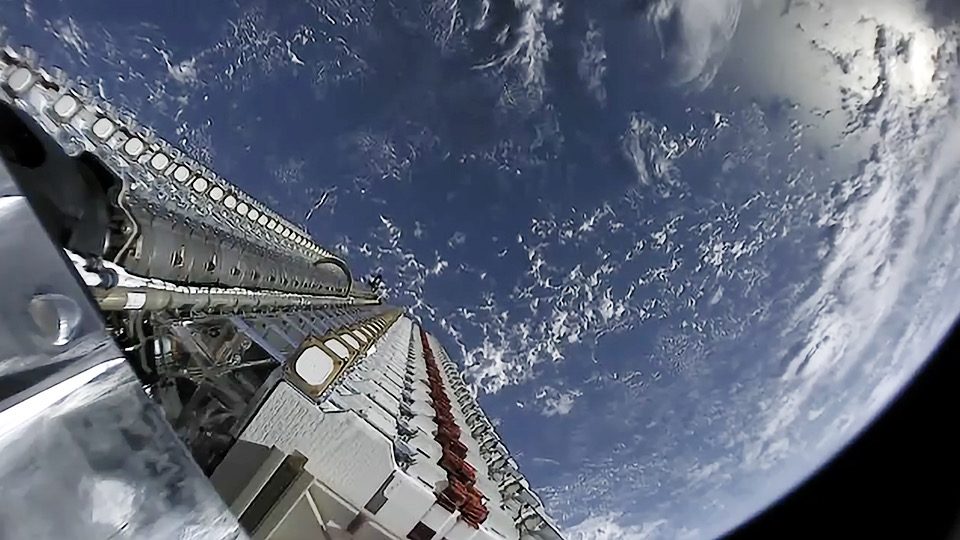
Image: File photo: a stack of 60 Starlink satellites before deployment, 24 May 2019 (Starlink satellites, not the proposed Starmind spacecraft). Photo: Official SpaceX Photos, CC0 public domain dedication, via Wikimedia Commons (https://commons.wikimedia.org/wiki/File:Starlink_Mission_(47926144123).jpg)
About this article: prepared by The Daily Context editorial desk using automated, source-based reporting from the publications linked below. No reporter was on the ground.
Sources
- FCC: FCC Authorizes 1 Million Satellites for Data Centers in Space, news release (25 November 2026): https://eu-assets.contentstack.com/v3/assets/blt23eb5bbc4124baa6/blt3284fad4ee39d97e/6b071287af911015536d731d/FCC_Authorizes_1_Million_Satellites_for_Data_Centers_in_Space_PR_11-25-2026.pdf
- FCC Space Bureau: SpaceX Orbital Data Center System, Memorandum Opinion and Order and Authorization, DA 26-1273 (25 November 2026): https://eu-assets.contentstack.com/v3/assets/blt23eb5bbc4124baa6/bltf4cdf2af47159e12/6b071c5f5506bb38bca5b0ec/FCC_report_and_order_on_SpaceX_Starmind_AI_constellation_11-25-2026.pdf
- FCC: Space headlines (25 November 2026): https://www.fcc.gov/news-events/headlines/13329
- Ars Technica: The FCC has authorized SpaceX to deploy 1 million satellites (25 November 2026): https://arstechnica.com/space/2026/11/the-fcc-has-authorized-spacex-to-deploy-1-million-satellites/
- Spaceflight Now: FCC green lights SpaceX's plan to launch 1 million 'Starmind' data center satellites (26 November 2026): https://spaceflightnow.com/2026/11/26/fcc-green-lights-spacexs-plan-to-launch-1-million-starmind-data-center-satellites/
- Reuters via NBC News: SpaceX gets green light to deploy 1 million satellites for data centers in space (25 November 2026): https://www.nbcnews.com/science/space/spacex-fcc-authorizes-1-million-satellites-data-centers-space-rcna611341
- CNBC: SpaceX wins FCC approval for 1 million orbital data center satellites (25 November 2026): https://www.cnbc.com/2026/11/25/spacex-fcc-satellite-approval.html
Kabeer Ahmad
Kabeer Ahmad is the founder and editor of The Daily Context. He oversees the site's source-based coverage of world affairs, technology, business, entertainment, lifestyle and sports, and is responsible for its editorial standards, sourcing and corrections.