FAA nationwide ground stop: what caused it and what travellers face now
The US Federal Aviation Administration halted departures at every US airport for more than four hours on Friday, 13 November 2026, after a communications failure hit several regional air traffic control centres. Officials blamed overloaded legacy equipment, said there was no sign of a cyberattack, and FlightAware data showed more than 12,500 US flights cancelled across Friday and Saturday morning.
The US Federal Aviation Administration (FAA) stopped all departures at every airport in the United States on the afternoon of Friday, 13 November 2026, after communication problems struck several of the regional centres that guide aircraft between airports. The nationwide ground stop lasted more than four hours, ending at about 8:15 p.m. Eastern time (6:15 a.m. Saturday in Pakistan). Transportation Secretary Sean Duffy blamed overloaded, decades-old network equipment, and Homeland Security Secretary Markwayne Mullin said officials had seen no evidence of a cyberattack. The knock-on effects continued into Saturday: by Saturday morning, flight tracker FlightAware counted more than 12,500 US cancellations across the two days, according to ABC News.
Every aircraft that was airborne when the order was issued landed safely, officials said. CNN reported that more than 3,500 planes were in the air at the time.
What happened on Friday?
The FAA said in a preliminary statement that it had issued "a nationwide ground stop for all U.S. airports following communication issues impacting multiple Air Route Traffic Control Centers", and that its technicians were investigating. Air Route Traffic Control Centers, often shortened to ARTCCs or "en route centres", handle aircraft at cruising altitude between departure and arrival areas. There are about 20 of them covering the continental United States, so a failure affecting several at once touches flights almost everywhere.
A ground stop is the FAA's bluntest traffic-management tool. Aircraft that have not yet taken off are held at their gates; flights already in the air continue to their destinations or divert. CNBC reported that the halt began around 4 p.m. Eastern time. An advisory from the FAA's Air Traffic Control System Command Center, which coordinates national traffic flow, listed the reason simply as "communications failure" and said that "as enroute facilities recover, flights will be allowed to depart" through coordination with the Command Center.
The Washington Post reported that the stop ended at about 8:15 p.m. Eastern after nearly four and a half hours. Before clearing departures, the FAA said, "we thoroughly tested our systems to confirm they were stable and that operations remain reliable."
What do officials say caused the outage?
At a White House news conference on Friday night, Duffy described a problem with "old switches, old routers". "We use 1980s little copper lines. It's an old system that went down and went down everywhere. It got overloaded," he said, according to ABC News. CNBC reported his explanation that routers were overloaded with data and began giving air traffic control centres inconsistent information, prompting the decision to stop traffic.
Duffy said the fix pointed to "a legacy network problem" and added that "all of the new equipment that we put in, none of that went down." The Associated Press reported a slightly different emphasis from administration officials: that new technology being added to the system had overloaded antiquated equipment, causing "intermittent" communications and radar gaps. Both accounts point to the interaction between ageing infrastructure and the network carrying it, but a full technical explanation had not been published as of Saturday.
On security, Mullin told reporters: "We have seen zero evidence that this is a cyberattack," according to a Department of Homeland Security summary of the briefing. ABC News reported that he said officials were still investigating, and Anadolu Agency quoted him saying: "We're not ruling out anything."
How many flights were affected?
The numbers are still moving, and different outlets captured them at different times:
- Friday: 9,132 US cancellations and 7,030 delays, per FlightAware figures cited by ABC News. CNBC noted that some of Friday's disruption was also caused by bad weather.
- Saturday morning: 3,374 cancellations and 1,008 delays nationwide by early Saturday, again per FlightAware via ABC News; CNBC reported more than 3,000 cancellations by 5:45 a.m. Eastern.
- Combined: 12,506 cancellations across Friday and Saturday at the time of ABC's update, a figure it expected to rise.
Cirium, an aviation data company, told CNBC that about 3 million people would typically be scheduled to fly on a Saturday. Because planes and crews ended up in the wrong cities, airlines were using spare aircraft and staff to rebuild schedules, and CNBC reported that disruption could extend through the weekend. Airlines offered travel waivers, and United Airlines said after the stop was lifted that it was "resuming operations, including some planned Friday night flights."
Who else was affected?
The halt reached well beyond holidaymakers and business travellers. CNBC reported that NBA, NHL and college sports teams struggled to reach games, and that the Southeastern Conference moved some college football games to Sunday. Duffy said college football teams travelling on charter flights could receive priority and urged them to contact the FAA to schedule departures. The AP reported that the disruption spread ripple effects around the world, and Anadolu Agency reported that the FAA said international flights would be handled case by case.
How rare is a nationwide ground stop?
Very rare. CNBC described it as the longest nationwide ground stop since the 11 September 2001 attacks and said it was only the second time the FAA had issued one since then. The AP called it the longest nationwide ground stop in 25 years. The most recent comparable event was in January 2023, when a failure of the FAA's NOTAM system, which distributes safety notices to pilots, led the agency to pause departures nationwide for part of a morning.
Why does this matter for US air traffic control?
The outage has reopened a long-running argument about the state of America's air traffic control technology. Duffy called the situation "an emergency" and asked Congress for $50 billion in emergency funding for a "complete overhaul" of the system. "You will have more of these," he warned, "unless the American people and the Congress tell us to build." Mullin said the outdated system was "a national security risk" and that "it hasn't been a priority from Congress", according to the DHS summary.
CNBC noted that ageing equipment and controller shortages have frustrated airline executives for years because of the cost of resulting disruption. Whether Congress approves new money, and how quickly, is a political question that Friday's events have made more pressing but have not settled. Funding requests and the administration's framing are claims to be tested in that debate, not established conclusions.
What happens next?
Several things remain unclear. The FAA has not yet published a detailed account of which equipment failed, why several en route centres were affected at once, or what will prevent a repeat. Its first statement was explicitly labelled "preliminary and subject to change." Watch for:
- an FAA or Department of Transportation technical review of the failure;
- whether Congress responds to Duffy's $50 billion request;
- how quickly airlines restore normal schedules ahead of the busy US Thanksgiving travel period later this month.
For travellers: check your airline's app or website before going to the airport, look for travel waivers if your flight was cancelled or delayed, and allow extra time. Rights to refunds and compensation vary by airline, ticket and country, so check your carrier's own policy.
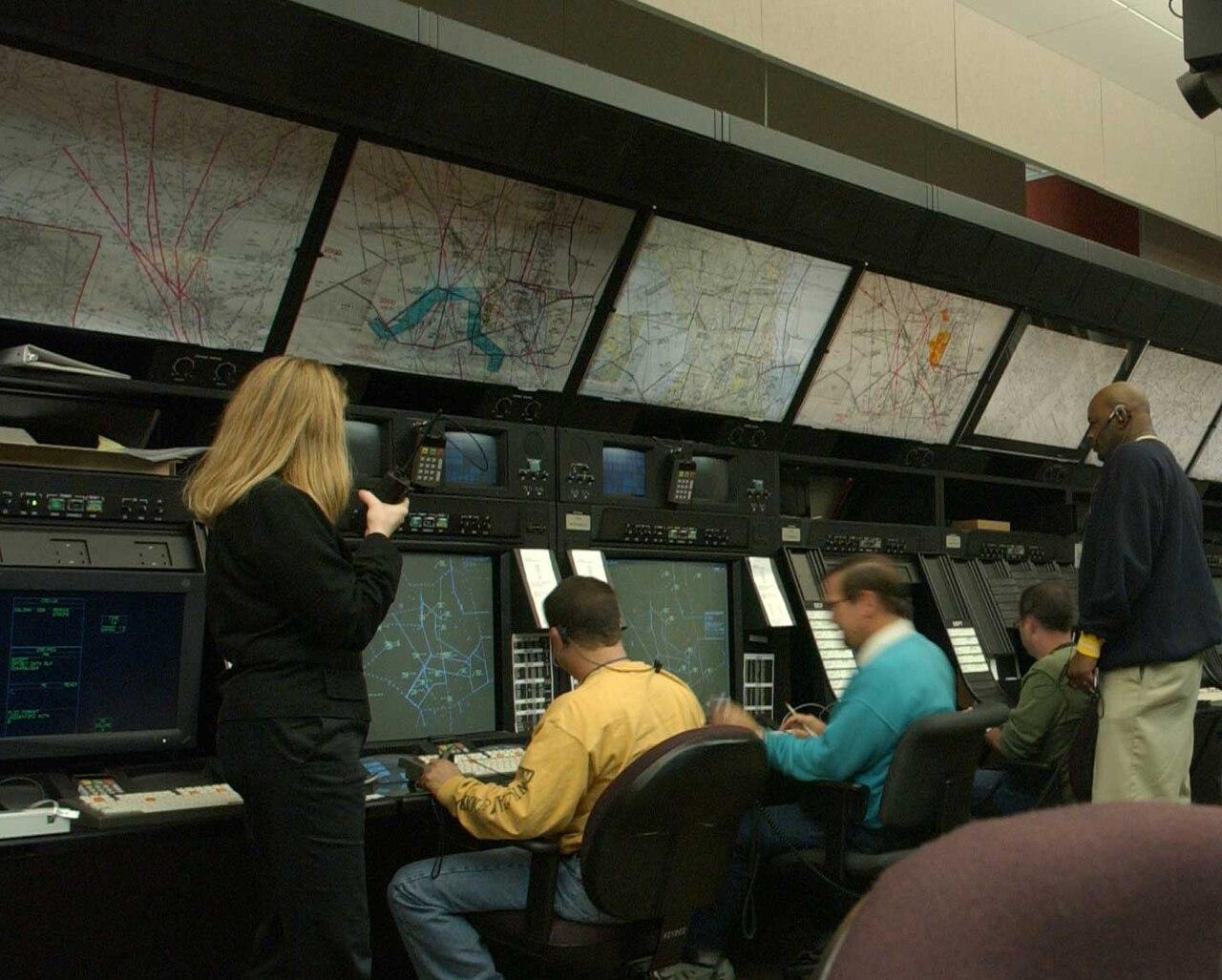
Image: Photo: U.S. Federal Aviation Administration, public domain, via Wikimedia Commons (https://commons.wikimedia.org/wiki/File:Air_traffic_controllers_at_the_Washington_ARTCC.jpg) — undated file photo of controllers at the Washington ARTCC, resized; not taken during the 13 November outage
About this article: prepared by The Daily Context editorial desk using automated, source-based reporting from the publications linked below. No reporter was on the ground.
Sources
- Federal Aviation Administration statement (13 Nov 2026): https://www.faa.gov/newsroom/faa-statement-nationwide-ground-stop
- FAA Air Traffic Control System Command Center advisory 120 (13 Nov 2026): https://www.fly.faa.gov/adv/adv_otherdis?adv_date=11132026&advn=120
- US Department of Homeland Security briefing summary (13 Nov 2026): https://www.dhs.gov/news/2026/11/13/icymi-secretary-mullin-and-secretary-duffy-address-nationwide-faa-ground-stop-all
- ABC News live updates (13–14 Nov 2026): https://abcnews.com/US/live-updates/faa-ground-stop-live-updates-hundreds-flights-canceled/?id=138125140
- CNBC (14 Nov 2026): https://www.cnbc.com/2026/11/14/faa-ground-stop-flights-resume-delays.html
- The Washington Post (13 Nov 2026): https://www.washingtonpost.com/transportation/2026/11/13/faa-grounds-flights-all-us-airports-citing-communications-issue/
- Associated Press (14 Nov 2026): https://apnews.com/article/ground-stop-flights-airlines-cancellations-faa-1fbf4992f0ddaa4c463b0e4990b6e291
- CNN live updates (13 Nov 2026): https://www.cnn.com/2026/11/13/us/live-news/flights-ground-stop-faa
- Anadolu Agency morning briefing (14 Nov 2026): https://www.aa.com.tr/en/world/morning-briefing-nov-14-2026/4124855
Kabeer Ahmad
Kabeer Ahmad is the founder and editor of The Daily Context. He oversees the site's source-based coverage of world affairs, technology, business, entertainment, lifestyle and sports, and is responsible for its editorial standards, sourcing and corrections.