SpaceX catches Starship from orbit for the first time as booster is lost
SpaceX caught its Starship upper stage with the launch tower's arms at Starbase, Texas, on Saturday, 14 November 2026, after about 22 hours and 14 orbits in space. It was the first time any Starship has been recovered from orbit. But the Super Heavy booster aborted its own tower catch on Friday and was destroyed over the Gulf of Mexico, so the first full recovery of the rocket will have to wait.
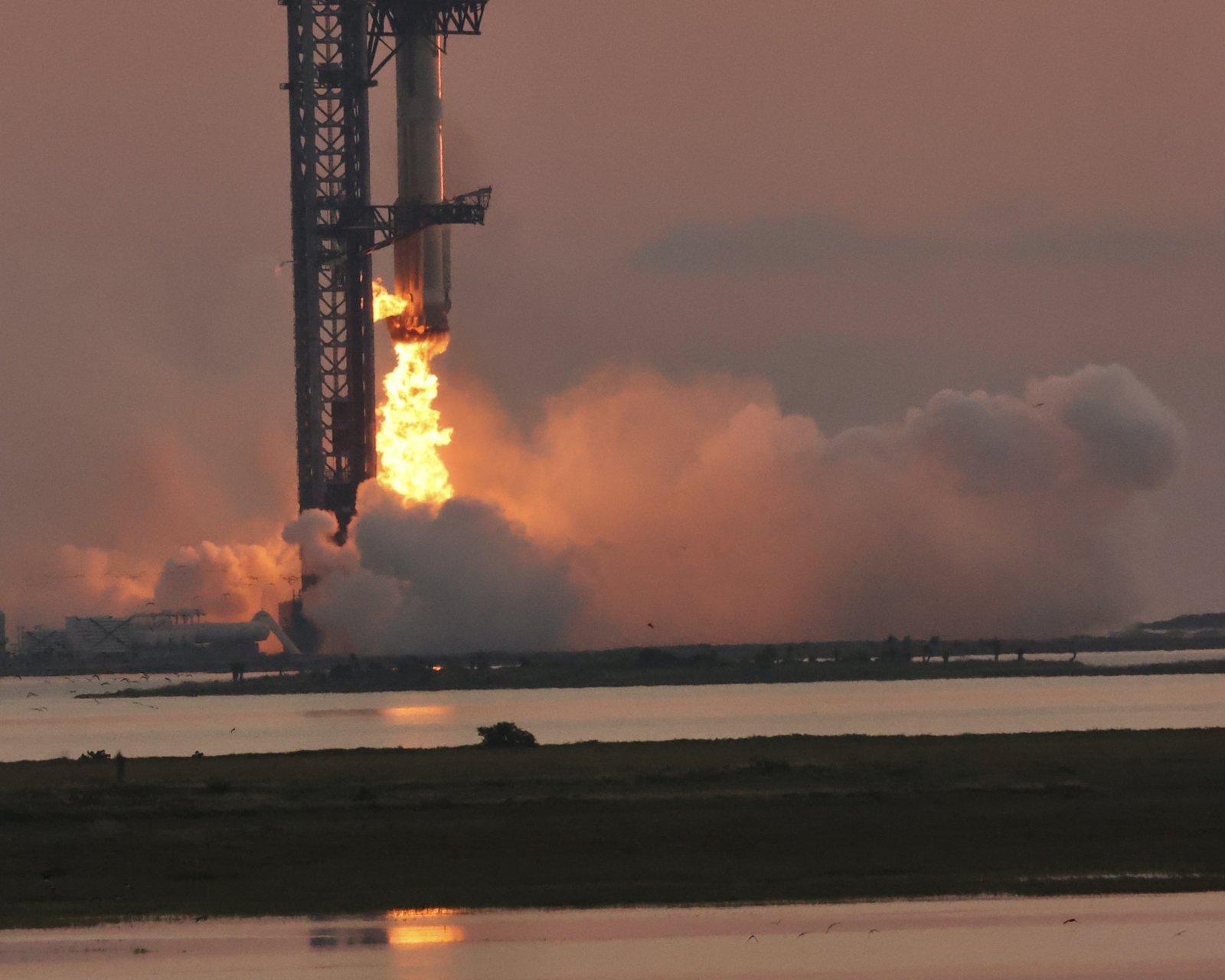
SpaceX caught the upper stage of its Starship rocket with the mechanical arms of its launch tower in Texas on Saturday, 14 November 2026, the first time a Starship spacecraft has been recovered after a flight to orbit. The vehicle, known as Ship 42, landed in the tower's "chopsticks" at Starbase at about 3:20 p.m. local time (21:20 UTC), roughly 22 and a half hours after lifting off and after circling the Earth about 14 times.
The milestone came with a significant caveat. Flight 15 had been planned as the first attempt to catch both stages of the rocket, which would have been the first complete recovery of an orbital launch vehicle. Instead, the Super Heavy first stage, Booster 22, aborted its own catch attempt minutes after Friday's launch, diverted out to sea and was destroyed just above the Gulf of Mexico.
What happened on Starship Flight 15?
Starship lifted off from Pad 2 at Starbase, near Boca Chica in South Texas, at 4:47 p.m. Central time (22:47 UTC) on Friday, 13 November, according to Spaceflight Now and the BBC. All 33 Raptor engines on the Super Heavy booster fired as planned for the climb, SpaceX commentator Dan Huot said on the company's webcast, as reported by Space.com.
After stage separation, the Ship continued to orbit, which it reached about 27 minutes after launch, according to Reuters reporting carried by NBC News. It then deployed 26 of SpaceX's newest Starlink V3 internet satellites, the second Starship flight to carry operational Starlinks. SpaceX said in its mission description that three of those satellites had been modified with cameras to photograph Starship's heat shield, giving engineers imagery to judge whether the vehicle was healthy enough to come home.
SpaceX could have ended the mission early with a splashdown near Hawaii or Chile if there was any doubt about the vehicle's condition. According to Teslarati, SpaceX said the heat-shield imagery showed the ship was in good shape, and on Saturday morning the company posted on X that "pad and tower systems are go for catch."
On Saturday afternoon the Ship fired its engines to leave orbit, came back through the atmosphere on a path over Mexico and South Texas, flipped upright with a final landing burn and slid between the tower's arms. "That was the Holy Grail of space flight, plummeting through fire to be snatched out of the air by steel. We caught a Starship and now everything changes," Huot said, as quoted by AFP via the BBC.
Why did the Super Heavy booster abort its catch?
The booster's job was to return to the tower about six and a half minutes after liftoff. It was the first return-and-catch attempt for SpaceX's larger Version 3 Super Heavy. Three earlier, older-design boosters had been caught successfully, most recently in March 2025.
On Friday, Huot initially said the booster had been "go" for a catch but "aborted itself for a GNC issue," referring to guidance, navigation and control. One of its 33 engines dropped out after stage separation, leaving 32 for the boostback burn that turns the booster back towards the launch site. On Saturday he corrected himself: "It was not a GNC issue that caused us not to come back. GNC triggered that abort; it was doing what it was supposed to do." The system, he said, detected that the booster "was not in the place that it was supposed to be" and sent it to an offshore contingency landing.
SpaceX's Kate Tice told viewers on Saturday that "early indications are that the booster ended its boostback [burn] early due to a low fuel mass alarm," and that the root cause was still being investigated, Space.com reported. Video showed the booster lighting its landing engines and hovering above the water before its engines cut off and the flight termination system destroyed it.
Elon Musk wrote on Saturday that the booster ran short of propellant because its engines slightly underperformed, according to Teslarati. He said the fix would be more consistent engines with an updated Raptor version and a software change to shut the engines off "about one second earlier," leaving enough fuel for the return. "This booster loss does not change our timeline to reach high volume, fully reusable Starship flights," he added. These are SpaceX's early explanations. No formal finding had been published at the time of writing.
Why does catching the Ship matter?
Rocket boosters are now landed routinely. The upper stage is a much harder problem. It returns from orbit at roughly orbital speed, must survive the heat of re-entry on its tiled heat shield, then relight its engines and arrive within metres of the tower's arms. Before Saturday, every Starship upper stage had ended in the ocean or been destroyed. According to the BBC, the Ship only reached a full orbit for the first time in September.
A recovered Ship can be inspected after a real return from orbit, rather than judged from video and telemetry. More importantly, Starship's whole business case rests on reuse. SpaceX needs cheap, frequent flights to launch its much larger Starlink V3 satellites. Each adds about 1 terabit of capacity, SpaceX says, and a single Starship can carry up to 60, according to CNBC. NASA's Artemis plans also depend on Starship. A version of the vehicle is contracted to land astronauts on the Moon, and that requires several tanker flights to refuel it in orbit, which is only practical if vehicles can fly again quickly.
Musk has said he expects Starship to reach a weekly launch cadence in the first half of 2027, Teslarati reported. How quickly SpaceX can inspect, refurbish and refly a caught Ship will be the first real test of that ambition.
What happens next, and will the FAA get involved?
The US Federal Aviation Administration licenses Starship flights. It issued a revised licence on 13 November authorising a single Flight 15 launch and re-entry, Seeking Alpha reported. When a Super Heavy booster was lost on Flight 12 in May 2026, the FAA declared a mishap and required a SpaceX-led investigation under its oversight. It closed that inquiry in July, citing heat effects on propulsion components and wrong engine-alarm settings, and accepted four corrective actions.
We found no FAA statement on Flight 15 at the time of writing, so it is not yet clear whether the booster loss will be classed as a mishap needing a formal investigation before the next flight. The booster was destroyed over the water inside the planned hazard area by its own safety system, and no injuries or damage to public property have been reported.
The flight also had knock-on effects for aviation. On Friday, Hawaii's Department of Transportation briefly paused some flights to and from the US West Coast because of the risk of falling debris, CNBC reported. The pause has since been lifted. It was separate from the unrelated nationwide FAA ground stop the same day caused by a telecommunications outage, which The Daily Context covered here: https://www.thedailycontext.com/article/faa-nationwide-ground-stop-telecommunications-outage-flights-cancelled-november-2026
SpaceX has not announced a date for Flight 16. Its next goals are to catch both stages on one flight and to fly a caught vehicle again.
Image: Photo: Steve Jurvetson, CC BY 2.0 (https://creativecommons.org/licenses/by/2.0/), via Wikimedia Commons (https://commons.wikimedia.org/wiki/File:Starship_Booster_Landing_on_Mechzilla_(54064036815).jpg) — file photo of a Super Heavy booster being caught by the Starbase tower on Starship Flight 5 in October 2024, not from Flight 15, cropped and resized
About this article: prepared by The Daily Context editorial desk using automated, source-based reporting from the publications linked below. No reporter was on the ground.
Sources
- Space.com: https://www.space.com/space-exploration/launches-spacecraft/spacex-says-starship-flight-15-booster-aborted-chopsticks-landing-catch-after-launch-due-to-guidance-issue-video
- SpaceX, Starship Flight 15 mission page: https://www.spacex.com/launches/starship-flight-15
- BBC News, live coverage of the Ship catch: https://www.bbc.com/news/live/cq0k683l3dz3t
- BBC News, booster catch aborted: https://www.bbc.co.uk/news/articles/ckregdgnl0xpo
- CNBC: https://www.cnbc.com/2026/11/14/spacex-plans-to-try-first-ever-catch-of-starship-rocket-from-orbit.html
- Associated Press: https://apnews.com/article/spacex-elon-musk-starship-rocket-df394c1b5a0f85e11194f9ff7db9ee6b
- NBC News / Reuters: https://www.nbcnews.com/science/space/spacex-launches-15th-starship-flight-aborts-booster-recovery-maneuver-rcna609274
- Spaceflight Now: https://spaceflightnow.com/2026/11/13/live-coverage-starship-flight-15-attempts-to-recover-full-vehicle-in-double-launch-pad-catch/
- Teslarati: https://www.teslarati.com/spacex-catches-starship-first/
- The Verge: https://www.theverge.com/science/1033930/spacex-chopstick-starship-catch
- FAA general statements (Flight 12 mishap investigation): https://www.faa.gov/newsroom/statements/general-statements
- Seeking Alpha, FAA Flight 15 licence: https://seekingalpha.com/news/4672602-faa-revises-spacex-starship-license-authorizes-single-flight-15-launch
Kabeer Ahmad
Kabeer Ahmad is the founder and editor of The Daily Context. He oversees the site's source-based coverage of world affairs, technology, business, entertainment, lifestyle and sports, and is responsible for its editorial standards, sourcing and corrections.