New Zealand's final count wipes out Luxon's majority, leaving Opportunity holding the key to government
Official results from New Zealand's 7 November election leave Christopher Luxon's National-ACT-NZ First coalition on 65 of 130 seats, one short of a majority. The seven MPs of the centrist Opportunity party now decide whether the coalition governs or voters return to the polls.
New Zealand's centre-right government has lost its parliamentary majority after special votes were counted, leaving Prime Minister Christopher Luxon dependent on a small centrist party he spent most of the year refusing to work with. Official results from the 7 November general election, released by the Electoral Commission at 2pm New Zealand time on Friday 27 November (6am in Pakistan), give Luxon's National Party and its partners ACT and New Zealand First 65 seats in a 130-seat Parliament. A majority needs 66.
That makes the seven MPs of Opportunity, a party entering Parliament for the first time, the deciding bloc. Its leader, Qiulae Wong, said she would talk to National first but would not rule anything out, including a fresh election. Luxon said formal negotiations would now begin and warned they would be "challenging".
What did the official count change?
On election night the coalition led by 67 seats to 64 in what was then a 131-seat House. The official count added about 485,000 special votes (ballots cast by people who enrolled late, voted outside their electorate, live overseas or are on the unpublished roll) and a second check of ordinary votes. That moved three electorates, RNZ and The Post reported:
- Wairarapa went from National's Mike Butterick to Labour's Kieran McAnulty, by 81 votes.
- Hamilton East went from National's Ryan Hamilton to Labour's Georgie Dansey, by 172 votes.
- Wellington Bays, won by Labour's Craig Renney on election night, went to the Green Party's Julie Anne Genter.
The final seat totals are National 40, Labour 36, Greens 17, ACT 13, New Zealand First 12, Opportunity 7 and Te Pāti Māori 5. National lost two seats compared with election night and the Greens gained one.
Labour actually won slightly more party votes than National: 29.9% against 28.4%, according to the Electoral Commission figures published by RNZ. National's share compares with 38.1% in 2023. The Greens took 14.1%, ACT 10.5%, NZ First 9.6% and Opportunity 6.1%. Turnout was 77.2% of enrolled voters, down from 78.2% in 2023, and about 26,000 votes were disallowed.
Why does Parliament have 130 seats, and why does 65 fall short?
New Zealand uses mixed-member proportional representation (MMP). Each voter has two votes, one for a local electorate MP and one for a party. Parliament normally has 120 seats, topped up with list MPs so that each party's share of seats matches its share of the party vote. A party needs 5% of the party vote or one electorate win to qualify.
When a party wins more electorates than its party vote entitles it to, it keeps the extra seats and Parliament grows. That is called an overhang. This time there is a 10-seat overhang, six for National and four for Te Pāti Māori, which makes a 130-seat House and puts the majority at 66. National won all 40 of its seats in electorates and no list seats. The Post reported that three senior National figures, Nicola Willis, Chris Bishop and Paul Goldsmith, are no longer MPs, and that Luxon must appoint new caretaker ministers to cover their roles by 3 December.
The two blocs are now level. National, ACT and NZ First have 65 seats. Labour, the Greens, Te Pāti Māori and Opportunity together also have 65. Neither can govern without the other side's help. The left cannot reach a majority even with Opportunity, which is why Labour leader Chris Hipkins said Labour "is not in a position to negotiate to form a government", Reuters reported. Reuters noted one theoretical alternative: NZ First could deal with the centre-left parties, as it did with Labour after the 2017 election. Nothing in Friday's statements suggests that is on the table.
What does Opportunity want?
Wong set out five bottom lines during the campaign, and on Friday she repeated that they are the minimum for any coalition or confidence-and-supply deal. (Under a confidence-and-supply deal, a party agrees to back the government on confidence votes and budgets without joining it.) According to RNZ, the five are:
- more power and independence for the Commerce Commission to tackle market power in supermarkets and other uncompetitive sectors;
- regulating lobbying and capping political donations at NZ$30,000;
- a 10-year health plan with clear commitments on funding, workforce and infrastructure;
- phasing out bottom trawling;
- upholding New Zealand's international climate commitments and the independence of the Climate Change Commission.
Wong also stood by her pre-election refusal to support a government in which NZ First leader Winston Peters is foreign minister. She said she had not spoken to Peters and that there had been no formal talks with any party. "We are going to do everything we can to make sure that there is a stable government," she told reporters, adding that all options remained open, including sitting on the crossbenches. Her negotiating team is herself, deputy leader Daniel Eb and chief of staff Iain Lees-Galloway.
Those demands collide with parts of the coalition's agenda. ACT wants New Zealand to leave the Paris Agreement unless its targets are loosened. Its leader, David Seymour, said on Friday he believed the parties could work together, but argued that "being tougher is not always better when it comes to climate". Peters has in the past dismissed Opportunity as "pinko communists", The Spinoff noted. NZ First did not hold a news conference on Friday. In an email to members it said the result "has not provided the certainty our country needs".
What did Luxon say?
Luxon, who is caretaker prime minister until a new government is sworn in, said he had already spoken with Peters, Seymour and Wong and that formal negotiations would now start. "Kiwis won't thank us for rushing to an agreement that falls apart, or for sending them back to the polls," he said. He said he wanted a government that would last the full three-year term and that talks would "take as long as it takes". He said he would not stand down as National leader, RNZ reported.
Could the numbers still change?
Possibly, though only slightly. Candidates and party secretaries have until the end of Wednesday 2 December to apply for recounts. Given the 81-vote margin, RNZ said National was likely to seek a recount in Wairarapa. In 2023, three electorate recounts took 12 days and changed no winners.
A nationwide party-vote recount has never been held under MMP. The Spinoff reported it would cost the applying party NZ$90,000. Chief Electoral Officer Karl Le Quesne said changing how list seats are shared out would take "at least 3,000 votes, all going one way". Past electorate recounts have shifted votes by 10 to 20, he said, so a nationwide recount was "highly unlikely" to alter the result. But with the House split 65–65, a single electorate changing hands would change the arithmetic.
What happens next, and how long could it take?
There is no deadline for a deal, but the new Parliament must sit by 14 January. In 2023, the coalition agreement came three weeks after the official count. Political analysts told Reuters that a second election was unlikely but that talks could run into next year. The most likely outcome, RNZ's assessment suggested, is that Opportunity supports the centre-right bloc on key votes, or abstains, in return for policy concessions. It could also seek ministerial posts or a full four-party coalition.
Markets are watching. The New Zealand dollar, which hit a 17-year low against the US dollar this week, strengthened slightly after the results, Reuters reported. Westpac economists Kelly Eckhold and Darren Gibbs wrote that it would be "very challenging to form a government before Christmas" and that "uncertainty may plague markets for a while". That is a forecast, not a certainty. The outcome depends on talks that have barely started.
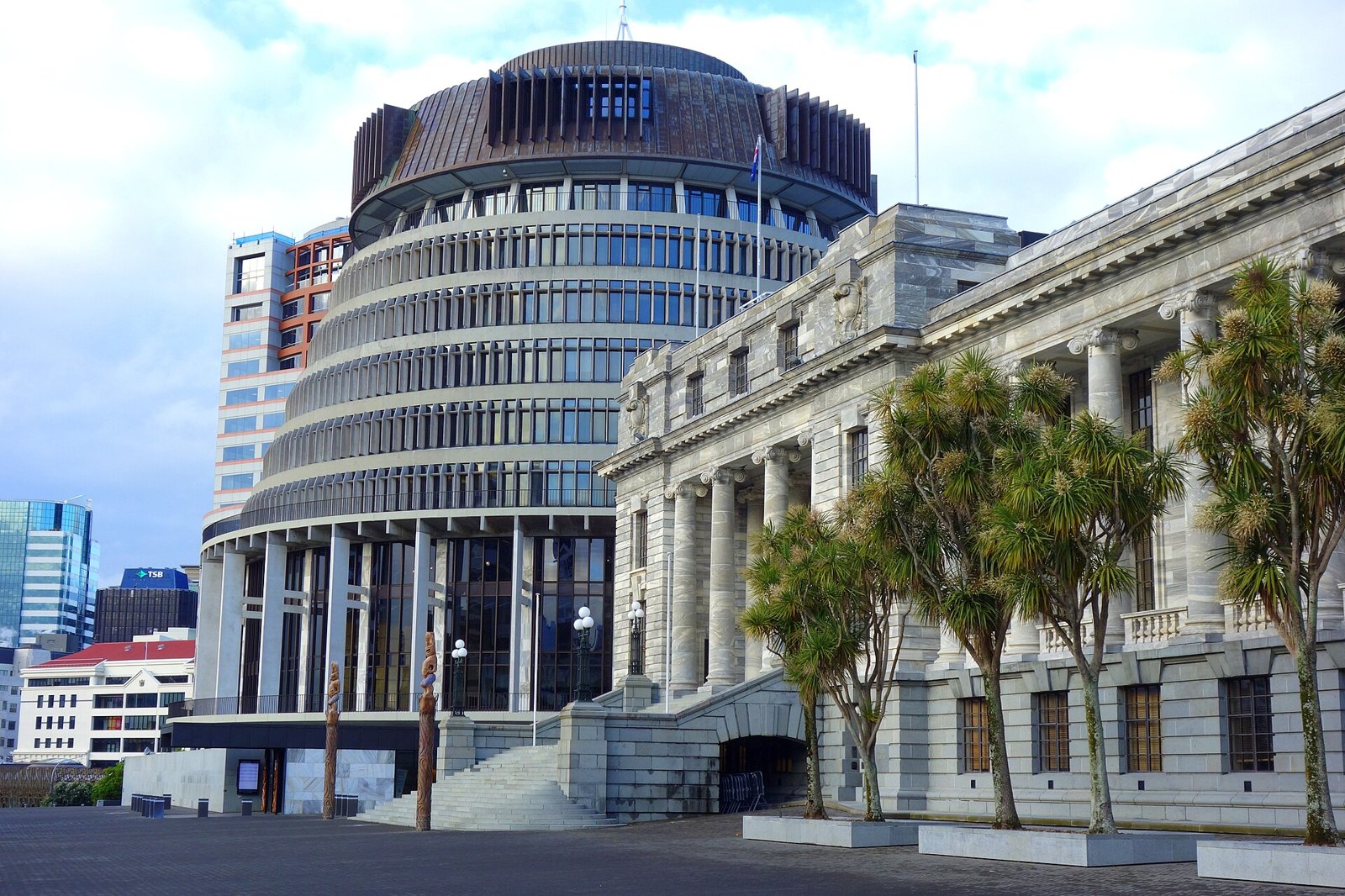
Image: File photo: the Beehive and Parliament House in Wellington, 14 October 2024. Photo: Daderot, CC0 (public domain dedication), via Wikimedia Commons (https://commons.wikimedia.org/wiki/File:Beehive_and_Parliament_House_-_Wellington_-_New_Zealand_-_DSC00165.jpg); resized
About this article: prepared by The Daily Context editorial desk using automated, source-based reporting from the publications linked below. No reporter was on the ground.
Sources
- RNZ: Election 2026 final results: Coalition loses majority, another election possible (27 November 2026): https://www.rnz.co.nz/news/politics_election-2026/2820329/election-2026-final-results-coalition-loses-majority-another-election-possible
- RNZ: Election 2026 full results (official result, 27 November 2026): https://www.rnz.co.nz/news/election-2026-results
- RNZ: Wong won't rule out sending voters back to polls, Luxon says 'challenging' talks coming (27 November 2026): https://www.rnz.co.nz/news/politics_election-2026/2829864/election-2026-final-results-wong-won-t-rule-out-sending-voters-back-to-polls-luxon-says-challenging-talks-coming
- Reuters: New Zealand's ruling coalition falls just short of majority, needs centrist party's support to govern (27 November 2026): https://www.reuters.com/3fec1b0a85a0/world/asia-pacific/new-zealands-ruling-coalition-falls-just-short-majority-final-election-count-2026-11-27/
- The Post: Coalition needs Opportunity to govern, no path to power for left (27 November 2026): https://www.thepost.co.nz/politics/361125609/election-2026-coalition-needs-opportunity-govern-no-path-power-left
- The Spinoff: Final results revealed: all the numbers and reaction (27 November 2026): https://thespinoff.co.nz/politics/27-11-2026/live-updates-as-the-final-nz-election-results-are-revealed
- New Zealand Gazette: 2026 General Election Results of the Official Count (notice 2026-au6960): https://gazette.govt.nz/notice/id/2026-au6960
Kabeer Ahmad
Kabeer Ahmad is the founder and editor of The Daily Context. He oversees the site's source-based coverage of world affairs, technology, business, entertainment, lifestyle and sports, and is responsible for its editorial standards, sourcing and corrections.