Asian markets: Kospi falls 3.3% as Seoul, Taipei and Beijing roll out support measures
South Korea's Kospi fell 3.31% on Monday 23 November 2026 to its lowest close since January, extending a global sell-off in AI-linked shares. Taiwan's market rebounded 2.2% after a blanket short-selling ban and state-fund buying, and mainland China edged higher after Beijing eased margin rules.
South Korea's stock market fell sharply again on Monday 23 November 2026, even after the government said over the weekend that it was ready to activate an emergency market stabilisation fund. The benchmark Kospi index closed down 161.42 points, or 3.31%, at 4,708.54, its lowest close since 13 January, Yonhap News Agency reported. At one point it was down more than 5%.
Elsewhere in Asia, the picture was mixed. Taiwan's main index swung from losses to a gain of 2.16% on the first day of a blanket ban on short selling below the previous close, and as a state-backed stabilisation fund said it was buying shares. Mainland Chinese indices closed slightly higher after Beijing's exchanges moved to let investors borrow more to buy shares. Hong Kong's Hang Seng was trading close to Friday's level in the afternoon after an early fall. Tokyo was closed for a public holiday.
The moves follow a brutal week for technology shares worldwide, driven by doubts about whether the huge sums being spent on artificial intelligence will pay off.
What happened in Seoul on Monday?
The Kospi opened 2.77% lower and slid further as foreign investors, who had been net buyers early in the session, turned to selling, according to Yonhap. At about 11:33am local time the exchange suspended programme trading for five minutes, a so-called sidecar measure, when the index was down 5.11%. It hit a low of 4,586.80 before recovering some ground.
Losers outnumbered gainers by 823 to 69, Yonhap said. Individual and foreign investors were both net sellers, while institutions bought a net 187.1 billion won of shares. Samsung Electronics, the largest company on the market, fell 3.06% to 177,500 won, and SK hynix lost 2.52%. SK Telecom dropped 7.32%; Yonhap linked the fall to the Nasdaq listing of Anthropic, the US AI company in which the telecoms group holds a stake. The won weakened to 1,345.9 per dollar at 3:30pm, from 1,336.2 at Friday's close.
Monday's fall came on top of a 5.21% drop on Friday, when the Kospi closed at 4,869.96. CNBC said the index is now down more than 46% from its June high, and Bloomberg reported that what had at one point been a gain of more than 110% for the year has shrunk to about 10%.
What has South Korea promised to do?
On Sunday the heads of the finance ministry, the Bank of Korea, the Financial Services Commission and the Financial Supervisory Service held an emergency meeting, according to Bloomberg, as reported by Lianhe Zaobao. The finance ministry then said it would prepare the securities market stabilisation fund, a pool of money from financial institutions valued at 10.76 trillion won (nearly $8 billion), for immediate activation if needed, CNBC reported.
The government also said it would relax daily limits on how many of their own shares listed companies can buy back, for three months starting on 24 November, and would begin a "special intensive monitoring period" against illegal short selling. Regulators will also track margin lending and forced liquidations, in which brokers sell investors' shares when borrowed money can no longer be covered.
The ministry said volatility had "significantly increased" because of uncertainty around the global AI and semiconductor industries and US interest rate rises, but argued that the medium- to long-term growth outlook for AI remained intact and that "excessive anxiety is not a concern", according to CNBC's translation of the Korean statement. Monday's trading suggests investors were not yet persuaded.
Why did Taiwan's market rise?
Taiwan's weighted index closed up 778.6 points, or 2.16%, at 36,811.89, after swinging across a range of more than 1,600 points during the day, Taiwan's Central News Agency reported. Turnover topped NT$1 trillion. TSMC, the island's dominant chipmaker, rose 1.5% to NT$2,030 after briefly trading below NT$2,000 in the morning. The index had fallen 6.23% on Friday, and Bloomberg said last week was its worst weekly fall in 35 years.
Monday was the first day of new rules from the Financial Supervisory Commission. They ban short selling below the previous day's closing price for all listed and over-the-counter shares, with an exception for hedging by securities and futures firms; raise the minimum margin for short sales from 130% to 150%; and suspend applications from brokers to issue new put warrants, which are bets on falling prices. The commission also said share buybacks completed between the fourth quarter of 2026 and the first quarter of 2027 would count towards companies' ESG ratings.
Taiwan's NT$500 billion (about $15 billion) National Financial Stabilization Fund said it had entered the market to support shares, Bloomberg reported. The chairman of the Taiwan Stock Exchange, Lin Hsiu-ming, wrote to all listed companies on Monday encouraging financially sound firms to consider buybacks and to hold investor briefings more often, the United Daily News reported.
What did China do?
China's three stock exchanges, in Shanghai, Shenzhen and Beijing, said on Sunday that the minimum margin ratio for buying shares with borrowed money will fall from 100% to 80% from 30 November, reversing a tightening made in January. That lets investors borrow more against their holdings. The exchanges also announced fee cuts, and Shenzhen published draft rules to bring market makers to its ChiNext growth board.
Mainland markets ended the day in positive territory. The Shanghai Composite rose 0.15% to 3,538.95 and the CSI 300 gained 0.09% to 3,958.29, while the tech-heavy ChiNext index jumped 3.08%, according to closing data reported by FX168 and Yicai. Bloomberg reported that Chinese state-backed funds had put a record amount into the market on Friday.
In Hong Kong, the Hang Seng fell below 22,000 in the morning, more than 400 points down and a low of more than a year and a half, public broadcaster RTHK reported. By mid-afternoon it was trading roughly flat against Friday's close of 22,410.80.
Why are markets falling?
The sell-off began with technology shares. On Friday the S&P 500 in New York fell 3.7%, taking it into a correction, a drop of at least 10% from its recent high, and the Nasdaq Composite lost 5.3%, wiping out its gains for 2026, Al Jazeera reported. The Daily Context covered that slide in a separate report on Wall Street's worst week since 2020.
Investors are questioning whether technology companies can keep up, and earn a return on, the trillions of dollars they are pouring into data centres and chips. Gartner expects global AI-related investment to reach $2.7 trillion in 2026 and $3.6 trillion in 2027, Al Jazeera noted. South Korea and Taiwan are among the most exposed markets because their biggest companies, including Samsung, SK hynix and TSMC, supply memory and processors for AI systems.
Will the measures work?
Analysts quoted by news agencies were cautious. "These interventions are circuit breakers rather than a turning point," Dilin Wu, a strategist at Pepperstone Group, said, according to Bloomberg. "They can't reverse a broader reassessment of AI valuations or bring foreign investors back on their own." Fu Zhifeng of Shanghai Chengzhou Investment Management said China's steps looked "more sentiment- and liquidity-oriented than fundamentally market-changing".
There were some brighter signs. US stock futures pointed to a rebound on Monday, with S&P 500 futures up about 2.2% and Nasdaq futures about 2.9% in Asian hours, according to Al Jazeera. Khoon Goh, head of Asia research at ANZ, pointed to strong South Korean exports for the first 20 days of November, led by semiconductors.
What is still uncertain, and what comes next?
It is not yet clear whether Seoul will actually deploy its stabilisation fund, or how much Taiwan's fund has spent. Short-selling bans can reduce selling pressure for a time but can also make markets less liquid, a risk some Taiwanese analysts flagged on Monday. Korea's buyback relaxation takes effect on Tuesday and China's margin change on 30 November. Investors will watch Wall Street's Monday session closely for signs that Friday's slide has run its course.
This article reports market movements and official measures; it is not investment advice.
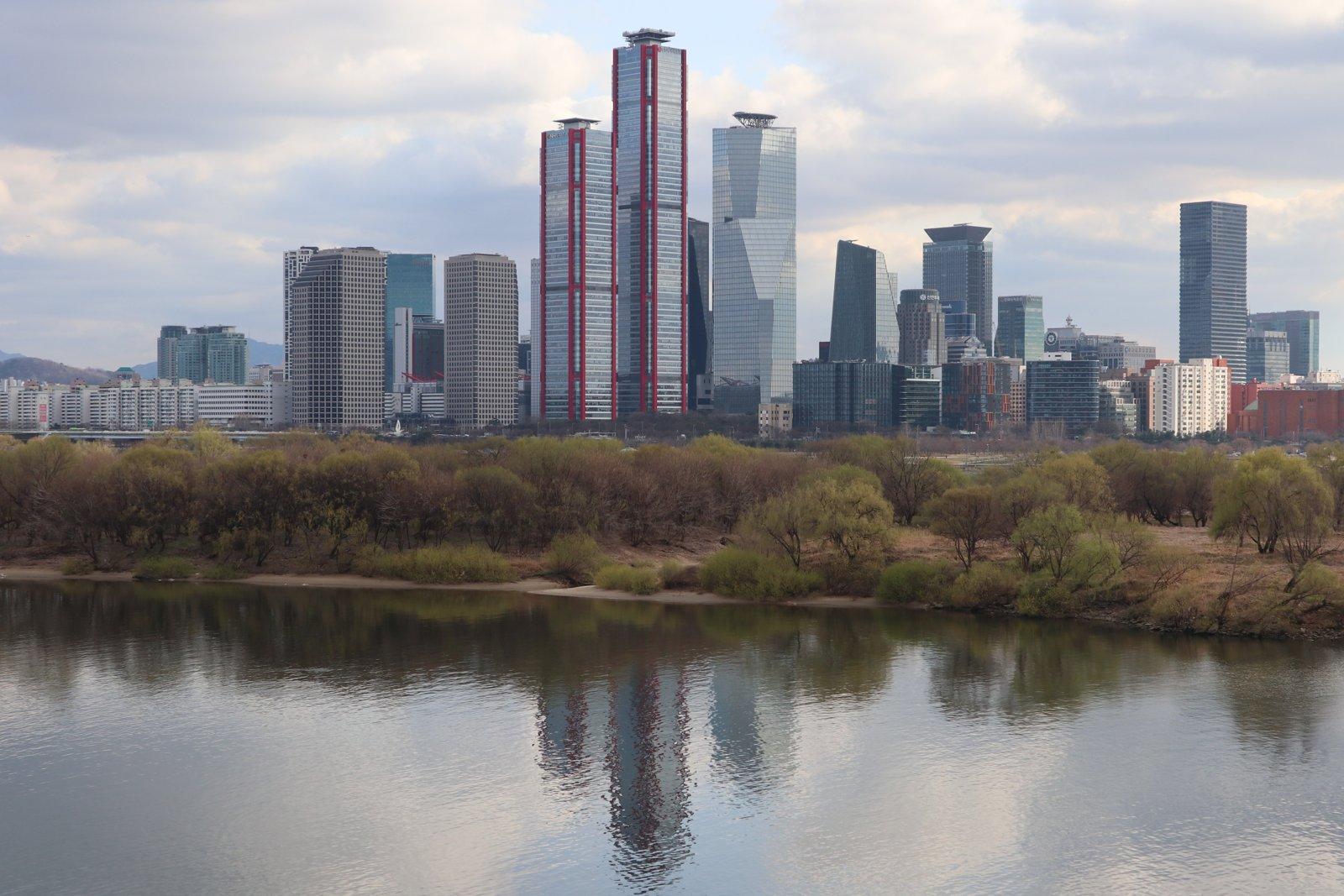
Image: File photo: the Yeouido financial district in Seoul, March 2024. Image: S h y numis, CC BY 4.0 (https://creativecommons.org/licenses/by/4.0/), via Wikimedia Commons (https://commons.wikimedia.org/wiki/File:Skyline_of_Yeouido,_a_prominent_finance_district_in_Seoul.jpg); cropped and resized
About this article: prepared by The Daily Context editorial desk using automated, source-based reporting from the publications linked below. No reporter was on the ground.
Sources
- Yonhap News Agency: (LEAD) Seoul shares plunge over 3 pct on AI jitters (23 November 2026): https://en.yna.co.kr/view/AEN20261123006651320
- CNBC: How Asian countries are looking to prop up markets as AI downturn sinks stocks (23 November 2026): https://www.cnbc.com/2026/11/23/asia-markets-kospi-taiwan-china-csi300.html
- Moneycontrol (Bloomberg): Asian stocks drop as AI worries offset state support measures (23 November 2026): https://www.moneycontrol.com/news/markets/global-markets/us-futures-attempt-recovery-but-asia-stays-under-pressure-as-korean-stocks-tumble-again-14086747.html
- Al Jazeera: Asian stock markets tumble as AI bubble fears mount (23 November 2026): https://www.aljazeera.com/news/2026/11/23/south-koreas-stock-market-tumbles-as-ai-bubble-fears-mount
- Lianhe Zaobao: Support measures in China, South Korea and Taiwan fail to halt Asian stock rout (23 November 2026): https://www.zaobao.com.sg/en/finance/singapore/asian-stocks-keep-falling-despite-new-support-measures-china-south-korea-and-taiwan
- United Daily News / Central News Agency: Taiwan shares close up 778 points (23 November 2026, Chinese): https://udn.com/news/story/7251/9896353
- Economic Daily News: Taiwan Stock Exchange letter on buybacks (23 November 2026, Chinese): https://money.udn.com/money/story/5607/9896392
- TVBS: TSMC rebounds as stabilisation measures take effect (23 November 2026, Chinese): https://news.tvbs.com.tw/money/4054799
- FX168: China index closes, 23 November 2026 (Chinese): https://www.fx168news.com/express/fastnews/1474088
- Yicai: A-share close, ChiNext up more than 3% (23 November 2026, Chinese): https://www.yicai.com/brief/103450298.html
- RTHK: Hang Seng turns higher after falling more than 400 points (23 November 2026, Chinese): https://news.rthk.hk/rthk/ch/component/k2/1878931-20261123.htm
Kabeer Ahmad
Kabeer Ahmad is the founder and editor of The Daily Context. He oversees the site's source-based coverage of world affairs, technology, business, entertainment, lifestyle and sports, and is responsible for its editorial standards, sourcing and corrections.