South Korea's education minister resigns over AI cheating chaos at the Suneung exam
South Korea's Education Minister Choi Kyo-jin resigned on Sunday 22 November, and President Lee Jae Myung accepted within about an hour. Choi said he took responsibility for the confusion caused by last-minute rules against AI-assisted cheating at last week's college entrance exam, where 111 suspected device cases were found.
South Korea's Education Minister Choi Kyo-jin resigned on Sunday 22 November 2026, three days after a national college entrance exam that was overshadowed by fears of cheating with artificial intelligence and by a series of rushed, last-minute rules meant to stop it. President Lee Jae Myung accepted the resignation about an hour after Choi announced it, according to the presidential spokesperson, Kang Yu-jung.
"As the minister in charge, I believe I cannot escape criticism that we failed to prepare in advance," Choi said in a statement released by the education ministry, as translated by the Yonhap news agency. "Now that the exam has concluded, I feel a deep sense of responsibility and am offering my resignation."
The exam itself, known as the Suneung, took place on Thursday 19 November. The ministry said on Friday that 111 suspected cheating cases involving electronic devices had been detected among roughly half a million candidates.
Why did the minister resign?
Choi was not accused of wrongdoing himself. His resignation statement focused on the confusion caused by changes that the ministry announced right up to the eve of the test. According to Yonhap, those changes included allowing candidates to bring only pencils into the exam room, putting stickers over clothing buttons to block miniature cameras and sending emergency alerts to every mobile phone in the country during the exam.
Teachers and candidates complained that the late changes added to the stress of an already high-pressure day, and teachers' unions called the government response belated, The Guardian reported.
Choi also drew criticism over remarks in parliament before the exam. Asked by a lawmaker whether he was confident that AI-assisted cheating could be detected, the 72-year-old replied, according to Yonhap's translation: "I don't think I could, because of my age." The Guardian reported that he then did not appear at the press briefings held in the days before the exam, where a vice minister announced the new measures instead.
In a separate post on X quoted by The Guardian, Choi said the exam had "concluded without any major incidents" but that he was not immune from criticism that the ministry had failed to prepare.
What set off the cheating scare?
The immediate trigger came on Sunday 15 November, four days before the Suneung. Han Won-seok, 34, who had topped this year's national certified tax accountant exam, admitted in a video posted on his lawyer's YouTube channel that he had cheated.
His score had already attracted suspicion: he got just one of 160 questions wrong in the first round, scoring 397.5 out of 400, the BBC reported. "I used a microcamera to photograph the test questions and sent them to an AI, then checked my answers on my smartphone to commit the cheating," he said in the video. Seoul police said they had received a written confession through his lawyer and assigned the case to investigators. The government said people found to have used AI to cheat on the tax exam would lose the qualification and be barred from retaking it for five years.
That case came on top of earlier worries. The BBC reported that two candidates had been caught using AI glasses in university entrance exams in October, and that the education ministry had said four middle and high school pupils were caught using AI glasses to cheat this year. Yonhap also reported that a man who achieved a perfect score in this year's law school entrance test, the LEET, was found dead on Thursday after facing cheating allegations; police have said they will continue investigating those allegations.
What measures were used at the Suneung?
The government responded with some of the most intrusive exam security South Korea has used. Before the test, Prime Minister Han Seong-sook said proctors would use metal detectors on candidates who behaved suspiciously and that the ban for cheaters would be lengthened from one year to 10, ABC News (US) reported via the Associated Press; authorities also deployed 8,400 additional supervisors. Candidates had to hand in phones, smartwatches, smart glasses and anything with a camera, and failing to do so counted as cheating whether or not the device was used. Glasses were placed on desks for inspection.
On exam day, three nationwide emergency alerts were sent between 08:00 and 15:00 local time, making phones sound even on silent mode, including those of tourists using roaming data, the BBC reported. It was the first time the national disaster alert system had been used to catch exam cheats. Channel NewsAsia reported that public Wi-Fi was cut around exam halls, that rewards of US$75,000 were offered to whistleblowers, and that the first alert sounded 10 minutes before the 8:40am start.
The Guardian reported that nearly half of the 111 device cases were found through the emergency alerts. Five candidates were caught actually using smart devices, according to the BBC; vice education minister Choi Eun-ok described cases involving smart glasses, a phone used to photograph an exam paper, phones used in a restroom, and a small camera with wireless earphones.
Why does the Suneung matter so much?
The College Scholastic Ability Test, to give the Suneung its formal name, largely decides which university a student can enter, and in South Korea that choice is widely seen as shaping careers and social standing. The country goes to unusual lengths to protect it: flights are rescheduled during the English listening section, military artillery drills are paused, the stock market opens an hour late and traffic is kept away from exam centres, The Guardian noted.
That is why the cheating scare has become a political issue rather than only an education one. On Friday, President Lee called for an overhaul of the exam system, saying that public exams "significantly affect the distribution of opportunities and resources" and that using AI to cheat "rocks the basic order of our society by undermining fairness and trust", the BBC reported.
The problem is not unique to South Korea. Cheap miniature cameras, smart glasses and AI chatbots that can read a photographed question have raised similar concerns for exam boards in many countries, but few run a single national test with such high stakes for so many students on the same day.
What happens next?
Kang, the presidential spokesperson, said the process to nominate a successor would follow normal procedures, and Lee instructed Prime Minister Han to concentrate on Suneung-related measures in the meantime, The Korea Herald reported.
The ministry's exam misconduct committee is reviewing the cheating cases and is due to decide penalties before scores are released on 11 December. The government and the ruling Democratic Party have suggested a 10-year ban for AI-assisted cheating that could apply retroactively to this year's exam, and officials are considering reviewing past entrance exams based on credible tips, according to The Korea Herald. Channel NewsAsia reported that the prime minister ordered exam papers from 2025 to be kept "until further notice" for a cheating investigation. Before the exam, the government also said global AI chatbot companies had agreed to cooperate with post-exam investigations.
Several questions remain open: whether any of the 111 cases involved AI tools rather than simply banned devices, whether a retroactive ban would survive legal challenge, and who will replace Choi at the ministry.
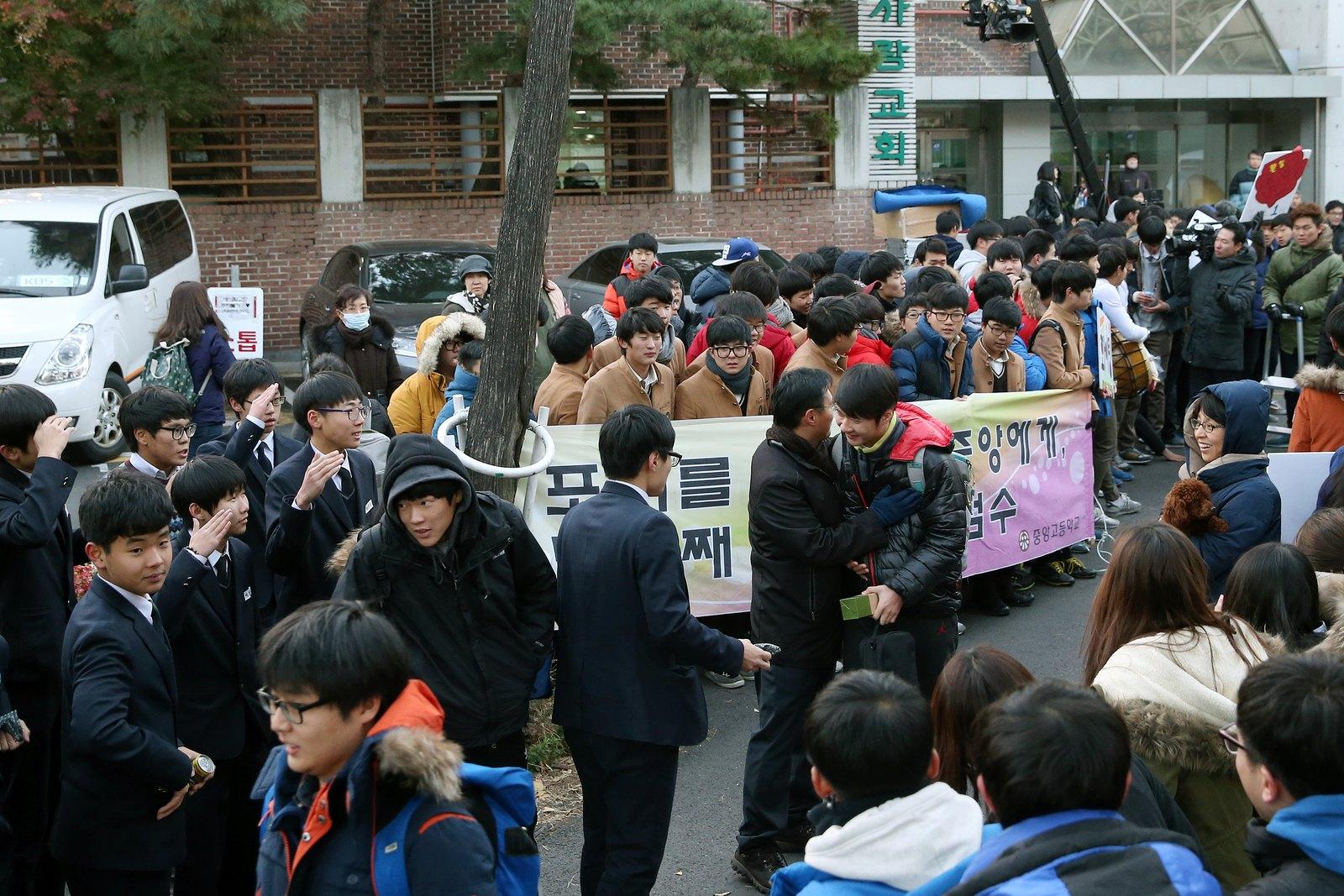
Image: File photo (November 2014) of pupils cheering on candidates outside Kyungbock High School in Seoul on College Scholastic Ability Test day; not from this year's exam. Photo by the Republic of Korea (Korean Culture and Information Service / Korea.net), CC BY-SA 2.0, via Wikimedia Commons (https://commons.wikimedia.org/wiki/File:Korea_College_Scholastic_Ability_Test_Day_04_(15775814811).jpg); cropped and resized
About this article: prepared by The Daily Context editorial desk using automated, source-based reporting from the publications linked below. No reporter was on the ground.
Sources
- Yonhap News Agency: Education minister resigns over college exam chaos amid AI cheating fears (22 November 2026) https://en.yna.co.kr/view/AEN20261122001051315
- BBC News: South Korea education minister resigns over exam cheating scandal (22 November 2026) https://www.bbc.com/news/articles/cw3dgk29d37no
- The Guardian: South Korea education minister resigns after AI cheating scandal engulfs university exams (22 November 2026) https://www.theguardian.com/world/2026/nov/22/south-korea-education-minister-resigns-after-ai-cheating-scandal-engulfs-university-exams
- The Korea Herald: Education minister steps down amid Suneung-related controversies (22 November 2026) https://www.koreaherald.com/article/10945089
- BBC News: South Korea: 111 students caught with new measures against cheating at Suneung exam https://www.bbc.com/news/articles/cm3vgw1xevvwo
- BBC News: South Korea's top scorer in tax accountancy exam admits cheating https://www.bbc.com/news/articles/ckvg2ezvpe08o
- Channel NewsAsia: South Koreans sit key college exam mired in cheating scandal (20 November 2026) https://www.channelnewsasia.com/east-asia/south-korea-university-exams-ai-cheating-6566301
- ABC News (US), Associated Press: Glasses and shirt buttons will be examined to stop cheating in South Korea's college entrance exams https://abcnews.com/Technology/wireStory/glasses-shirt-buttons-examined-stop-cheating-south-koreas-138202119
Kabeer Ahmad
Kabeer Ahmad is the founder and editor of The Daily Context. He oversees the site's source-based coverage of world affairs, technology, business, entertainment, lifestyle and sports, and is responsible for its editorial standards, sourcing and corrections.