Ramayana: Rise of a Legend opens to $55.7m worldwide in widest US release for an Indian film
Nitesh Tiwari's Hindi-language epic Ramayana: Rise of a Legend took a studio-reported $55.7 million worldwide in its four-day debut, including about $32 million in India and $12.2 million in the US and Canada, Variety reported. It opened in 1,433 North American cinemas, the widest release there for an Indian film.
Ramayana: Rise of a Legend, director Nitesh Tiwari's adaptation of the ancient Indian epic, collected a studio-reported $55.7 million worldwide over its four-day opening, Variety reported on Sunday 8 November. India contributed about $32 million, the United States and Canada $12.2 million and 37 other international markets $11.5 million. Variety said the result set a new Diwali holiday opening record for an Indian production, and that the film sold more than 11 million tickets, making it the most-watched film in the world that weekend.
In North America the Hindi-language film, distributed by Sony Pictures, opened in 1,433 cinemas, the widest release there for an Indian film, according to Deadline as reported by ComingSoon and the Associated Press. It still ranked only fifth on the domestic Friday-to-Sunday chart, in a weekend dominated by another Asian release, Godzilla Minus Zero.
How much did Ramayana make on its opening weekend?
The headline figures depend on which days are counted. Variety's $12.2 million North American figure, and Deadline's $12.1 million, cover four days including early previews. The standard Friday-to-Sunday weekend figure, used for the domestic chart, was $8.65 million, according to Deadline and Box Office Mojo; the AP rounded it to $8.7 million. Box Office Mojo's daily breakdown shows $2.42 million on Friday, $3.83 million on Saturday and an estimated $2.41 million on Sunday. The Numbers lists a domestic total of about $12.16 million.
Outside India and North America, Variety listed the UK ($3 million), the United Arab Emirates ($2.2 million), Australia ($1.9 million), Germany ($625,000), Thailand ($550,000), Nepal ($500,000), the Netherlands ($240,000) and South Africa ($75,000). It said the UK, Thailand, Netherlands and South Africa results were local records for an Indian film.
All of these are studio estimates. Final domestic figures for the weekend are released on Monday in the US, the AP noted, and they can differ slightly from Sunday's estimates.
How did it do in India?
Indian box office is usually tracked in rupees and as "net" collections, which exclude taxes, so Indian and international reports are not directly comparable. The tracker Sacnilk, cited by The Week, put the film's India net collections at ₹238.85 crore (₹2.39 billion) after four days, with ₹56.15 crore on day four alone across 21,719 shows. The Hindi version accounted for ₹36.75 crore of that day's total, with Kannada, Telugu, Tamil and Malayalam versions making up much of the rest.
The Week, again citing Sacnilk, said the film narrowly missed the all-time top 10 of opening weekends in India by net collections, ranking 12th with ₹174 crore. Pushpa 2: The Rule leads that list. Independent trackers and studio figures often diverge, so these numbers should be treated as estimates.
Why is this release significant?
Ramayana: Rise of a Legend is the first of two parts and the most expensive Indian film ever made, the AP reported. It stars Ranbir Kapoor, Yash and Sai Pallavi, and is presented by Sony Pictures and Namit Malhotra's Prime Focus Studios in association with Monster Mind Creations and the visual effects company DNEG, according to Variety. ComingSoon reported that the score was composed by Hans Zimmer and A.R. Rahman.
The scale of the rollout was unusual. Variety said the film opened in more than 130 countries, on more than 10,000 screens and in 17 dubbed languages, the widest distribution ever attempted for Indian cinema. It opened in India and abroad at the same time, timed for the Diwali festival.
In North America, its four-day start was the second-biggest ever for an Indian film, behind Dhurandhar: The Revenge, which opened with $14 million in March, according to Variety and Deadline.
What part did IMAX and premium screens play?
Ramayana was filmed for IMAX, the AP said. Variety reported that it took $6 million from IMAX screens worldwide, about 11% of its global debut and a record global IMAX launch for an Indian film. That included $2 million in India, an all-time IMAX record there, $2.5 million from 53 North American screens and $1.4 million from 32 screens in other markets.
Deadline, as reported by ComingSoon, said IMAX and other premium large-format screens drove 40% of the film's North American gross. Audience surveys by PostTrak, also cited by Deadline, gave the film 86% in the top two boxes, a measure of how many viewers rated it excellent or very good, and a 75% definite-recommend score. The same data showed an audience that was 71% Asian American, 61% male and largely under 35.
How did it compare with Godzilla Minus Zero?
The weekend was a showcase for non-English, Asian productions. Toho's Godzilla Minus Zero led both the domestic and global charts, taking $31.6 million in North America and $63 million worldwide, according to Variety. That was the biggest North American opening ever for a live-action foreign-language film, the AP said. Ramayana was second globally, ahead of Warner Bros.' The Cat in the Hat, which took $30.5 million worldwide and $20.5 million domestically.
On the domestic Friday-to-Sunday chart, Ramayana placed fifth behind Godzilla Minus Zero, The Cat in the Hat, Angel Studios' Drummer Boy ($9.3 million) and the A24 documentary You Can See Everything ($8.9 million), according to the AP's Rentrak-based top 10. Overall ticket sales rose 96.8% from the previous, quieter Halloween weekend.
The Daily Context covered Godzilla Minus Zero's opening separately: https://www.thedailycontext.com/article/godzilla-minus-zero-box-office-friday-november-2026
Where is Ramayana opening next?
Sony is releasing the film in further waves, Variety reported: Indonesia on 11 November; Hong Kong, Mexico and Central Asia on 12 November; Brazil, Italy, Ukraine and Hungary on 19 November; Poland on 20 November; and Argentina, Colombia, Ecuador, Peru, Czechia and Central America on 26 November. NDTV Profit, citing the same schedule, also listed Macau for 12 November.
The continuing Diwali holiday period in India and the later international openings could help the film's run, according to Variety, though second-weekend results will give a clearer picture. No release date for the second part was given in the reports reviewed for this article.
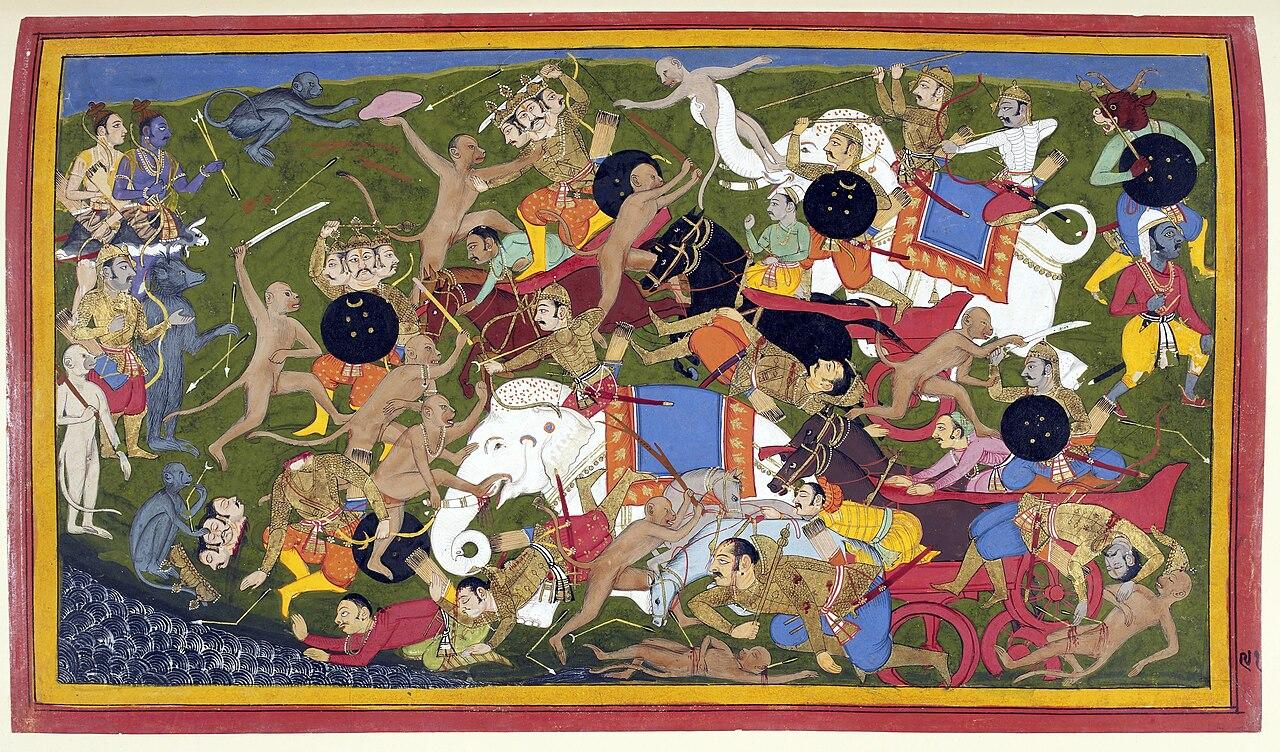
Image: Painting: Sahib Din, Battle at Lanka, Ramayana, Udaipur, 1649–53, British Library; public domain, via Wikimedia Commons (https://commons.wikimedia.org/wiki/File:Battle_at_Lanka,_Ramayana,_Udaipur,_1649-53.jpg) — a historic illustration of the epic, not an image from the film
About this article: prepared by The Daily Context editorial desk using automated, source-based reporting from the publications linked below. No reporter was on the ground.
Sources
- Variety: Godzilla Minus Zero and Ramayana: Rise of a Legend roar at international box office (Naman Ramachandran, 8 November 2026): https://variety.com/2026/film/box-office/godzilla-minus-zero-ramayana-nternational-box-office-1236942760/
- Associated Press via NBC News: Godzilla Minus Zero stomps to a record-setting debut (9 November 2026): https://www.nbcnews.com/pop-culture/pop-culture-news/godzilla-zero-stomps-record-setting-316-debut-clobbering-cat-hat-rcna608257
- ComingSoon (reporting Deadline figures): Sony's Ramayana opens No. 2 at worldwide box office (Anubhav Chaudhry, 8 November 2026): https://www.comingsoon.net/movies/news/2219855-ramayana-rise-of-a-legend-box-office-worldwide
- Box Office Mojo: Ramayana release data: https://www.boxofficemojo.com/release/rl2471264513/
- The Numbers: Ramayana Part 1 (2026) box office: https://www.the-numbers.com/movie/Ramayana-Part-1-(2026-India)
- The Week (citing Sacnilk): Ramayana day 4 box office collection (8 November 2026): https://www.theweek.in/news/entertainment/2026/11/08/ramayana-day-four-box-office-collection-500-crore.html
- NDTV Profit: Ramayana scores biggest worldwide IMAX debut for an Indian film (9 November 2026): https://www.ndtvprofit.com/entertainment/ramayana-scores-biggest-worldwide-imax-debut-for-an-indian-film-see-global-collection-12302343
Kabeer Ahmad
Kabeer Ahmad is the founder and editor of The Daily Context. He oversees the site's source-based coverage of world affairs, technology, business, entertainment, lifestyle and sports, and is responsible for its editorial standards, sourcing and corrections.