COP31 fails to adopt main deal after EU and others reject text silent on fossil fuels
The UN climate summit in Antalya closed on Sunday 22 November 2026 without adopting its main political decision, after the EU, the UK, Panama, Norway and several island states objected to a final text that never mentioned fossil fuels. UN chief António Guterres said he was “deeply disappointed”.
Update, 22 November 2026 (around 9:30pm Pakistan time): The summit has now formally closed. At about 15:42 GMT (8:42pm in Pakistan) COP31 president Murat Kurum told the plenary that "this conference concludes here", without the overarching decision being adopted. UN Secretary-General António Guterres said he was "deeply disappointed". Details of the closing session and reactions are in the new section below.
The COP31 climate summit in Antalya, Türkiye, failed to adopt its main political agreement on Sunday 22 November 2026, after nearly two days of overtime. The European Union, the United Kingdom, Norway, Panama, the Marshall Islands, Vanuatu, Belize and others objected to the final draft of the so-called "Antalya Pact" because it did not mention fossil fuels. Turkey's environment minister Murat Kurum, who presided over the talks, told delegates there was no consensus and that "these decisions have not been adopted".
It is the first time in years that a UN climate conference of the parties (COP) has failed to agree its central "cover decision", the overarching text that usually sums up what nearly 200 countries have agreed. Reuters noted that the last time UN climate talks ended without a deal adopted by everyone was in Copenhagen in 2009. Several less contentious decisions on other agenda items were still passed, according to The Guardian, so the conference will not end with nothing at all.
What happened in the closing plenary?
The summit had been due to end on Friday 20 November. Instead, talks ran through two nights of overtime, and on Sunday afternoon COP31 became the longest climate summit on record, overtaking COP25 in Madrid in 2019, which ran about 44 hours past its scheduled close, The Independent and AFP reported.
The final text, released in the early hours of Sunday after the presidency asked for last inputs, was put to the closing plenary, which got under way at about 10:09 GMT (3:09pm in Pakistan). At about 11:02 GMT, Ireland's climate and energy minister Darragh O'Brien, speaking for the EU because Ireland holds the rotating presidency of the Council of the EU, formally objected.
"We will not endorse a cover decision, or an Antalya Pact, that does not even mention fossil fuels, which is the key driver of climate change," O'Brien said, according to AFP. "We will not accept negotiating backwards in time. And we will not accept a COP that greenwashes fossil fuel." The BBC's correspondent in the hall reported that the statement was cheered by observers at the back of the room. O'Brien later told AFP the summit had been "hijacked by some oil states".
Panama followed. Its environment minister Juan Carlos Navarro said the talks were being held hostage by a "petroleum mafia" and told the hall: "Panama cannot support this decision. The planet cannot continue to wait," DW reported. Norway, the Marshall Islands, Vanuatu and Belize also objected, according to The Guardian's live coverage.
At about 11:33 GMT (4:33pm in Pakistan) Kurum acknowledged defeat. "We have done our utmost; ultimately, we have not imposed this text on anyone, nor have we issued an ultimatum such as a 'take it or leave it' demand," he said. "It is clear that there are parties in this hall who oppose this text. We recognise that there is no consensus on this document. Therefore, these decisions have not been adopted." He later said there would be no new draft, the BBC reported.
What was in the Antalya Pact?
The draft was written by the summit's unusual joint presidency: Türkiye hosted the conference, while Australia's climate and energy minister Chris Bowen chaired the negotiations as "President of Negotiations". According to AFP, DW and The Guardian, the final version:
- expressed "deep concern" that global warming would pass 1.5C above pre-industrial levels within the next few years, effectively acknowledging that the Paris Agreement's most ambitious goal will be overshot, and called on countries to keep that overshoot as small as possible;
- called for the share of electricity in total final energy consumption to rise to 35% by 2035, and for an expansion of "clean energy", without requiring that the extra electricity come from renewables;
- supported carbon capture, use and storage (CCUS) and carbon dioxide removal technologies;
- referred only obliquely to the 2023 COP28 agreement in Dubai to transition away from fossil fuels, without using the words "fossil", "oil", "coal" or "phase out";
- dropped a US$120 billion target for adaptation finance that developing countries had wanted.
Carbon capture, use and storage means trapping carbon dioxide from power plants or factories and either using it or storing it underground. Critics argue that heavy reliance on it lets oil and gas production continue; supporters, including Saudi Arabia, say it is a practical tool. Carbon dioxide removal means taking CO2 that is already in the atmosphere back out, for example through forests or engineered systems.
Why did the EU and others reject it?
The core dispute was fossil fuels, which scientists identify as the main driver of global warming. More than 130 countries had pushed for the text to endorse a "transition away from fossil fuels", The Guardian reported, but oil producers led by Saudi Arabia argued against naming them, and earlier drafts had progressively removed references to coal, oil and gas.
Opponents said the result would move the world backwards from what was agreed in Dubai. Germany's environment minister Carsten Schneider had warned on Sunday morning that the draft "actually takes a step backward", DW reported. The UK delegation's spokesperson Kate Hughes called it "the lowest common denominator" and said it was "not commensurate with the urgency of overshoot", listing adaptation finance, emissions cuts in line with 1.5C and the protection of forests, oceans and mountains as areas where it fell short, according to the BBC.
Developing countries had separate complaints. The chair of the African Group of Negotiators, Ghana's Antwi-Boasiako Amoah, told the presidency it had "not shown respect to a group of 54 countries", DW reported. Campaigners such as Mohamed Adow of Power Shift Africa blamed rich countries, arguing that adaptation finance and a proposed just transition mechanism had stalled and that "loss and damage" had been sidelined.
Who supported the deal?
Not every country objected. China raised concerns but said it would accept the text to keep the process moving, the BBC and The Guardian reported. Saudi Arabia defended the inclusion of carbon capture, and its delegate Mohammad Ayoub said Arab countries had "continued to engage in good faith". A Saudi representative told the plenary, according to Reuters, that it made "no sense" to take "concrete solutions" off the table if the climate challenge was as urgent as others claimed.
Russia defended keeping fossil fuels out of the text, warning that a rapid phase-out would cause "fuel poverty", and criticised the EU for providing climate finance largely as loans, the BBC reported. India, speaking for the Like-Minded Developing Countries group, said it wanted to keep working, which The Guardian described as neither acceptance nor outright rejection. The Africa Group and Pakistan did not formally object, despite reservations, according to The Guardian.
Does this mean the Paris Agreement has failed?
No. Reuters noted that failing to agree a political declaration in Antalya does not erase obligations agreed at earlier summits or remove the legal and technical framework of the 2015 Paris Agreement. Countries are still bound by the Paris process, including submitting national climate plans and taking part in the next "global stocktake" of progress, due in 2028.
But the result is a significant blow. The cover decision is how a COP signals collective direction, and this one was meant to respond to the UN Environment Programme's confirmation in October that warming is set to exceed 1.5C. Ani Dasgupta, president of the World Resources Institute, called it "a failure of political leadership, not a failure of the Paris Agreement". Some campaigners welcomed the rejection: Harjeet Singh of the Fill the Fund campaign said "no deal is better than a deal that locks in failure".
The UK energy secretary, Miatta Fahnbulleh, said it was "immensely disappointing" that consensus could not be built, but that the UK would keep working with partners "on the genuine progress made in Antalya".
How did the summit formally end?
After rejecting the text, delegations spent several hours making closing statements. Reuters reported that Kurum had earlier said "there will be no new text from now on" and at one point left the stage while country representatives were still speaking. According to the BBC, he later apologised to Ghana's delegation, which had accused him of disrespecting it and the African Group of Negotiators by interrupting its remarks, saying his intervention had been for "order in the room". He then announced at about 15:42 GMT that the conference had concluded, adding that Türkiye's responsibility as holder of the COP31 presidency continues.
Kurum used his final remarks to point to voluntary initiatives launched under the presidency's "action agenda" rather than the negotiated text. The BBC reported that these included an aim to scale up global geothermal energy supply for power and heat to 12 times 2025 levels by 2050, a push for greener and more resilient freight corridors, and backing from more than 80 countries for a target of raising electricity's share of global energy use to 35% by 2035. These are pledges by groups of countries, not binding decisions of all parties.
Simon Stiell, executive secretary of UN Climate Change (the UNFCCC secretariat), said he shared delegates' disappointment and that there were "lessons that must be learnt", but argued that the action agenda had "delivered real progress and concrete results". He told reporters he would seek advice on "areas of potential reform" to the consensus-based system, while defending it as "the process that has worked to get us where we are", the BBC reported. "COP32 is a vital stepping stone," he said.
In a statement, Guterres said: "There may be no consensus in the negotiating room. There is no ambiguity in the science." He argued that countries had already agreed at COP28 in Dubai to transition away from fossil fuels and that the priority now was to accelerate and finance that shift, UN News reported. Australia's climate minister Chris Bowen, the COP31 president of negotiations, called the outcome "very disappointing" and said disagreements over fuels and climate finance were the deal-breakers, according to Reuters; he told the plenary the summit had faced the "most complicated and fraught geopolitical environment in living memory", the BBC reported.
Not every country objected. UN News reported that Pakistan urged delegates to keep working towards consensus, warning that the wider package should not be sacrificed; Ghana, for the African Group, criticised gaps on finance, loss and damage and the just transition but said the group would not block the text; and Saudi Arabia, speaking for the Arab League states, defended the references to carbon capture and storage. The BBC said China accepted the text while raising concerns, and India neither accepted nor rejected it. Christiana Figueres, the former UN climate chief who oversaw the 2015 Paris deal, told BBC Radio 4 it was "better to not have a political decision rather than to have a political decision that pulls us back", noting that many technical decisions had been adopted.
What happens next?
The summit closed without a decision on how the unadopted cover texts will be handled, and neither the presidency nor the secretariat had announced a resumed session by Sunday evening. Before the close, observers had discussed options such as a special session in Bonn, Germany, where the UN climate secretariat is based (as happened after talks broke down at COP6 in The Hague in 2000), or carrying unresolved issues over to next year's summit. Stiell's promised look at reforming the consensus rule is likely to be debated in the run-up to COP32.
The next regular negotiating session is the mid-year meeting of the UN climate bodies in Bonn in June 2027. COP32 is due to be held in Addis Ababa, Ethiopia, in 2027. Ethiopia's president-designate, Gedion Timothewos, had said earlier in the week that he hoped COP31 would deliver an outcome the incoming presidency could build on, according to the Ethiopian News Agency. Canada, Fiji and others said on Sunday that they wanted discussions on oceans and on reforming the COP process to continue.
The Daily Context will update this report if the presidency or the UN climate secretariat announces a resumed session or other procedural next steps.
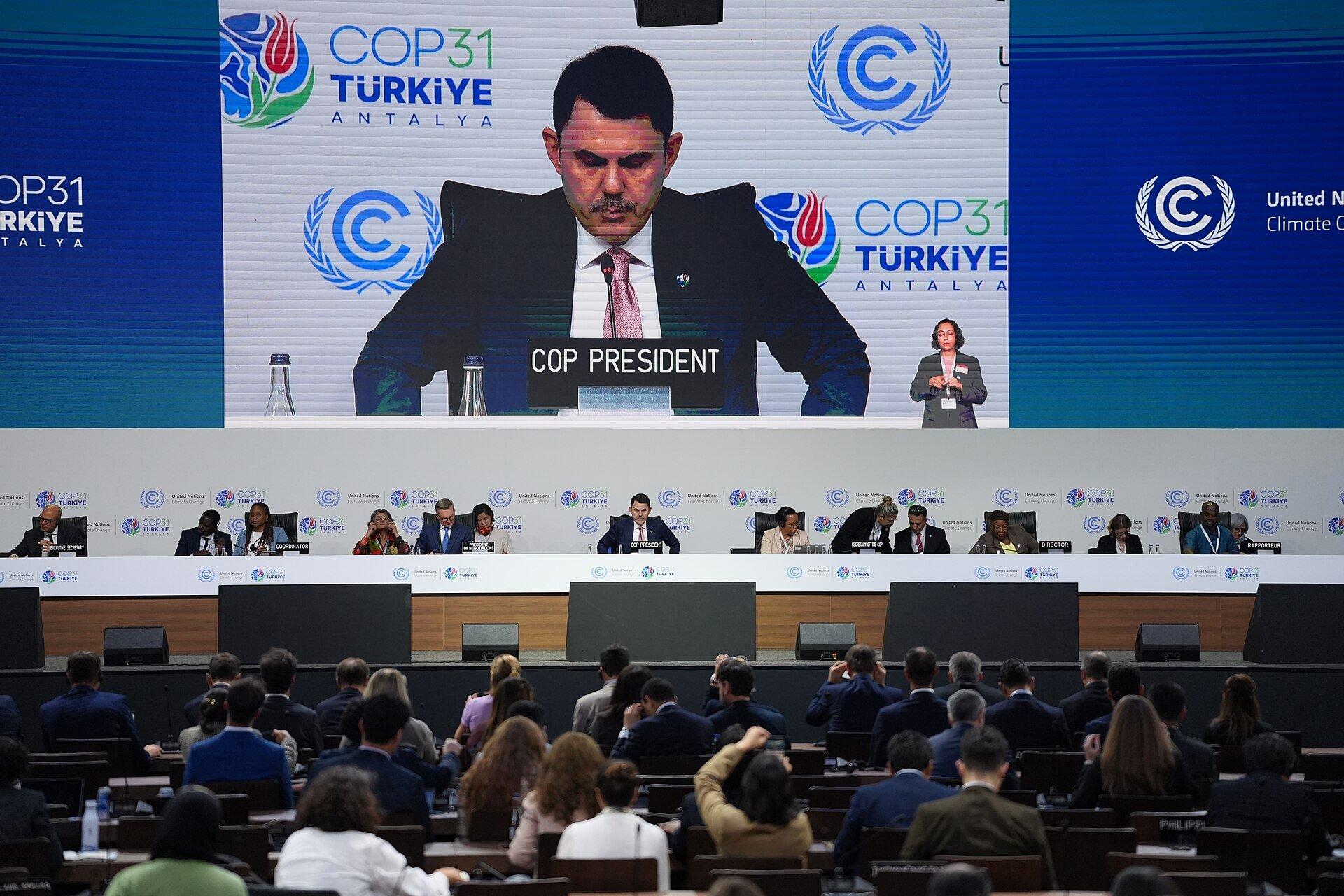
Image: Photo taken at the first session of the COP31 closing plenary on the night of 20 November 2026, not at Sunday's session. Image: Xuthoria, CC BY-SA 4.0 (https://creativecommons.org/licenses/by-sa/4.0/), via Wikimedia Commons (https://commons.wikimedia.org/wiki/File:COP31_-_Closing_Plenary_04.jpg); resized
About this article: prepared by The Daily Context editorial desk using automated, source-based reporting from the publications linked below. No reporter was on the ground.
Sources
- UN News: COP31 ends without climate pact as UN chief warns there is "no ambiguity in the science" (22 Nov 2026): https://news.un.org/en/story/2026/11/1168855
- Reuters via Rappler: COP31 climate talks collapse as EU and others reject deal (22 Nov 2026): https://www.rappler.com/world/global-affairs/cop31-outcomes-november-22-2026/
- CBS News: U.N. COP31 climate conference ends with no agreement (22 Nov 2026): https://www.cbsnews.com/news/un-cop31-climate-conference-ends-no-agreement-fossil-fuel-debate-standstill/
- Reuters via Al-Monitor: COP31 climate talks break down as EU and others reject deal (22 Nov 2026): https://www.al-monitor.com/originals/2026/11/cop31-climate-talks-break-down-eu-and-others-reject-deal
- The Guardian: Cop31 climate talks set to end in deep division as key deal rejected (22 Nov 2026): https://www.theguardian.com/environment/2026/nov/22/cop31-climate-talks-set-to-end-in-deep-division-as-key-deal-rejected
- The Guardian live blog, 22 Nov 2026: https://www.theguardian.com/environment/live/2026/nov/22/cop31-climate-crisis-talks-turkey-latest-news-updates
- BBC News live coverage, 22 Nov 2026: https://www.bbc.com/news/live/crly5w901n20t
- AFP: EU will "not endorse" climate deal, throwing COP31 deal into doubt (22 Nov 2026): https://www.afp.com/en/eu-will-not-endorse-climate-deal-throwing-cop31-deal-doubt
- DW live coverage, 20–22 Nov 2026: https://www.dw.com/en/cop31-climate-deal-not-adopted-as-eu-others-reject-draft-declaration-over-fossil-fuels-omission/live-79999516
- The Independent (22 Nov 2026): https://www.independent.co.uk/climate-change/news/cop31-summit-deal-turkey-failure-fossil-fuels-b3089390.html
- Ethiopian News Agency (19 Nov 2026): https://www.ena.et/web/eng/w/eng_9952162
Kabeer Ahmad
Kabeer Ahmad is the founder and editor of The Daily Context. He oversees the site's source-based coverage of world affairs, technology, business, entertainment, lifestyle and sports, and is responsible for its editorial standards, sourcing and corrections.