College Football Playoff expands to 24 teams from 2027, ending Power Four title games
The College Football Playoff will double from 12 to 24 teams starting with the 2027-28 season, with ESPN keeping exclusive rights to all 23 games through 2031-32. The ACC, Big Ten, Big 12 and SEC have said this December's championship games will be their last.
The College Football Playoff (CFP), the postseason tournament that decides the national champion in America's top tier of college football, will expand from 12 teams to 24 starting with the 2027-28 season. The CFP's management committee unanimously approved the change on Monday 9 November 2026 and announced a new agreement making ESPN the exclusive worldwide broadcaster of all 23 games in the new bracket through the 2031-32 season.
The CFP did not disclose financial terms. ESPN reporter Heather Dinich, citing sources, reported that the network will pay nearly $1.7 billion more over five years, which Reuters put at about $345 million a year on top of the existing six-year, $7.8 billion deal signed in March 2024. The biggest casualty is the conference championship game: the ACC, Big Ten, Big 12 and SEC have confirmed that their December 2026 title games will be the last. This season's playoff still uses the 12-team format.
How will the 24-team playoff field be chosen?
According to the CFP's format fact sheet, the 24 places will go to:
- The four conference champions of the ACC, Big Ten, Big 12 and SEC, as determined by those conferences.
- The highest-ranked team from the six other top-division conferences: the American, Conference USA, the MAC, the Mountain West, the Pac-12 and the Sun Belt (often called the Group of 6).
- The 19 highest-ranked remaining teams in the CFP selection committee's final ranking.
The Power Four leagues are the four wealthiest conferences in the Football Bowl Subdivision (FBS), the highest level of college football. Because their championship games are going away, each league is expected to name its champion from its final standings, using its own tiebreakers where needed, sources told ESPN.
How will the bracket and home games work?
Seeds 1 to 8 receive a first-round bye and then host a second-round game on their own campus. Seeds 9 to 16 host first-round games against seeds 17 to 24. That means 16 of the 23 playoff games will be played on campus, up from four in the current format, the CFP says.
The quarter-finals and semi-finals will stay at the six CFP bowl partners: the Cotton, Fiesta, Orange, Peach, Rose and Sugar bowls. The national championship host cities are already set: Las Vegas on 25 January 2027 for the last 12-team final, then New Orleans on 24 January 2028 for the first 24-team final and Tampa Bay on 22 January 2029.
The fact sheet says first- and second-round games will be played from Thursday to Saturday of their weekends. ESPN will show at least three games from each of the first and second rounds on ABC, its broadcast network, and can sublicense some games to other outlets, in addition to its existing sublicensing deal with TNT Sports. Dinich reported that ESPN can sublicense six of the 12 new games.
What happens to conference championship games?
Formally, the CFP says decisions on conference title games rest with each conference. In practice, all four Power Four leagues confirmed on Monday that this year's games will be the final editions, according to Pro Football Network. The Big Ten said this December's game in Indianapolis will be its 16th and final championship game. The SEC, which staged college football's first conference championship game in 1992, said its game at Mercedes-Benz Stadium in Atlanta this December will be the 35th and last.
SEC commissioner Greg Sankey called the game "a defining event in college football for more than three decades, producing unforgettable moments and crowning legendary champions." CBS Sports has reported that the game brought the SEC about $100 million a year, and that Sankey had initially favoured a 12- or 16-team playoff that would have kept it. Big Ten commissioner Tony Petitti, whose conference led the push for 24 teams, had argued that dropping the title games was a worthwhile sacrifice.
The games were valuable television. NCAA.com notes that last season's Big Ten final between Indiana and Ohio State drew 18.33 million viewers on Fox, and the SEC title game between Georgia and Alabama drew 15.75 million on ABC. ESPN's Pete Thamel reported that ending the SEC, ACC and Big 12 games, which ESPN televises, returns about $140 million a year to the network, offsetting part of what it will pay for the bigger playoff. Fox, which shows the Big Ten game, is expected to recover around $50 million a year.
Dropping the title games also limits how much football a team can play. NCAA.com says a team reaching the national final could have played 18 games if conference championships had survived; without them, the maximum is 17.
How will the season calendar change?
From 2027-28, every regular season will include two open weeks. The final regular-season games of 2027 will be played on Saturday 27 November, Thanksgiving weekend, and The Washington Post reports the season will start a week earlier to make room. Every qualifying team will get a week off before the first round, which begins in the first full week of December. The top eight seeds will have two open weeks before their first game. Selection Day and other key dates have not yet been announced.
Two traditions are being protected. No playoff game will clash with the Army–Navy game, the annual meeting between the US military academies. The Heisman Trophy, college football's best-known individual award, will move its ceremony weekend a week earlier, to 3 to 5 December in 2027.
Will the regular season still matter?
That is the central criticism. Several commentators argued on Monday that doubling the field weakens the stakes of regular-season games; one, quoted by Pro Football Network, said the regular season "officially becomes unimportant". Supporters point to the incentives built into seeding: a top-eight finish brings a bye and a home playoff game, and a top-16 finish brings a home first-round game. Petitti has described these as "tiered incentives".
The CFP is also adding scheduling standards meant to discourage soft non-conference schedules. Each Power Four school will be expected to play at least 10 regular-season games against conference opponents, other Power Four teams or Notre Dame, which plays as an independent. Group of 6 schools will need at least 10 games against conference opponents, other FBS conferences, Notre Dame or other independents. The selection committee will give no weight to more than one win per season over a team from the Football Championship Subdivision (FCS), the tier below the FBS. The management committee can grant waivers in extraordinary circumstances.
In its statement, the CFP said expansion was "driven by a desire to increase opportunities for FBS programs, student-athletes and fan bases to participate in the Playoff". Executive director Rich Clark said: "We will make the 24-team Playoff spectacular for the fans, student-athletes, their institutions and all our stakeholders."
How fast has the playoff grown?
The CFP began in the 2014-15 season with four teams. It expanded to 12 in 2024-25, and the 2026-27 season is the third and final year of that format. The new 24-team bracket is locked in for the length of the ESPN agreement, through 2031-32. With twice as many teams and 12 extra games, the change is the largest overhaul of the sport's postseason since the playoff was created.
What happens next?
This season's 12-team playoff begins with first-round games on 18 and 19 December 2026, after the final Power Four championship games on 4 and 5 December. The CFP says Selection Day and other dates for the 2027-28 playoff will be announced later, and ESPN says programming and distribution plans for the new games will follow.
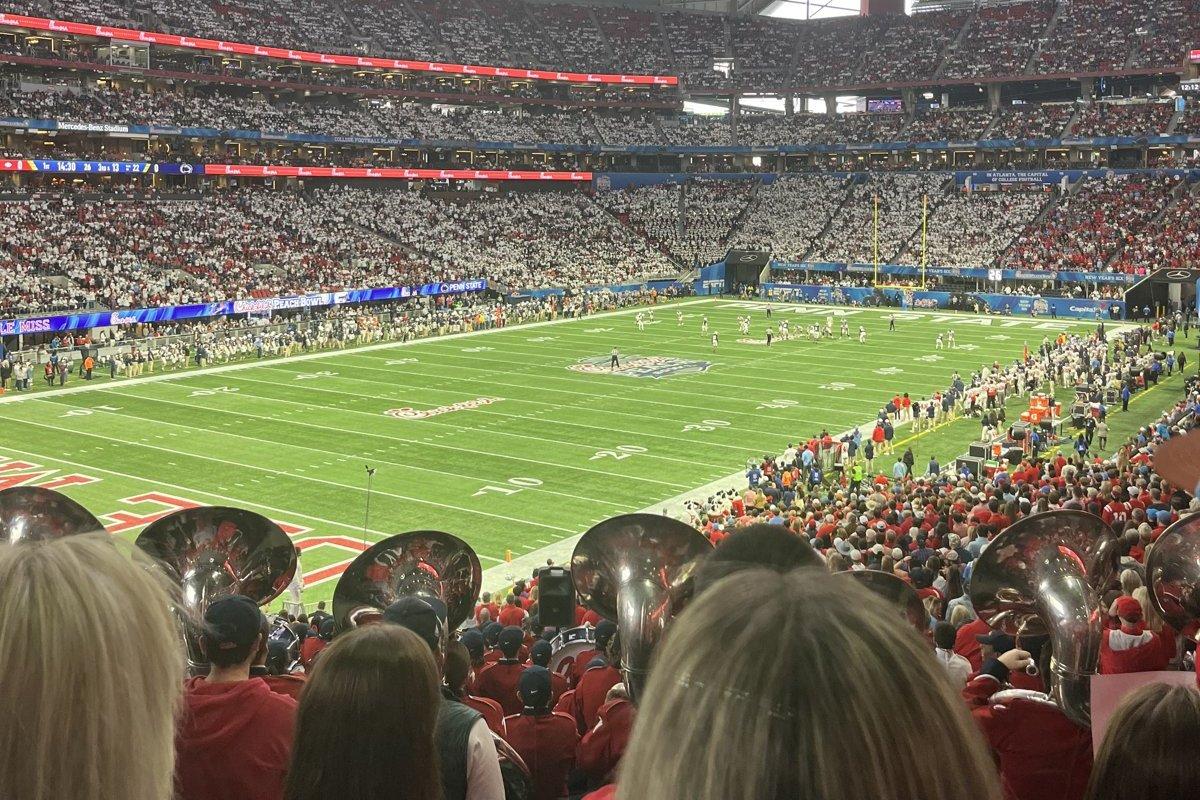
Image: Photo: Marycollinsc, CC0 (public domain), via Wikimedia Commons (https://commons.wikimedia.org/wiki/File:Ole_Miss_vs_Penn_State,_2023_Peach_Bowl,_Mercedes-Benz_Stadium,_Atlanta.jpg) — December 2023 file photo of the Peach Bowl, one of the six CFP bowl partners; cropped
About this article: prepared by The Daily Context editorial desk using automated, source-based reporting from the publications linked below. No reporter was on the ground.
Sources
- College Football Playoff: https://collegefootballplayoff.com/news/2026/11/9/24-team-expansion
- ESPN Press Room: https://espnpressroom.com/press-release/espn-secures-exclusive-media-rights-to-new-games-in-expanded-24-team-college-football-playoff/
- NCAA.com: https://www.ncaa.com/news/football/article/2026-11-09/look-history-college-football-conference-championships
- Pro Football Network: https://www.profootballnetwork.com/cfb/cfp-24-team-expansion-reaction/
- Reuters via Devdiscourse: https://www.devdiscourse.com/article/international/4004356-reuters-sports-news-summary
- The Washington Post: https://www.washingtonpost.com/sports/2026/11/09/college-football-playoff-will-expand-24-teams/
- CBS Sports: https://www.cbssports.com/college-football/news/greg-sankey-sec-championship-game-24-team-playoff/
Kabeer Ahmad
Kabeer Ahmad is the founder and editor of The Daily Context. He oversees the site's source-based coverage of world affairs, technology, business, entertainment, lifestyle and sports, and is responsible for its editorial standards, sourcing and corrections.